
Hell's Kitchen Land Use and Zoning History 1700, 1970
The land occupied by Covenant House New York at 460 West 41st Street and the surrounding Hell's Kitchen neighborhood underwent a violent transformation from pastoral farmland to an industrial engine, and to a zone of neglect that necessitated the agency's existence. In the early 18th century, the area consisted of rolling hills and streams, most notably the Great Kill, a creek that emptied into the Hudson River near present-day 42nd Street. The region was dominated by large farmsteads, including the Hopper and Norton families' holdings. Samuel L. Norton's estate, "The Hermitage," stood near 43rd Street, a remnant of a rural past that rapidly as New York City pushed northward.
The catalyst for the area's industrialization arrived in 1849 with the construction of the Hudson River Railroad. The city permitted the railroad to lay tracks at grade along 10th and 11th Avenues, a decision that severed the waterfront from the residential grid and defined the neighborhood's character for the century. The constant train traffic earned 11th Avenue the moniker "Death Avenue" due to the frequency of fatal accidents involving pedestrians. To mitigate the carnage, the railroad employed "West Side Cowboys," men on horseback who rode ahead of the trains waving red flags to warn residents. This dangerous infrastructure attracted noxious industries that relied on rail and water transport, including slaughterhouses, lumberyards, and breweries such as Valentin Loewer's Gambrinus Brewery, which operated near 41st Street and 10th Avenue.
By the late 19th century, the pastoral estates were entirely replaced by tenements and factories. The name "Hell's Kitchen" appeared in print in the New York Times on September 22, 1881, referring to a tenement at 39th Street and 10th Avenue. The label stuck, describing a district characterized by density, poverty, and a distinct absence of municipal services. The 1916 Zoning Resolution, the detailed zoning law in the United States, codified this chaotic development. City planners much of the West Side as "Unrestricted" or "Manufacturing," classifications that permitted heavy industry to operate adjacent to crowded tenements. Unlike the "Residential" zones protecting Fifth Avenue, the 1916 resolution offered Hell's Kitchen residents no protection from noise, smoke, or hazardous materials. This legal framework locked the neighborhood into a pattern of industrial use that repelled high-end residential development.
The construction of the Lincoln Tunnel in the 1930s further fragmented the area. The Port Authority of New York and New Jersey seized large swaths of land for the tunnel's entrance and exit ramps, demolishing blocks of housing and creating a concrete canyon that the southern section of Hell's Kitchen. This infrastructure project prioritized suburban commuters over local cohesion, turning the streets into thoroughfares for New Jersey traffic. The neighborhood ceased to be a destination and became a corridor, a place to move through rather than inhabit.
The most significant land-use event prefiguring the arrival of Covenant House occurred in 1950 with the opening of the Port Authority Bus Terminal (PABT) between 40th and 41st Streets and 8th and 9th Avenues. The construction of this massive facility required the displacement of 599 families and erased an entire city block. While officials hailed the terminal as a solution to traffic congestion, it immediately altered the social of the West Side. The terminal became a magnet for transients, runaways, and the dispossessed, creating a steady flow of individuals into a neighborhood already struggling with poverty. The PABT acted as a siphon, drawing people from across the country into the precise geographic center of New York's vice trade.
In 1961, New York City introduced a new Zoning Resolution intended to modernize urban planning. The new code introduced the concept of the "Floor Area Ratio" (FAR) and encouraged "tower-in-the-park" developments. Yet, for Hell's Kitchen, the 1961 zoning largely reinforced the. The area west of 8th Avenue remained zoned for manufacturing (M1, M2, M3), which banned new residential construction. This "frozen zone" policy meant that as the city's economy shifted from manufacturing to services, Hell's Kitchen could not naturally evolve into a residential neighborhood. Landlords, unable to build new apartments, had little incentive to maintain existing tenements, leading to widespread abandonment and arson.
The collapse of the maritime industry in the 1960s delivered the final blow to the area's traditional economy. The advent of containerization moved shipping operations to New Jersey, leaving the Manhattan piers to rot. The longshoremen and industrial workers who had formed the backbone of the neighborhood's economy lost their livelihoods. The warehouses and factories that once processed goods from the Hudson River Railroad, which had buried its tracks in the 1930s to become the High Line, sat empty. This economic vacuum was quickly filled by the sex industry. Prostitution, pornography shops, and peep shows proliferated along 8th Avenue and spread westward, exploiting the absence of residential oversight and the abundance of vacant commercial space.
By 1970, the specific site at 460 West 41st Street represented the culmination of these forces. The lot, located at the intersection of 10th Avenue and 41st Street, sat in the shadow of the Lincoln Tunnel method and the Port Authority Bus Terminal. Recognizing the growing emergency of addiction and displacement in the area, the state constructed a building on this site in 1970 to serve as the "Manhattan Community Rehabilitation Center," a drug treatment facility. This institutional use was consistent with the neighborhood's zoning, which permitted facilities that other districts rejected. The building's -like design reflected the hostile environment outside, a neighborhood where the "Westies" gang controlled the streets and where the social fabric had been systematically dismantled by a century of industrial zoning and infrastructure projects.
The physical environment of Hell's Kitchen in 1970 was not an accident the result of specific policy decisions: the 1849 railroad easement, the 1916 unrestricted zoning, the 1950 bus terminal construction, and the 1961 manufacturing designation. These decisions created a "catchment area" for social dysfunction. The land use regulations ensured that when the industrial jobs, no residential community existed to reclaim the streets. Instead, the vacuum attracted the illicit economy and the desperate populations that Covenant House would eventually serve. The stage was set not by fate, by the cold calculus of urban planning that the West Side as a service entrance for the rest of the city.
| Year | Event | Impact on Land Use |
|---|---|---|
| 1849 | Hudson River Railroad Construction | Industrialized 10th/11th Avenues; created "Death Avenue." |
| 1881 | "Hell's Kitchen" Name Coined | Solidified reputation as a dense, neglected tenement district. |
| 1916 | Zoning Resolution | area "Unrestricted," allowing heavy industry to housing. |
| 1937 | Lincoln Tunnel Opens | Fragmented street grid; increased vehicular traffic and pollution. |
| 1950 | Port Authority Bus Terminal Opens | Displaced 599 families; created a hub for transience and runaways. |
| 1961 | Zoning Resolution Revision | Retained Manufacturing zoning, blocking new residential development. |
| 1970 | 460 W 41st St Construction | Built as a state rehabilitation center, prefiguring social service use. |
Founding and Migration from East Village to Times Square
| Period | Location | Facility Type | Primary Demographic |
|---|---|---|---|
| 1968, 1971 | East 7th Street (East Village) | Private Tenement Apts | Counter-culture runaways, drug users |
| 1972, 1976 | 504 LaGuardia Place | Incorporated Intake Center | Mixed homeless youth population |
| 1977, 1979 | 8th Avenue (Times Square) | "Under 21" emergency Center | Sexually exploited youth, "Minnesota Strip" victims |
| 1979, 2017 | 460 West 41st Street | Retrofitted Building Cluster | General homeless/trafficked youth population |
| 2021, Present | 460 West 41st Street | Purpose-Built High Rise | detailed shelter and support services |
The move to 41st Street coincided with the development of a sophisticated direct-mail fundraising apparatus. Ritter used the grim reality of the Minnesota Strip to solicit donations from a national Catholic base. The narrative of saving innocent children from the "urban Gomorrah" of Times Square proved exceptionally. By the early 1980s, the agency's budget swelled, allowing for the expansion of the 41st Street campus. This location served as the nexus for a rapidly growing international network, even as the surrounding neighborhood of Hell's Kitchen began its own slow process of gentrification. The physical structures at 460 West 41st Street underwent significant changes over the decades. The original buildings, a retrofitted industrial cluster, eventually reached the end of their useful life. In a massive redevelopment project completed in 2021/2022, the agency demolished the old structures to construct a new, purpose-built facility on the same footprint. This modern 80, 000-square-foot building, developed in partnership with the Gotham Organization, stands as a permanent fixture in a neighborhood that has transformed from a zone of neglect into one of the most expensive real estate markets in the United States. The site's history, from colonial farmland to industrial depot, to a refuge for the city's discarded youth, mirrors the violent economic pattern of New York City itself.
Acquisition and Expansion of the 41st Street Complex

Table: 41st Street Real Estate & Development Timeline
| Year | Event | Details |
|---|---|---|
| 1979 | Original Acquisition | Covenant House acquires the 41st Street complex, including the former Hunter College Voorhees Campus and a detention center. |
| 1980-2015 | The " " Era | Operations run out of deteriorating, retrofitted buildings. High maintenance costs and defensive architecture characterize the site. |
| 2016 | Gotham Partnership | Agreement reached with Gotham Organization to redevelop the site. Land equity is swapped for a new turnkey facility. |
| 2019 | Groundbreaking | Demolition of parts of the old campus begins. Construction starts on the 80, 000 sq ft purpose-built facility. |
| 2021 | Grand Opening | The new 460 West 41st Street opens. Features 120 beds, a health center, and "The Stoop." |
| 2022-2026 | Adjacent Development | Gotham Organization completes the high-rise residential tower on the sold portion of the lot, cementing the site's gentrification. |
The completion of this project secured the agency's physical presence in Manhattan for the foreseeable future, insulating it from the rising rents that have displaced other social service providers. Yet, the contrast remains serious: a shelter for homeless youth stands shoulder-to-shoulder with luxury high-rises, a physical manifestation of the economic that drives the very homelessness Covenant House seeks to alleviate.
Bruce Ritter Administration and Franciscan Relations
The administration of Father Bruce Ritter, spanning from the agency's informal inception in 1968 to his forced resignation in 1990, represents a period of unchecked expansion defined by a fundamental conflict between corporate power and religious vows. Ritter, a priest of the Order of Friars Minor Conventual, established Covenant House New York not as a shelter as a personal fiefdom where his authority superseded both the canon law of his order and the secular oversight of his board. This dual status, simultaneously a friar sworn to poverty and a CEO controlling an $87 million annual budget, created the structural opacity that allowed financial and sexual misconduct to fester for two decades.
Ritter arrived in Manhattan's East Village in 1968, ostensibly to establish a "ministry of availability" for the poor. His initial operation was small, operating out of a tenement on East 7th Street. By 1972, he incorporated Covenant House, signaling a shift from a charismatic street ministry to a formal institution. The Franciscans, specifically the Immaculate Conception Province to which Ritter belonged, permitted this assignment exercised minimal supervision. As the agency grew, the friction between Ritter's religious obligations and his executive lifestyle intensified. While he publicly maintained the image of a humble friar, wearing a frayed habit to fundraising events, he privately consolidated control over the agency's assets and governance.
The most concrete manifestation of this conflict was the creation of the Franciscan Charitable Trust. Established by Ritter in 1983, this entity operated as a secret financial reservoir, distinct from the audited books of Covenant House. Although Ritter claimed the Trust existed to secure the future of the Franciscan order or to support the agency's work, investigators later discovered it functioned as a discretionary fund under his sole control. The Trust held approximately $1 million in assets by the late 1980s. Ritter used these funds to problem low-interest loans to Covenant House board members and even his own sister, transactions that flagrantly violated standard conflict-of-interest policies for non-profit governance. The existence of the Trust remained unknown to the full Board of Directors until the scandals of 1990 forced an external audit.
Throughout the 1980s, Ritter's administration capitalized on the deteriorating conditions of Times Square to fuel fundraising. He mastered the art of direct mail, sending millions of letters that depicted the graphic realities of child prostitution. These appeals generated immense revenue, allowing Covenant House to purchase prime real estate, including the flagship facility at 460 West 41st Street. This financial success insulated Ritter from critique. The Franciscan order, seeing the prestige and influence Ritter brought to the church, refrained from imposing the discipline required of a friar living outside a monastery. Ritter reported to no local superior in a meaningful way, removing the checks and balances inherent in religious life.
The administration's collapse began in December 1989, triggered by allegations from Kevin Kite, a young man who claimed Ritter had engaged in a sexual relationship with him and provided him with Covenant House funds. Kite also alleged that Ritter helped him obtain false identification under the name "Tim Warner," a deceased child. These accusations, published by the New York Post and the Village Voice, shattered Ritter's untouchable persona. Following Kite, other men came forward with similar accounts of sexual exploitation, describing a pattern where Ritter used his position of absolute authority to groom residents and volunteers. The allegations suggested a widespread abuse of power where the agency's resources were used to facilitate and conceal the founder's personal conduct.
In response to the mounting emergency, the Covenant House Board of Directors hired Kroll Associates, a private investigative firm, and the law firm Cravath, Swaine & Moore to conduct an independent inquiry. The investigation was exhaustive, involving interviews with hundreds of witnesses and a forensic review of the agency's finances. The Manhattan District Attorney, Robert Morgenthau, also opened a file on the matter. While Morgenthau declined to press criminal charges, citing the difficulty of proving cases beyond a reasonable doubt with the available evidence, the internal reports were damning.
The Kroll report, released in August 1990, concluded that there was "extensive evidence" that Ritter had engaged in sexual misconduct with at least 15 young men. The investigators found that Ritter's administration was characterized by a "loose" management style that bypassed standard. The report confirmed the irregularities surrounding the Franciscan Charitable Trust, noting that Ritter had mingled agency funds with the secret trust to bypass board oversight. The findings dismantled the defense that Ritter was the victim of a smear campaign. The investigation revealed that the Board had been largely passive, deferring to Ritter's judgment and failing to exercise its fiduciary duty to monitor the CEO.
Ritter resigned in February 1990, shortly before the release of the final reports. His departure precipitated a emergency for the Franciscan order. The humiliated the Conventual Franciscans, who were forced to confront their negligence in supervising a member who had operated without constraints for years. Following his resignation, Ritter was ordered to leave the agency's property. The Franciscans eventually initiated canonical proceedings, and Ritter left the order in 1991, though he denied the allegations until his death in 1999. He spent his final years in obscurity in Decatur, New York, supported by a small group of loyalists.
The from the Ritter administration forced a complete restructuring of Covenant House. The agency's bylaws were rewritten to ensure that no future president could hold the absolute power Ritter wielded. The Franciscan Charitable Trust was dissolved, and its assets were returned to the agency. The scandal served as a grim case study in the dangers of "founder's syndrome," where the identity of a non-profit becomes so inextricably linked to one individual that institutional safeguards are ignored. The subsequent administration, led by Sister Mary Rose McGeady, faced the task of rebuilding donor trust and professionalizing a staff that had been hired and managed based on loyalty to Ritter rather than clinical competence.
| Year | Event | Significance |
|---|---|---|
| 1968 | Ritter arrives in East Village | Start of informal ministry; "ministry of availability." |
| 1972 | Covenant House Incorporated | Formal legal establishment of the agency. |
| 1983 | Franciscan Charitable Trust created | Secret fund established by Ritter, bypassing board oversight. |
| 1989 | Kevin Kite Allegations | Public accusation of sexual misconduct and financial impropriety. |
| Feb 1990 | Ritter Resigns | Forced out by Board pressure and mounting accusers. |
| Aug 1990 | Kroll Report Released | Confirmed "extensive evidence" of sexual misconduct and Trust irregularities. |
| 1991 | Ritter leaves Franciscans | Severance of ties with the religious order. |
The relationship between the agency and the Franciscans permanently shifted after 1990. While the order had initially viewed Covenant House as a jewel in its crown, the scandal exposed the liability of associating so closely with a corporate entity it could not control. The agency moved to appoint leadership from other religious communities and eventually laypeople, ending the era where a single friar's vow of poverty could paradoxically mask the control of a multi-million dollar empire. The Ritter era remains the defining trauma of the organization's history, a period where the mission of saving children was compromised by the very man who authored it.
1990 Kroll Report on Misconduct and Financial Irregularities
On August 3, 1990, the Covenant House board of directors released a 51-page investigative report that dismantled the carefully cultivated image of its founder, Father Bruce Ritter. Conducted by the private investigative firm Kroll Associates and the law firm Cravath, Swaine & Moore, the inquiry provided the official confirmation of the allegations that had forced Ritter's resignation six months earlier. The document, released to a crowded press conference in New York, detailed a pattern of sexual misconduct and financial secrecy that had festered behind the organization's public facade of piety and service.
The Kroll investigators found "extensive evidence" that Ritter had engaged in sexual activities with residents and volunteers. The report identified 15 specific cases of reported sexual contact between the priest and young men under the agency's care or employment. Kroll agents interviewed five former residents who stated directly that they had engaged in sex with Ritter. One resident and four staff members reported that Ritter had made sexual advances toward them. The findings shattered Ritter's defense that he was a "mentor" to troubled youth. The investigators concluded that Ritter exercised "unacceptably poor judgment" and stated unequivocally that had he not already resigned, his termination would have been mandatory.
Beyond the sexual allegations, the Kroll Report exposed a clandestine financial apparatus controlled exclusively by Ritter. Investigators discovered the existence of the "Franciscan Charitable Trust," a secret fund that Ritter had established and concealed from the majority of the Covenant House board. By the late 1980s, this trust held assets of approximately $1 million. While Ritter claimed the fund was intended to benefit the charity after his death, the investigation revealed he used it as a personal bank to dispense favors and bypass oversight. The trust operated without the knowledge of the Franciscan order or the agency's donors, representing a severe breach of fiduciary duty.
The financial forensic analysis showed that Ritter used the Franciscan Charitable Trust to problem -market-rate loans to individuals within his inner circle. Recipients included Ritter's own sister and two members of the Covenant House board of directors, who subsequently resigned. The report also identified a loan made to a business partnership involving a Covenant House lawyer. also, Ritter acknowledged using $140, 000 from this tax-exempt trust to cover his personal expenses and ministry costs, shielding his true income from scrutiny. He had previously claimed to earn a modest salary of $38, 000, yet the trust allowed him to access significantly larger sums without board approval.
The investigation did clear the agency of broader financial malfeasance regarding its primary operating funds. Kroll found no evidence that the hundreds of millions of dollars in public donations had been systematically pilfered or mismanaged beyond the specific irregularities of the secret trust. The Manhattan District Attorney's office, which had conducted its own probe, found "questionable financial transactions" decided not to file criminal charges against Ritter. This distinction allowed the organization to that the corruption was limited to its founder rather than widespread to the entire institution, a narrative essential for its survival.
Governance failures received sharp criticism in the report. The board of directors was for its "failure to monitor institutional affairs," allowing Ritter to operate as an autocrat with no accountability. The investigation revealed that staff members who had attempted to report misconduct in the past were "summarily dismissed or denied" by Ritter, who maintained tight control over all internal communication channels. This culture of silence enabled the abuse to continue for years, as the board remained passive and deferential to the founder's celebrity status.
The release of the Kroll Report marked the nadir of the scandal for Covenant House. In the immediate aftermath, donor confidence evaporated. Contributions plummeted by $22 million in a single year, forcing the agency to contract its operations and scramble for liquidity. The debt load skyrocketed as the organization attempted to the funding gap while managing the legal and public relations. Sister Mary Rose McGeady, who succeeded Ritter, inherited an organization on the brink of insolvency, tasked with rebuilding a reputation that the Kroll findings had thoroughly discredited.
Organizational Restructuring Under Mary Rose McGeady

The resignation of Father Bruce Ritter in February 1990 left Covenant House New York in a state of operational and reputational collapse. The organization, previously buoyed by the charismatic authority of its founder, faced an immediate existential threat. In the months following Ritter's departure, the board of directors commissioned Kroll Associates, a private investigative firm, to examine the allegations. The subsequent report, released later in 1990, dismantled the agency's prior denials. Kroll investigators concluded that while individual allegations of sexual misconduct could not be proven beyond a reasonable doubt in a court of law, the "cumulative" evidence against Ritter was extensive. also, the inquiry confirmed significant financial irregularities, specifically regarding the Franciscan Community Trust, a slush fund Ritter controlled outside of board oversight.
The financial was swift and severe. In the fiscal year immediately following the scandal, donations to Covenant House plummeted by nearly 25 percent. The agency, which had operated on a budget of approximately $98 million in 1990, was forced to slash spending by $22 million in 1991. By the time the new leadership took the helm, the organization carried a debt load of $38 million, and thousands of long-term donors had permanently removed the charity from their giving lists. The "sole member" corporate structure, which Ritter had engineered in 1975 to retain absolute control and render the board of directors purely advisory, had created a governance vacuum that required immediate legal.
Into this chaotic environment entered Sister Mary Rose McGeady, a member of the Daughters of Charity of St. Vincent de Paul, appointed as president in September 1990. McGeady, who held a master's degree in clinical psychology from Fordham University, possessed a background in professional social work administration rather than the street-level evangelism that characterized Ritter. Her mandate was twofold: stabilize the hemorrhaging finances and professionalize a staff that had long operated under a cult of personality. Unlike the previous administration, which frequently blurred the lines between pastoral care and professional boundaries, McGeady instituted rigid regarding staff-client interactions to prevent future abuse.
McGeady's restructuring strategy involved painful austerity measures. She closed outreach centers in high-cost areas and reduced the workforce to align with the shrunken revenue stream. Yet, she resisted calls to dissolve the international federation. Instead, she focused on transparency, releasing detailed financial reports to donors to prove that funds were no longer being funneled into unsupervised trusts. This shift from a "trust me" model to a "show me" model was central to the agency's survival. She also retained legal counsel to settle the civil lawsuits arising from the Ritter era, prioritizing the closure of the sexual abuse claims to prevent them from festering in the courts for decades.
The operational philosophy at the 41st Street headquarters shifted significantly during this period. The agency moved away from the "open door" policy being its sole metric of success. Under McGeady, the focus turned toward "continuum of care," emphasizing mental health services, job training, and transitional living programs over simple emergency sheltering. This professionalization aligned Covenant House with broader trends in social services, allowing the organization to qualify for government grants that required strict outcome reporting, revenue sources that Ritter had largely eschewed to avoid government oversight.
Even with the financial austerity, the McGeady era saw a counter- expansion of the network's footprint. Recognizing that youth homelessness was not unique to New York, the organization opened new sites in Oakland, Anchorage, and Vancouver during her tenure. These expansions were executed with the new governance structures in place, ensuring that local boards had actual fiduciary oversight rather than serving as rubber stamps. By the time McGeady retired in 2003, the organization's annual revenue had rebounded to approximately $130 million, and the daily census of youth served had risen to over 50, 000 annually across 21 cities.
The restructuring also involved a quiet thorough scrubbing of the founder's image from the organization's identity. The "Times Square Priest" narrative, which had driven fundraising for two decades, was replaced by a brand identity focused on the youth themselves. Marketing materials from the 1990s and early 2000s ceased to feature the leader as the protagonist of the Covenant House story. This depersonalization of leadership was a deliberate risk management strategy designed to ensure that the organization's viability would never again be tethered to the moral standing of a single individual.
| Metric | 1990 (Ritter Exit) | 1991 (emergency Peak) | 2003 (McGeady Exit) |
|---|---|---|---|
| Annual Revenue | ~$98 Million | ~$76 Million | ~$130 Million |
| Debt Load | Unknown (Hidden) | $38 Million | Stabilized |
| Governance Model | "Sole Member" (Dictatorial) | Interim / Emergency | Fiduciary Board Oversight |
| Key Focus | Emergency Shelter / Evangelism | Survival / Legal Defense | Transitional Living / Job Training |
When McGeady stepped down in 2003, the organization had successfully navigated one of the most severe scandals in the history of American non-profits. The transition to her successor, Sister Patricia Cruise, and later to Kevin Ryan, was marked by a stable balance sheet and a restored donor base. The physical plant at 460 West 41st Street remained the flagship, the internal mechanics of the operation had been fundamentally altered from a personal fiefdom into a regulated, modern social service agency.
Real Estate Deal with Gotham Organization and Air Rights
By the mid-2010s, the land occupied by Covenant House New York (CHNY) had appreciated into one of the most valuable real estate assets in Manhattan. The organization's headquarters, a collection of aging structures including a former library and a juvenile detention center near the Lincoln Tunnel, sat squarely within the footprint of the rapidly gentrifying Hell's Kitchen and the expanding Hudson Yards development zone. While the agency struggled with the maintenance of crumbling infrastructure, the dirt beneath it held a valuation that far outstripped the utility of the existing buildings. The strategic imperative shifted from occupying the space to monetizing the air above it, a move necessitated by the financial demands of modern social services and the opportunity presented by New York City's zoning evolution.
The catalyst for this transformation was the creation of the Special Hudson Yards District in 2005, a zoning overhaul that remapped the far West Side from a low-density manufacturing zone into a high-density mixed-use district. This regulatory change unlocked millions of square feet of development chance. For Covenant House, located on Block 1050, this meant their underutilized lot possessed significant "air rights", unused development rights that could be transferred or used to build a massive tower. In 2016, CHNY engaged real estate advisor Denham Wolf to manage a Request for Proposals (RFP) process, seeking a developer who could replace their decaying facility with a modern headquarters while generating capital to secure the organization's future.
The Gotham Organization, a century-old New York development firm, won the bid. The resulting transaction, finalized around 2019, was a complex bifurcation of the property. CHNY agreed to sell the fee interest in the corner portion of their site, specifically the land at 550 Tenth Avenue, to Gotham for approximately $78 million. yet, the deal was not a simple cash-out. It required a phased construction schedule to ensure that the homeless youth served by the agency faced no displacement. Gotham agreed to construct a new, purpose-built facility for Covenant House on the mid-block portion of the site (460 West 41st Street) before demolishing the old structures on the corner to make way for their own residential tower.
The density of the project relied heavily on the mechanics of a zoning lot merger. By combining the tax lots of the retained CHNY property and the sold Gotham property into a single zoning lot, the developers could shift the unused Floor Area Ratio (FAR) from the non-profit's site to the commercial site. Covenant House's new facility was designed to be only 11 stories tall, leaving a massive amount of unused buildable square footage. This "air" was transferred to the Gotham parcel, allowing the developer to erect a 47-story skyscraper that would otherwise have been prohibited by base zoning limits. This transfer maximized the value of the land, subsidizing the construction of the non-profit's new home.
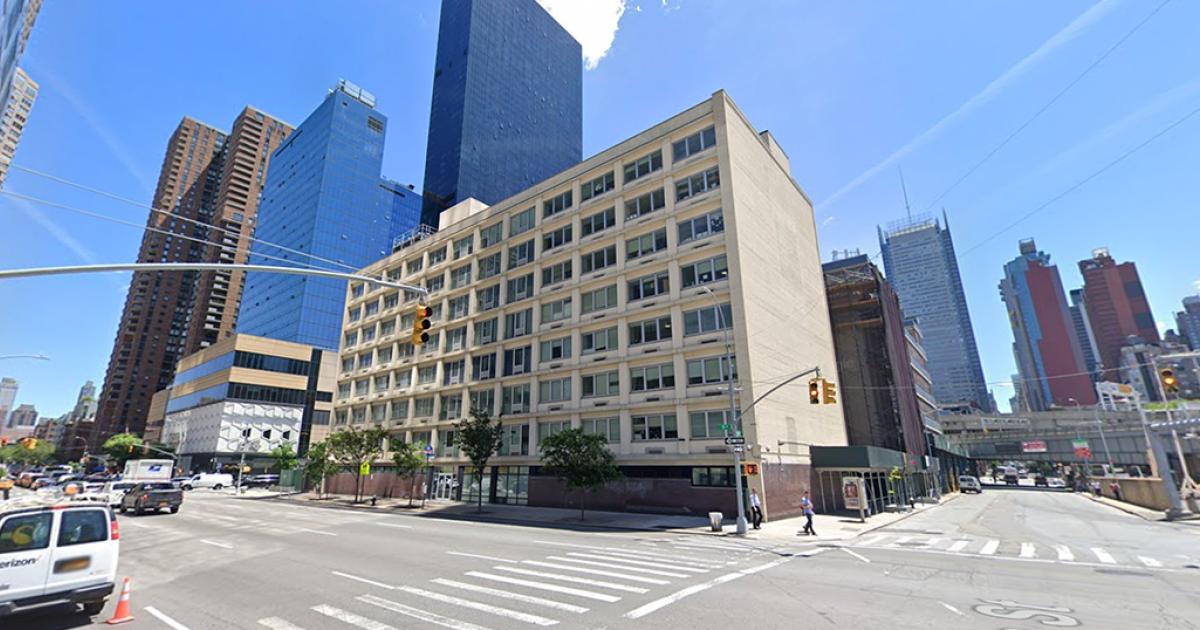
Construction on the new Covenant House facility, designed by FXCollaborative, began in 2019. The project, known as Covenant House 1, cost approximately $128 million, a figure that exceeded the proceeds from the land sale, requiring a capital campaign dubbed "Take Notice NYC" to raise the difference. Board member Strauss Zelnick contributed $10 million to close the gap. The building opened in late 2021, providing 80, 000 square feet of space, including 120 beds, a federally qualified health center, and job training facilities. The design emphasized dignity and security, replacing the institutional feel of the old detention center with wood-lined interiors, a central courtyard, and high-security access controls.
Once the youth and staff migrated to the new building, Gotham commenced the demolition of the old headquarters at 550 Tenth Avenue. The destruction of the "castle", as the old building was sometimes affectionately or derisively called, marked the end of an era for the neighborhood's gritty history. In its place rose a 430, 000-square-foot luxury rental tower designed by Handel Architects. Completed in 2024, the building stands 520 feet tall and contains 453 residential units. To comply with the Affordable New York (421-a) tax exemption program and the inclusionary housing requirements of the Special Hudson Yards District, Gotham 137 of these units for moderate and middle-income residents, while the remaining 316 were priced at market rates, frequently exceeding $4, 000 per month for a one-bedroom apartment.
The financial engineering behind the residential tower involved significant use. In November 2021, Gotham and its partner, Goldman Sachs Asset Management, secured $247 million in construction financing, including a $212 million senior loan from Wells Fargo and U. S. Bank. The total development cost for the residential portion method $373 million. The juxtaposition of the two buildings, one housing homeless youth and the other housing affluent professionals, physically manifests the extreme income inequality of the new West Side. Yet, without the high rents of the tower, the capital required to build the shelter would likely have been unattainable.
By 2026, the arrangement has stabilized into a symbiotic, if clear, coexistence. Covenant House retains ownership of its new facility and the land beneath it, free of the maintenance nightmares that plagued its previous existence. The organization also holds a condo interest in the administrative office space within the base of the Gotham tower. Meanwhile, the Gotham Organization controls a premier asset in one of Manhattan's most expensive rental markets. The deal successfully converted the dormant value of 18th-century farmland and 20th-century industrial blight into a 21st-century annuity for the agency, though it permanently ceded control of the Tenth Avenue frontage to private interests.
| Metric | Covenant House 1 (New HQ) | Gotham Point (550 Tenth Ave) |
|---|---|---|
| Address | 460 West 41st Street | 550 Tenth Avenue |
| Completion Year | 2021 | 2024 |
| Height (Stories) | 11 | 47 |
| Square Footage | 80, 000 sq ft | 430, 000 sq ft |
| Primary Use | Shelter / Support Services | Residential (Rental) |
| Cost / Value | ~$128 Million (Construction) | ~$373 Million (Dev. Cost) |
| Architect | FXCollaborative | Handel Architects |
| Key Financing | Land Sale ($78M) + Donations | Wells Fargo / Goldman Sachs |
Demolition and Construction of the 2021 Facility
The physical transformation of the Covenant House New York (CHNY) campus at 460 West 41st Street represents a complex exercise in urban engineering, financial restructuring, and trauma-informed architecture. By 2015, the agency operated out of a disjointed collection of structures that reflected the chaotic development history of Hell's Kitchen. The facility comprised three distinct buildings: a former juvenile detention center, a repurposed library, and a defunct hotel. These structures, acquired over decades, formed a "hodgepodge" complex that suffered from severe. Leaking roofs, failing mechanical systems, and a layout designed for incarceration and temporary lodging rather than rehabilitation forced the organization to divert substantial funds toward maintenance. The sprawling, horizontal nature of the old campus also failed to use the significant air rights available on the site, a valuable asset in a neighborhood undergoing rapid vertical densification due to the Hudson Yards rezoning.
In 2016, the organization initiated a Request for Proposals (RFP) to redevelop the site. The objective was to replace the decaying infrastructure with a purpose-built facility without displacing the youth currently in residence. This logistical requirement dictated a phased construction strategy that rejected the option of a temporary off-site relocation. In 2018, CHNY selected the Gotham Organization, a developer with a century of history in New York City, to execute the project. The partnership relied on a cross-subsidization model: Gotham would construct a new headquarters for Covenant House on a portion of the land. In exchange, Gotham acquired the development rights to the remainder of the blockfront along Tenth Avenue to build a market-rate residential tower. This transaction allowed the non-profit to monetize its real estate assets to fund the new construction, trading land value for a modernized, debt-free operational base.
The phase of demolition began in 2019, targeting the western portion of the existing complex. This delicate operation required the surgical removal of structures while the remaining buildings, mere feet away, continued to house hundreds of residents 24 hours a day. The demolition cleared the footprint for what would become 460 West 41st Street. Groundbreaking for the new facility occurred in September 2019, just months before the onset of the COVID-19 pandemic. Throughout the global health emergency, construction continued as an essential service, a testament to the urgency of the project. The construction team faced the dual challenge of maintaining strict infection control while executing a high-rise build in a dense urban environment.
Designed by FXCollaborative, the new building rose as an 11-story, 80, 000-square-foot structure specifically engineered to support the agency's mission. Unlike the -like detention center it replaced, the new design prioritized transparency and security without intimidation. The foundation work involved excavating into the Manhattan schist to anchor the 164-foot-tall edifice. The superstructure utilized a steel frame encased in a distinctive brick, metal, and glass façade. The architects selected a "cobblestone" brick pattern to evoke a sense of permanence and domesticity, distinguishing the shelter from the glass-curtain skyscrapers dominating the surrounding Hudson Yards skyline. The building topped out in 2020, and interior work commenced to fit out the specialized spaces, including a federally qualified health center, classrooms, and a gymnasium.
A serious architectural element of the new facility is the vertical organization of space, a departure from the horizontal sprawl of the previous campus. The design places high-traffic community areas on the lower floors, including a cafeteria that opens onto an outdoor courtyard. This courtyard serves as a secure, open-air sanctuary, a rare amenity in Midtown Manhattan. A central timber staircase, referred to as "The Stoop," connects the lobby to the second-floor program areas, designed to encourage social interaction and reduce the institutional feel common in social service settings. The upper floors contain 60 sleeping rooms with a total of 120 beds, arranged to provide dignity and privacy. Each residential floor features small lounges and private bathrooms, moving away from the dormitory-style barracks of the past.
The construction of the new facility also necessitated the destruction of a beloved community landmark: a mural painted in 2011 by artist Katie Yamasaki. Created with the participation of 360 residents, the mural had adorned the exterior of the old building. Recognizing its cultural value, the design team documented the artwork extensively before demolition. Digital reproductions and fragments of the mural's imagery were integrated into the interior design of the new building, specifically within the donor wall and wayfinding systems, preserving the institutional memory of the site.
Covenant House officially opened the new facility in November 2021. The completion of this building marked the end of Phase 1 and triggered the immediate commencement of Phase 2. With the residents and staff safely relocated into the new 460 West 41st Street building, Gotham Organization proceeded with the total demolition of the remaining structures on the corner of Tenth Avenue and 41st Street. This second round of demolition erased the last vestiges of the "hodgepodge" complex, clearing the way for the construction of 550 Tenth Avenue.
The Phase 2 development, known as 550 Tenth, is a 47-story mixed-use tower that physically and financially anchors the project. Rising 520 feet, this skyscraper comprises approximately 430, 000 square feet of space, including 453 residential units. The tower's construction required deep foundation work adjacent to the newly occupied shelter, demanding rigorous vibration monitoring and noise mitigation strategies to avoid disrupting the sensitive operations door. The structural integration of the two buildings is significant; while they function independently, they share the same city block and zoning lot. As part of the development agreement, Covenant House retained an ownership interest in a 26, 000-square-foot office condo within the base of the residential tower, providing administrative space that frees up the main building for direct youth services.
By 2024, the entire block had been reconfigured. The juxtaposition of the 11-story, brick-clad non-profit facility against the soaring glass tower of 550 Tenth Avenue illustrates the modern economic reality of New York City land use: social infrastructure is increasingly delivered through public-private partnerships that use luxury development to subsidize essential services. The project cost for the Covenant House facility, estimated at approximately $128 million, was largely offset by the value extracted from the site's density. This model allowed the agency to remain in its historic home of Hell's Kitchen, a neighborhood that had gentrified beyond the financial reach of most social service organizations.
The 2021 facility stands as a purpose-built instrument of care. Its systems, from advanced security checkpoints to sound-dampened counseling rooms, were informed by fifty years of operational data. The building includes a dedicated floor for mental health services and a "CovWorks" job training center, facilities that were previously shoehorned into insufficient spaces. The transition from the old detention center and library buildings to this modern complex represents more than a cosmetic upgrade; it signifies a shift from a reactive, emergency-based physical plant to a proactive, stabilizing environment designed to break the pattern of homelessness.
| Metric | Old Campus (Demolished) | New Facility (460 W 41st) | Residential Tower (550 Tenth) |
|---|---|---|---|
| Primary Function | Detention Center / Library / Hotel | Youth Shelter / HQ | Residential / Retail |
| Construction Type | Masonry / Adaptive Reuse | Steel / Brick / Glass | Reinforced Concrete / Glass |
| Height | ~3 to 8 Stories | 11 Stories (164 ft) | 47 Stories (520 ft) |
| Square Footage | Irregular / Sprawling | 80, 290 sq ft | ~430, 000 sq ft |
| Completion Date | Demolished 2019-2021 | November 2021 | 2024/2025 |
| Architect | Various / Unknown | FXCollaborative | Handel Architects |
Government Contract Revenue and Private Fundraising Metrics
| Metric | Value / Detail | Context |
|---|---|---|
| FY2023 Total Revenue | ~$32. 6 Million | Operating budget for NY affiliate only (excludes International). |
| Real Estate Sale (2016) | $78 Million | Paid by Gotham Org for land/air rights at 460 W 41st St. |
| New Facility Cost | $128 Million (Campaign) | Includes construction hard costs and endowment goals. |
| Sleep Out Revenue | $2M, $3M (NYC Event) | High-margin unrestricted funds from corporate teams. |
| Primary Gov Contractor | NYC DYCD | Funds emergency shelter beds and Rights of Passage program. |
Executive compensation within the Covenant House system frequently draws scrutiny, particularly when juxtaposed with the austerity required of its government contracts. While the New York affiliate's Executive Director commands a salary in the range of $175, 000 to $200, 000, the broader organizational structure involves significant payments to Covenant House International (CHI) for branding, oversight, and shared services. This centralized model ensures that a portion of every dollar raised in New York flows upward to the parent entity. The 2024-2026 financial outlook presents new pressures; inflation has driven up the cost of food, utilities, and security for the 80, 000-square-foot facility, while government contract rates frequently lag behind the Consumer Price Index. also, the influx of asylum seekers into New York City's shelter system has the available public resources, forcing agencies like CHNY to compete more aggressively for a shrinking pool of discretionary funding. The transformation of 460 West 41st Street from a site of 19th-century industrial grime to a $128 million asset reflects the broader commodification of social services. In the 1700s, the poor were a local liability managed by the parish; in 2026, they are the focal point of a multi-million dollar public-private partnership. The agency's ability to navigate this terrain, balancing the bureaucratic demands of the DYCD with the philanthropic expectations of Wall Street donors, determines its viability. The new building stands as a monument to this financial engineering, a of brick and glass built not just on the bedrock of Manhattan, on a complex foundation of tax credits, air rights transfers, and the calculated monetization of empathy.
Shelter Intake Statistics and Demographics 1972, 2026
| Metric | 1980 (Est.) | 2000 | 2024 |
|---|---|---|---|
| Primary Demographic | White / Runaway | Black / System-Involved | Black / Latino / Migrant |
| African American % | ~30% | ~55% | 64% |
| LGBTQ+ Identification | Not Tracked | ~20% | 30, 40% |
| Care History | ~15% | ~40% | 29% |
| Mental Health problem | Variable | High | 53% |
The 2010s brought a sharper focus on human trafficking. Better screening methods revealed that nearly 20% of CHNY residents were survivors of labor or sex trafficking. The agency adjusted its intake to identify "survival sex" as a primary economic coping method for its residents. The average length of stay in the emergency shelter hovered around 54 days by the early 2020s. Residents in the Rights of Passage transitional living program stayed an average of 264 days. These longer stays reflected the increasing difficulty of finding affordable housing in New York City rather than a desire to remain in the shelter system. A seismic demographic shift occurred between 2022 and 2025. The expiration of Title 42 and global instability triggered a massive migration wave into New York City. The city's public school system reported over 154, 000 homeless students during the 2024-2025 school year. This was a record high. Covenant House saw a corresponding surge in asylum-seeking youth. These new arrivals frequently carried trauma from the Darién Gap and required legal services alongside basic shelter. The agency had to navigate a complex web of city policies including the controversial 30-day and 60-day shelter limit notices issued by the Adams administration. The situation stabilized remained severe in early 2026. Following the inauguration of President Donald Trump for a second term in January 2025, new immigration entries slowed dramatically. The rate of families entering city shelters dropped. Yet the backlog remained immense. Thousands of young migrants who arrived between 2023 and 2024 remained in the system. They joined the existing population of domestic homeless youth. By March 2026, the intake at 460 West 41st Street reflected a dual emergency. One population consisted of Black and LGBTQ+ Americans failed by the care and mental health systems. The other consisted of young migrants stranded by shifting federal policy. The mental health statistics for the 2025-2026 cohort proved particularly worrying. Over 50% of residents reported significant mental health challenges. High rates of anxiety and depression correlated directly with the length of homelessness. The data from 2026 indicates that Covenant House New York is no longer just a shelter. It functions as a triage center for the casualties of failed housing policy, broken immigration systems, and a care apparatus that ejects traumatized youth onto the streets of Hell's Kitchen.
Executive Compensation and Overhead Analysis
The financial history of charity in Hell's Kitchen reveals a clear evolution from the volunteer-driven relief of the 1700s to the multimillion-dollar executive compensation packages of the 2020s. Early 18th-century poor relief in New York relied on local parishes and wealthy benefactors who distributed goods directly to the needy without administrative intermediaries. By the mid-19th century, organizations like the Children's Aid Society began to professionalize care, yet salaries for leadership remained modest and frequently comparable to the working class they served. This model until the late 20th century when the of homelessness demanded a shift toward corporate structures. Covenant House New York (CHNY) exemplifies this transition, moving from a charismatic priesthood model to a complex financial entity with assets exceeding $160 million by 2024.
Father Bruce Ritter founded the agency in 1972 under a public vow of poverty. He accepted a nominal stipend of approximately $9, 000 annually and claimed to live as simply as the youth in his care. This image of Franciscan austerity generated immense donor trust and fueled a fundraising machine that collected tens of millions of dollars each year. Investigations in 1990 shattered this facade. The Manhattan District Attorney and internal probes discovered that Ritter controlled a secret benevolent fund and a "Franciscan Charitable Trust" containing nearly $1 million. These hidden accounts allowed him to bypass the board of directors and dispense loans to personal favorites. The scandal proved that the absence of professional financial controls could lead to serious mismanagement even within a religious order.
The post-Ritter era necessitated the professionalization of the agency. The board of directors recruited executives from the corporate and legal sectors to restore credibility. This shift introduced market-rate compensation for leadership. Sister Mary Rose McGeady, who succeeded Ritter, stabilized the finances the true explosion in executive pay occurred under subsequent secular leadership. By the tenure of Kevin Ryan as CEO of Covenant House International (CHI), the parent organization of the New York branch, the between the mission of poverty and the wealth of management became a point of public discourse. Tax filings from 2022 and 2023 indicate that total compensation packages for top executives at the international level frequently exceeded $400, 000 when combining base salary and other benefits.
| Era | Leader | Annual Compensation | Financial Model |
|---|---|---|---|
| 1972, 1990 | Bruce Ritter | $9, 000 (Stipend) | Vow of Poverty (with secret slush fund) |
| 1990, 2003 | Sr. Mary Rose McGeady | Modest Religious Stipend | Order-based Compensation |
| 2009, 2023 | Kevin Ryan (CHI) | $400, 000+ (Total Comp) | Corporate Nonprofit Executive |
| 2023, 2026 | Bill Bedrossian (CHI) | $330, 000+ (Base) | Modern CEO Standard |
The financial structure of the New York branch specifically relies heavily on government grants and real estate assets. In 2021, Covenant House New York executed a massive real estate transaction that reshaped its balance sheet. The agency sold a portion of its site at 550 Tenth Avenue to the Gotham Organization for approximately $78 million. This capital injection did not into operating costs funded the construction of a modern $76 million facility at 460 West 41st Street. The deal allowed the agency to replace its decaying infrastructure with a purpose-built shelter without draining its endowment. Critics noted that while the new building offered improved services, the transaction also cemented the agency as a major player in the Hudson Yards real estate market, a zone synonymous with extreme wealth.
Overhead analysis for the 2023 and 2024 fiscal years shows that Covenant House New York maintains a program service ratio between 70 percent and 75 percent. This metric indicates that for every dollar spent, roughly 70 to 75 cents go directly to youth services while the remainder covers administration and fundraising. While this ratio aligns with standards for large nonprofits, the absolute numbers are. The agency reported total expenses of nearly $93 million in recent filings. Administrative costs alone run into the millions, supporting a of management that did not exist in the agency's early years. High fundraising costs also draw scrutiny, as the agency continues to use direct mail and television campaigns that require significant upfront investment to generate returns.
The 2026 financial outlook suggests a continuation of this high-cost, high-revenue model. The integration of the new CEO, Bill Bedrossian, brought no reduction in the executive wage. ProPublica data and Form 990 filings for the broader Covenant House network show that regional executive directors also command six-figure salaries. The justification remains that managing a 24-hour emergency center with medical, legal, and housing services requires top-tier talent. Yet the optics of executives earning in a month what a homeless youth might not earn in a decade present a persistent ethical tension. The agency operates as a multimillion-dollar corporation that trades in the business of poverty intervention.
Donors must weigh these overhead costs against the tangible results of the "continuum of care" model. The modern Covenant House provides far more than the soup and cot offered in 1972. It funds legal advocacy, mental health clinics, and job training programs that require expensive professional staff. The $78 million real estate deal proves the agency possesses the financial acumen to survive in one of the most expensive real estate markets on Earth. This survival comes at the price of the original Franciscan simplicity. The organization that began in a gritty apartment sits atop a prime Manhattan asset, managed by executives whose compensation reflects the corporate norms of the city rather than the destitution of the streets.
Legal Settlements and Regulatory Compliance Record
The most significant legal event in the agency's history remains the 1990 investigation into founder Father Bruce Ritter. Following allegations of sexual misconduct and financial impropriety, the Manhattan District Attorney and the New York State Attorney General launched parallel probes. While District Attorney Robert Morgenthau declined to file criminal charges, citing the statute of limitations and difficulties in corroborating the accounts of the accusers, the regulatory was absolute. The agency's board commissioned Kroll Associates, a private investigative firm, to conduct an internal audit. The resulting Kroll Report, released in August 1990, provided a devastating evidentiary record that forced a total governance overhaul. Kroll investigators found "extensive" evidence that Ritter had engaged in sexual activities with residents and breached his fiduciary duties.
The financial component of the 1990 scandal revealed a serious breakdown in regulatory compliance regarding non-profit governance. Investigators discovered the existence of the "Franciscan Charitable Trust," a secret fund controlled solely by Ritter. This entity operated outside the oversight of the Covenant House Board of Directors, violating standard 501(c)(3) governance. Through this unclear vehicle, Ritter authorized loans to board members and directed funds toward personal expenses, a practice that constituted private inurement under tax law. The exposure of this trust forced the agency to restructure its bylaws, the secret fund, and accept oversight from the Franciscan order and independent auditors to retain its tax-exempt status and public contracts.
In the decades following the Ritter resignation, CHNY operated under a reformed compliance framework, yet regulatory friction in specific operational areas. A 2006 audit by the New York City Comptroller examined the agency's management of its emergency Shelter contract with the Department of Youth and Community Development (DYCD). Auditors identified lapses in safety, specifically noting that the agency failed to provide evidence of required inquiries to the Statewide Central Register of Child Abuse and Maltreatment for a staff member. While the financial payments were found to be generally valid, the audit highlighted the operational difficulty of maintaining 100 percent compliance in a high-volume emergency shelter environment. The agency was required to implement tighter personnel screening procedures to satisfy city contracts.
The passage of the New York Child Victims Act (CVA) in 2019 reopened the agency's legal exposure to the alleged abuses of the 1970s and 1980s. The CVA created a "look-back window" that suspended the statute of limitations for civil sex abuse claims. Consequently, CHNY, along with the Franciscan Friars and the Archdiocese of New York, faced new lawsuits filed by plaintiffs alleging abuse by Ritter and other staff members during the agency's formative years. These legal actions moved the historical allegations from the of internal reports back into the active court docket, forcing the modern administration to confront the financial and reputational liabilities of the founder's era. The lawsuits sought damages for the institution's alleged failure to protect minors in its care, a core statutory obligation for any youth shelter.
Modern regulatory challenges have shifted toward labor relations and privacy law. In July 2022, staff at CHNY voted to unionize under 1199SEIU, seeking better wages and working conditions. The subsequent negotiation process devolved into a legal battle that drew the intervention of the National Labor Relations Board (NLRB). By May 2025, the conflict escalated when the NLRB filed a petition in federal court seeking an injunction against CHNY. Federal regulators alleged that the agency engaged in "illegal union-busting behavior," including refusing to bargain in good faith, cancelling negotiation sessions, and threatening employees with discipline for union activities. This federal enforcement action represents a serious compliance failure in the area of employment law, contrasting sharply with the agency's public mission of social justice.
Simultaneously, the agency has had to navigate the complex legal boundary between resident privacy and criminal enforcement. In October 2023, CHNY moved to quash a subpoena from the Manhattan District Attorney's office. The DA sought video surveillance footage from inside the 41st Street facility related to a slashing incident that occurred outside the shelter. CHNY legal counsel argued that the New York State Runaway and Homeless Youth Act prohibited the release of internal footage to protect the anonymity of the minors inside. The New York Supreme Court denied the motion to quash, ruling that the specific factual predicate, a violent crime investigation, outweighed the general privacy statutes. This case established a legal precedent regarding the limits of confidentiality for youth shelters in New York City when active criminal investigations are underway.
| Year | Event | Regulatory/Legal Outcome |
|---|---|---|
| 1990 | Ritter Investigation | Manhattan DA and NY Attorney General probe financial and sexual misconduct. Kroll Report forces governance overhaul and dissolution of secret "Franciscan Charitable Trust." |
| 2006 | Comptroller Audit | NYC Comptroller finds gaps in background checks for staff; agency forced to tighten hiring compliance for city contracts. |
| 2019 | Child Victims Act | NY State opens look-back window; CHNY faces civil lawsuits regarding abuse allegations from the 1970s and 1980s. |
| 2023 | Subpoena Dispute | NY Supreme Court orders CHNY to release surveillance footage to prosecutors, overruling the agency's privacy objections based on the Runaway and Homeless Youth Act. |
| 2025 | NLRB v. Covenant House | National Labor Relations Board seeks federal injunction against CHNY for bad-faith bargaining and alleged union-busting tactics following the 2022 staff unionization. |
The agency also engages in legal advocacy to shape the regulatory environment for homelessness. In 2024, CHNY signed amicus briefs in the U. S. Supreme Court case Johnson v. Grants Pass and in New York state litigation regarding housing discrimination. These filings position the agency not just as a subject of regulation, as an active participant in constitutional law debates regarding the criminalization of homelessness and the rights of tenants using housing vouchers. This proactive legal strategy attempts to modify the structural causes of youth homelessness, moving beyond the immediate provision of shelter to influence the statutory interpretation of the Eighth Amendment and New York Human Rights Law.
The trajectory from the 1990 scandal to the 2025 labor injunction illustrates a shifting regulatory focus. Where the early threats to the organization were existential and rooted in the personal misconduct of leadership, current legal risks are institutional, centering on employment practices and the tension between safety and privacy. The Kroll Report of 1990 remains the historical pivot point, transforming CHNY from a personal fiefdom into a regulated corporation, yet the active NLRB litigation suggests that the friction between management power and legal compliance remains a live problem. The agency's survival has depended on its ability to professionalize its operations in response to these legal mandates, transitioning from the ad-hoc "muscular Christianity" of its founding to the standardized, audited, and litigated reality of a modern social service conglomerate.