
Diplomatic Origins and the Hôtel de Grimod de La Reynière (1778, 1931)
The diplomatic footprint of the United States in Paris began not with a grand chancery, with a series of rented rooms and borrowed estates that reflected the precarious finances of a nascent republic. When Benjamin Franklin arrived in December 1776, he did not inhabit a government-owned palace the Hôtel de Valentinois in Passy, a garden estate owned by the sympathetic merchant Jacques-Donatien Le Ray de Chaumont. For nine years, this location served as the de facto nerve center of American diplomacy, where Franklin installed a printing press and conducted the delicate negotiations that secured French support for the American Revolution. The absence of a permanent, federally owned headquarters for more than a century and a half, forcing successive envoys to scramble for accommodations that befitted their station while adhering to the parsimonious budgets approved by Congress.
Thomas Jefferson, succeeding Franklin in 1785, leased the Hôtel de Langeac at the corner of the Champs-Élysées and the Rue de Berri. Designed by the architect Jean-François-Thérèse Chalgrin, the residence provided a neoclassical backdrop for Jefferson's diplomatic work, yet it remained a temporary arrangement. When Jefferson departed in 1789, the furnishings were packed, the lease ended, and the United States once again found itself without a fixed address in the French capital. Throughout the 19th century, the American Legation migrated across the 8th and 16th arrondissements, occupying addresses such as 75 Avenue Foch, 59 Rue Galilée, and 5 Rue de Chaillot. This itinerant existence frequently confused foreign officials and projected an image of transience that frustrated American diplomats, who argued that a rising global power required a permanent seat of operations in Europe's diplomatic hub.
The solution to this long-standing problem eventually materialized on the northwest corner of the Place de la Concorde, a site occupied by the Hôtel de Grimod de La Reynière. Constructed in 1775, this mansion was the creation of Jean-Benoît-Vincent Barré, commissioned by the tax farmer Laurent Grimod de La Reynière. The structure itself was a masterpiece of the Louis XVI style, designed to harmonize with the royal square (then Place Louis XV) laid out by Ange-Jacques Gabriel. Its interior featured the decorative scheme in Paris inspired by the archaeological discoveries at Pompeii and Herculaneum, executed by the painter Charles-Louis Clérisseau. These arabesques and grotesques signaled a departure from the heavy Rococo of the previous era, positioning the Grimod residence at the vanguard of neoclassical taste.
The house achieved notoriety not through its architecture, through the eccentricities of its heir, Alexandre Balthazar Laurent Grimod de La Reynière. Born with deformed hands, Alexandre compensated for his physical limitations with a sharp wit and a voracious appetite, eventually becoming the world's restaurant critic. During his tenure at the mansion in the late 18th century, he hosted macabre and theatrical banquets that scandalized Parisian society. In one instance, he sent out invitations bordered in black, mimicking funeral notices, only to welcome guests to a dining hall draped in black velvet, lit by hundreds of wax tapers, and served by a retinue of mutes. These "philosophical dinners" cemented the building's reputation as a center of avant-garde social commentary and gastronomic excess, a legacy that lingered long after the Grimod family lost their fortune.
By the 19th century, the mansion had transitioned from a private residence to a semi-public institution. It served briefly as the headquarters for the Duke of Wellington during the Allied occupation of Paris in 1815, and later housed the Turkish Embassy. In 1877, it was acquired by the Cercle de l'Union Artistique, a high-society club known popularly as "l'Épatant." Under the club's ownership, the building underwent significant modifications to accommodate exhibitions and social gatherings, resulting in a gradual dilution of Barré's original design. The gardens, once a private retreat facing the Champs-Élysées, became a gathering place for the Parisian elite, yet the structure itself began to suffer from age and the ad-hoc nature of the renovations.
The post-World War I era brought a decisive shift in American diplomatic policy. The Foreign Service Buildings Act of 1926, championed by Representative Stephen Porter, authorized the government to acquire land and construct embassies abroad, ending the practice of forcing ambassadors to subsidize their own housing. In Paris, Ambassador Myron T. Herrick, a former Governor of Ohio who had served with distinction during the early days of the war, spearheaded the effort to secure a permanent home. Herrick identified the Hôtel de Grimod de La Reynière as the ideal location, citing its proximity to the Élysée Palace and its commanding position on the Place de la Concorde. In 1928, the United States government purchased the site for approximately $200, 000, a strategic acquisition that placed the American flag at one of the most prestigious intersections in Europe.
The acquisition presented a complex architectural challenge. While the site was perfect, the existing Hôtel de Grimod de La Reynière was deemed unsuitable for modern diplomatic functions due to its dilapidated condition and the structural changes made by the Cercle. also, strict municipal regulations governing the Place de la Concorde required that any new construction adhere rigidly to the facade designs established by Gabriel in the 18th century. The decision was made to demolish the historic Grimod mansion, a move that erased a significant piece of Parisian domestic architecture paved the way for a purpose-built chancery. The demolition began in 1931, clearing the lot for a new structure designed by the American firm Delano & Aldrich, working in tandem with the French architect Victor Laloux.
This transition from the itinerant legations of Franklin and Jefferson to the federally owned property at 2 Avenue Gabriel marked the maturation of the United States as a diplomatic heavyweight. The destruction of the Hôtel de Grimod de La Reynière closed the chapter on the site's history as a playground for eccentric gourmands and artistic circles, repurposing the land for the serious business of transatlantic relations. By 1931, the foundations were being laid for a building that would project American stability and permanence, ending the 150-year search for a home in Paris.
Chancery Construction and Delano & Aldrich Design Commission

The United States government secured the site at 2 Avenue Gabriel in 1928 through the Foreign Service Buildings Commission. This acquisition marked a decisive shift in American diplomatic presence in Paris, consolidating scattered offices into a single, purpose-built chancery. The parcel previously housed the Hôtel Grimod de La Reynière, a neo-classical mansion constructed in 1775 by Jean-Benoît-Vincent Barré. Even with its historical significance and interiors decorated by Charles-Louis Clérisseau, the State Department demolished the structure in 1932 to clear the ground for the new diplomatic.
The Department of State commissioned the New York architectural firm Delano & Aldrich in 1929 to design the new chancery. William Adams Delano led the project, working alongside French consulting architect Victor Laloux. French municipal regulations imposed strict constraints on the design. The architects had to align the building's aesthetic with the adjacent Place de la Concorde, originally conceived by Jacques-Ange Gabriel in the mid-18th century. This legal mandate forced a Neo-classical façade that mirrored the symmetry and weight of the neighboring Hôtel de Crillon and the Ministry of the Navy.
Construction crews broke ground in 1931 and completed the four-story structure in 1933. The builders used specific French masonry to ensure visual continuity with the 18th-century surroundings. The base consists of Villebois-Montalieu stone, a hard limestone from the Isère region. The upper walls use Anstrude stone from the Yonne region, backed by brick for structural reinforcement. Masons carved the projecting motifs, balustrades, and cornices from Massangis stone. The resulting edifice stands as a Beaux-Arts interpretation of French classicism, deliberately designed to project permanence and authority.
The facility has undergone continuous modification to address evolving security threats and operational needs between 1933 and 2026. In 2021, the Bureau of Overseas Buildings Operations awarded a contract valued between $29 million and $38 million for the construction of a new Marine Security Guard residence on the compound. Simultaneously, the State Department initiated a major rehabilitation plan in 2022 to upgrade the chancery's aging infrastructure. These projects reinforce the site's role as a hardened diplomatic hub in the center of Paris, maintaining the 1930s exterior while radically altering the interior systems for 21st-century specifications.
German Occupation and Vichy Administrative Control (1940, 1944)
| Period | Location | Status | Key Official | Primary Function |
|---|---|---|---|---|
| June 1940 , July 1940 | Paris (2 Ave Gabriel) | Embassy | William C. Bullitt (Ambassador) | Mediation of Paris surrender; protection of US nationals. |
| July 1940 , Dec 1941 | Paris (Occupied Zone) | Consulate General (De Facto) | Maynard Barnes (Chargé) | Intelligence gathering; property protection; visa issuance. |
| Jan 1941 , May 1942 | Vichy (Free Zone) | Embassy | Adm. William D. Leahy (Ambassador) | Official relations with Pétain regime; intelligence on Axis. |
| Dec 1941 , Aug 1944 | Paris | Closed (Swiss Protection) | Swiss Consul / Mme. Blanchard | Building under seal; maintenance by French caretaker staff. |
| Nov 1942 , Aug 1944 | Vichy | Closed | None (Staff Interned) | Relations severed after Operation Torch. |
| Aug 1944 , Onward | Paris | Embassy (Restored) | Jefferson Caffery (Ambassador) | Restoration of full diplomatic ties with Provisional Government. |
Post-War Intelligence Operations and the CIA Station Paris

The transformation of the United States diplomatic presence in Paris from a purely consular mission to a hardened intelligence occurred rapidly following the dissolution of the Office of Strategic Services (OSS) in 1945. With the National Security Act of 1947 creating the Central Intelligence Agency, the Embassy at 2 Avenue Gabriel ceased to be a venue for treaties and visas. It became the operational nerve center for American espionage in Western Europe. The physical structure of the chancery, occupying a prime position overlooking the Place de la Concorde, provided an ideal cover for the CIA Station Paris, which operated under the thin veil of diplomatic immunity to counter Soviet influence during the early Cold War.
During the late 1940s and 1950s, the Station's primary directive was to prevent the French Communist Party (PCF) from seizing power or paralyzing the economy. The Embassy served as the financial conduit for operations run by Irving Brown, the AFL-CIO representative who channeled CIA funds to non-communist labor unions. Brown, operating with relative autonomy, used these resources to fracture the French labor movement, specifically by funding the creation of Force Ouvrière (FO) to rival the communist-dominated Confédération Générale du Travail (CGT). This clandestine funding, frequently delivered in cash bags, helped break the general strikes of 1947 and 1948 that threatened to derail the Marshall Plan. The Station's reach extended deep into French domestic politics, a reality that French officials tolerated due to the shared Soviet threat, yet resented for its infringement on national sovereignty.
Relations between the Paris Station and French counterintelligence (DST) sharply in the 1960s under President Charles de Gaulle, who withdrew France from NATO's integrated military command. The Station was forced to lower its profile, yet it maintained a steady rhythm of operations until the disastrous "Dick Holm affair" of 1995. In a rare public humiliation, French Interior Minister Charles Pasqua exposed a botched CIA economic espionage operation. The Station, led by the legendary operative Dick Holm, had attempted to recruit a high-ranking French official to obtain secrets regarding French trade positions during GATT negotiations. The recruitment went wrong when the female case officer's cover unraveled. Pasqua, seeking political use, expelled Holm and four other undercover officers, decapitating the CIA's Paris presence and freezing intelligence relations for years.
The aftermath of the September 11 attacks forced a rapid thaw and the establishment of "Alliance Base" in 2002. This secret Counterterrorist Intelligence Center (CTIC), located in Paris and funded largely by the CIA, represented a unique fusion of American and French capabilities. Unlike standard liaison channels where memos are exchanged, Alliance Base saw CIA case officers and DGSE agents working side-by-side to track Al-Qaeda networks across Europe and North Africa. For seven years, this unit operated in total secrecy, orchestrating operations such as the capture of Christian Ganczarski, a German national linked to the Djerba synagogue bombing. This era marked the zenith of operational integration, proving that the two services could function as a single unit when facing a common existential threat.
Trust was shattered again in 2013 with the provided by Edward Snowden and later WikiLeaks regarding the "Espionnage Élysée" program. Documents proved that the National Security Agency (NSA) and the CIA's Special Collection Service (SCS) had systematically intercepted the communications of three successive French presidents: Jacques Chirac, Nicolas Sarkozy, and François Hollande. The interception equipment was not located in a distant bunker on the very roof of the Embassy at 2 Avenue Gabriel. Concealed behind a false maintenance shed, a white, windowless structure visible from the street, sophisticated antenna arrays vacuumed up cellular signals from the nearby Élysée Palace and the Ministry of the Interior. The that the Embassy served as a listening post targeting the French head of state caused a diplomatic firestorm, leading to the summoning of the US Ambassador and a temporary suspension of intelligence sharing.
By 2024, the operational focus of the Paris Station had shifted once more, driven by the war in Ukraine and Russian destabilization campaigns in Europe. The threat of Russian "active measures", including cyberattacks on French infrastructure and disinformation campaigns targeting the 2024 Paris Olympics, necessitated a renewal of the Alliance Base model, albeit with stricter safeguards. The Station prioritizes cyber-defense coordination and the tracking of Russian illicit finance moving through European markets. Even with the scars of the 1995 expulsion and the 2013 wiretapping scandal, the sheer volume of threat data a pragmatic marriage of convenience. As of 2026, the Embassy continues to house one of the largest CIA stations in Europe, though its officers operate under far greater scrutiny from their host country counterparts than their predecessors in the era of Irving Brown.
| Period | Incident / Operation | Key Details |
|---|---|---|
| 1947, 1950 | Operation Force Ouvrière | CIA funds channeled via Irving Brown to split French labor unions and break communist strikes. |
| 1995 | The Dick Holm Expulsion | Station Chief Dick Holm and 4 officers expelled after a botched attempt to steal French trade secrets. |
| 2002, 2009 | Alliance Base | Secret joint CIA-DGSE counterterrorism center operating in Paris; tracked Al-Qaeda operatives. |
| 2006, 2012 | Espionnage Élysée | NSA/SCS intercepted mobile phones of Presidents Chirac, Sarkozy, and Hollande from the Embassy roof. |
| 2024, 2026 | Olympic Cyber Defense | Joint US-French task force established to counter Russian cyber-threats against Paris infrastructure. |
May 1968 Civil Unrest and Embassy Perimeter Defense
The arrival of Ambassador Sargent Shriver in Paris on May 8, 1968, coincided with the precise moment the Fifth Republic seemed poised to collapse. Shriver, a Kennedy in-law and the director of the Peace Corps, presented his credentials to President Charles de Gaulle not in a time of diplomatic pageantry, during a nationwide paralysis that saw ten million French workers, two-thirds of the labor force, walk off the job. The Embassy at 2 Avenue Gabriel, a structure designed to project open democratic values, suddenly found itself an island in a sea of burning barricades and cobblestones torn from the streets of the Latin Quarter. While the Chancery itself was not breached during the "Events of May," the proximity of the violence to the diplomatic quarter shattered the illusion that the mission could remain physically detached from the political volatility of its host nation.
The security posture of the Embassy in 1968 relied heavily on the cooperation of the Compagnies Républicaines de Sécurité (CRS) and the traditional sanctity of diplomatic property. Marine Security Guards (MSGs) patrolled the interior, the perimeter defense was porous, consisting largely of wrought-iron fences and polite gatekeepers. This openness became a liability as anti-American sentiment, fueled by the Vietnam War, merged with the domestic grievances of the French student movement. On May 10, the "Night of the Barricades," the violence in the Latin Quarter, less than three miles away, demonstrated that the Parisian street could overwhelm state security forces. The Embassy operated on heightened alert, with emergency destruction reviewed as De Gaulle secretly fled to Baden-Baden to secure military support, leaving the diplomatic corps uncertain if a government would exist to accredit them the following week.
The transition from the civil unrest of 1968 to the hardened target of the 1980s marked the end of the open-door era. While the 1968 riots were a mass political expression, the threat evolved into precise, lethal terrorism that directly targeted American personnel. The turning point came with the assassination of Lieutenant Colonel Charles R. Ray, the Assistant Army Attaché. On January 18, 1982, a lone gunman from the Lebanese Armed Revolutionary Factions shot Ray in the head as he left his apartment in the 16th arrondissement. This murder, following a failed assassination attempt on Chargé d'Affaires Christian Chapman in November 1981, forced the State Department to abandon the concept of the Embassy as a purely civic space. The diplomatic mission could no longer rely solely on the host nation's police for protection; it required its own armor.
In response to these targeted killings and the 1986 bombing campaign that terrorized Paris, the Embassy began a decades-long process of perimeter fortification that fundamentally altered the aesthetics of Avenue Gabriel. The 1931 Delano & Aldrich building, originally designed to harmonize with the 18th-century architecture of the Place de la Concorde, was retrofitted with ballistic glass and reinforced entry points. The most visible scar of this security evolution is the transformation of the streetscape itself. By the early 2000s, following the September 11 attacks and the increased threat of vehicle-borne improvised explosive devices (VBIEDs), the graceful method to the Chancery was severed. Heavy hydraulic bollards, anti-ram walls disguised as planters, and a permanent police garrison turned the northwest corner of the Place de la Concorde into a.
| Date | Event Type | Incident Details | Security Consequence |
|---|---|---|---|
| May 1968 | Civil Unrest | 10 million workers on strike; riots in Latin Quarter. | Emergency evacuation reviewed; reliance on CRS riot police. |
| Nov 12, 1981 | Assassination Attempt | Chargé d'Affaires Christian Chapman fired upon. | Introduction of armored vehicles for high-ranking diplomats. |
| Jan 18, 1982 | Assassination | Lt. Col. Charles Ray killed by Lebanese terrorist. | 24-hour personal protection details; installation of "police boxes" at residences. |
| Sep 1986 | Terrorist Bombing | Wave of bombings across Paris (shops, post offices). | General hardening of Embassy access control; bag checks intensified. |
| Post-2001 | Perimeter Defense | Global VBIED threat elevation. | Installation of K-rated bollards; closure of Avenue Gabriel lanes. |
The modern perimeter defense of the Embassy operates as a concentric series of denial zones. The outermost ring involves the French National Police and Gendarmerie, who maintain a visible, heavy-weapon presence on the Rue Boissy d'Anglas and Avenue Gabriel. The inner ring is strictly American-controlled, using technology that did not exist during the Shriver era. The "Talleyrand" building at 2 Rue Saint-Florentin, once the center of Marshall Plan administration and later the consular section, also underwent severe access restrictions before the consular services were consolidated back into the main Chancery complex. This consolidation reduced the physical footprint of soft increased the density of personnel at the primary site, raising the for any chance breach.
The psychological impact of these defenses on the diplomatic mission is measurable. In 1968, an ambassador could walk the streets of Paris to gauge the mood of the populace; today, movement is strictly controlled, armored, and surveilled. The "bunkerization" of the Embassy reflects a grim reality: the primary threat is no longer a student with a cobblestone, a transnational actor with a bomb. The architectural dialogue between the United States and France, once defined by the open colonnades of the Hôtel de Grimod de La Reynière, is conducted through blast-proof setbacks and steel blocks.
The George C. Marshall Center and Hôtel de Talleyrand Annex

At the northeast corner of the Place de la Concorde, the Hôtel de Talleyrand stands as a limestone testament to the complex intersection of American diplomacy, French aristocracy, and modern real estate finance. Officially the George C. Marshall Center, the structure at 2 Rue Saint-Florentin represents a distinct anomaly in the State Department's property portfolio: a federally owned palace restored not by tax dollars, through a commercial lease agreement with a private American law firm. This arrangement, finalized in the late 2000s and operative through 2026, saved one of Paris's most significant interiors from the slow decay that frequently plagues government buildings abroad.
The architectural pedigree of the site rivals that of the Élysée Palace. Constructed between 1767 and 1769, the residence was designed by Ange-Jacques Gabriel, the Architect to King Louis XV, who also drafted the plans for the adjacent Place de la Concorde (then Place Louis XV). While Gabriel defined the neoclassical exterior, the interiors were the work of Jean-François-Thérèse Chalgrin, best known for designing the Arc de Triomphe. The initial owner, the Comte de Saint-Florentin, required a residence that projected the absolute power of the Bourbon monarchy. The result was a series of salons featuring intricate boiseries, gilded plasterwork, and a grand staircase that signaled unyielding social dominance.
The building's most famous resident, Charles-Maurice de Talleyrand-Périgord, acquired the property in 1812. For more than two decades, the "Lame Devil" of French diplomacy maneuvered through the collapse of the Napoleonic empire and the Bourbon Restoration from these rooms. Historians note that the partition of Europe following Waterloo was largely engineered in the mezzanine of this building, where Talleyrand hosted the Czar of Russia and the Duke of Wellington. In 1838, the banking dynasty Rothschild purchased the estate, holding it for over a century. Baron James de Rothschild and his descendants filled the residence with collections that reflected the height of 19th-century financial power, yet they could not hold back the of war.
The Nazi occupation of Paris in 1940 turned the Hôtel de Talleyrand into a nerve center for the Third Reich's naval operations. The German Kriegsmarine requisitioned the building, using the gilded salons to coordinate U-boat wolf packs in the Atlantic. To facilitate movement between the Hôtel and the neighboring Naval Ministry, German engineers constructed a footbridge over the Rue Saint-Florentin, physically scarring the streetscape to bind the two command centers. This dark chapter ended on August 25, 1944, when troops from General Philippe Leclerc's 2nd Armored Division stormed the building, arresting the German naval staff in the very rooms where Talleyrand once redrew the map of Europe.
Post-war chaos necessitated a massive American intervention, and the Hôtel de Talleyrand became the engine room for the continent's resurrection. In 1948, the United States rented the building from the Rothschild family to house the Economic Cooperation Administration (ECA), the agency tasked with implementing the Marshall Plan. W. Averell Harriman, appointed by President Truman, directed the distribution of approximately $13 billion in aid from the second floor. The irony was palpable: the office that once directed the destruction of Allied shipping coordinated the reconstruction of the ports and factories those ships were meant to supply. The United States formally purchased the building on November 14, 1950, cementing its status as a diplomatic asset.
For decades following the recovery, the building suffered from the mundane attrition of bureaucratic use. It housed the U. S. Consular Service, the IRS, and other federal offices. Partitions were erected, cables were run through 18th-century walls, and the smoke from thousands of cigarettes stained the Chalgrin interiors. By the 1980s and 1990s, the State Department faced a serious problem: the building required a monumental restoration that the Office of Foreign Buildings Operations could not justify within its standard maintenance budget. The structural integrity was sound, yet the decorative schemes, the very reason for the building's historical listing, were degrading rapidly.
In the early 2000s, the State Department pursued an unorthodox solution that broke with the traditional model of embassy funding. They entered into a public-private partnership with Jones Day, a global American law firm. Under the terms of the agreement, Jones Day leased the upper office floors and the ground level for their Paris headquarters. In exchange, the firm financed a meticulous, multimillion-dollar restoration of the entire building, including the ceremonial salons retained by the U. S. government. The World Monuments Fund oversaw the technical aspects of this restoration, which involved 150 artisans working to strip away centuries of overpainting. They rediscovered and reinstated the original "Trianon Grey" glue-based paint used in 1769, correcting the erroneous gilding added in the 19th century.
The restoration, completed in 2010, split the building's function. The étage noble (noble floor) remains under the exclusive control of the U. S. Embassy and is the George C. Marshall Center. These rooms, the antichamber, the dining room, and the state office, serve as a venue for high-level diplomatic conferences and receptions, insulated from the commercial activities above. The arrangement allows the United States to retain ownership and diplomatic utility of a prime heritage asset without bearing the crushing annual costs of conservation. As of 2026, this lease structure remains active, with Jones Day occupying the commercial sectors of the building.
This division of space reflects a modern pragmatic method to diplomatic presence. While the -like Chancery on Avenue Gabriel handles the secure, classified business of intelligence and policy, the George C. Marshall Center handles the soft power of representation. The restoration returned the main fireplace to its original position and recovered the architectural rhythm disrupted by years of office partitions. Visitors to the Marshall Center today walk through the same vestibule where the Marshall Plan was operationalized, pristine, while the of international corporate law hums in the floors above, a juxtaposition that Talleyrand, ever the pragmatist, would likely have appreciated.
NSA Special Collection Service and the 2013 Espionage Leaks
The most significant architectural feature of the United States Embassy at 2 Avenue Gabriel is not the Gabriel façade or the Grimod de La Reynière gardens, a structure that does not officially exist. Visible from the upper floors of adjacent buildings and satellite imagery, the rooftop of the chancery houses a large, rectangular white structure. To the casual observer, it resembles a maintenance shed or an elevator machine room, complete with what appear to be windows. These windows are a trompe-l'œil, a visual deception painted onto dielectric panels designed to be transparent to radio frequencies while unclear to the human eye. Behind this canvas sits the Special Collection Service (SCS), a joint unit of the Central Intelligence Agency (CIA) and the National Security Agency (NSA) operating under the codename "Stateroom."
The SCS unit in Paris represents the apex of diplomatic espionage, turning the embassy's prime real estate in the 8th arrondissement into a weapon of surveillance. Installed during renovations between 2004 and 2005, the rooftop station provides a direct line of sight to the Élysée Palace, located less than 300 meters away at 55 Rue du Faubourg Saint-Honoré. This proximity allows the "Einstein" antenna arrays and other signals intelligence (SIGINT) equipment to intercept microwave transmissions, cellular signals, and Wi-Fi data from the French executive branch with minimal signal attenuation. While the embassy's lower floors conduct the overt business of diplomacy, the top floor operates as a vacuum for the private communications of the host government.
The existence of this unit moved from open secret to verified fact in 2013, following the disclosures by NSA contractor Edward Snowden. Documents published by the German magazine Der Spiegel identified Paris as one of approximately 80 locations worldwide hosting an SCS presence. The leaked slides described the "Stateroom" program as a method to conceal SIGINT equipment in diplomatic facilities, explicitly mentioning the use of fake architectural features to hide collection systems. The placed the Paris embassy in the same category as listening posts in Berlin, Madrid, and Geneva, confirming that the United States viewed its oldest ally not as a partner, as a high-priority intelligence target.
The operational scope of the Paris SCS station became clear in June 2015, when Wikileaks, in collaboration with the French outlet Libération and the investigative site Mediapart, published a cache of documents titled "Espionnage Élysée." These files contained five Top Secret NSA reports based on intercepts of French leadership, proving that the rooftop unit had systematically monitored three successive French presidents: Jacques Chirac, Nicolas Sarkozy, and François Hollande. The surveillance window stretched from at least 2006 to May 2012, covering the transition of power and sensitive negotiations regarding the Eurozone emergency.
| Target | Tenure | Key Intercepted Subject Matter |
|---|---|---|
| Jacques Chirac | 1995, 2007 | Appointments to the United Nations; factional disputes within the UMP party. |
| Nicolas Sarkozy | 2007, 2012 | Global financial emergency management; secret peace talks on the Israeli-Palestinian conflict; relations with Syria. |
| François Hollande | 2012, 2017 | Eurozone exit strategies for Greece; secret meetings with the German opposition (SPD) bypassing Angela Merkel. |
The content of the intercepts reveals that the SCS did not limit its collection to counter-terrorism or national security threats. The primary focus was political and economic advantage. One intercepted conversation from 2008 detailed President Sarkozy's private frustration with the United States regarding the financial collapse, where he blamed the U. S. government for its passivity. Another intercept from 2012 captured President Hollande discussing the fragility of the Greek economy and his secret consultations with the German opposition, a maneuver that would have caused significant diplomatic friction with Chancellor Angela Merkel had it been exposed at the time. The NSA classified these reports as "NOFORN" (Not Releasable to Foreign Nationals), ensuring that even Five Eyes partners ostensibly allied with France could not access the raw take.
The technical capabilities of the Paris station extended beyond passive listening. The "Espionnage Élysée" documents listed specific "selectors", phone numbers and email addresses, tasked by the NSA. These included not only the presidents also their closest aides, such as the diplomatic advisor Jean-David Levitte and the Secretary-General of the Élysée, Claude Guéant. The SCS operated with the ability to perform "close access" operations, a euphemism for tactics that can include the physical installation of bugs or the use of IMSI catchers to spoof local cell towers, forcing mobile phones in the vicinity to route their connections through the embassy's equipment.
The diplomatic of these followed a predictable, almost theatrical script. On June 24, 2015, French Foreign Minister Laurent Fabius summoned the U. S. Ambassador, Jane Hartley, to the Quai d'Orsay to explain the "unacceptable" violation of trust. President Hollande convened an emergency defense council meeting, issuing a statement that France " not tolerate any actions that threaten its security and the protection of its interests." Yet, the outrage contained a hollow core. French intelligence services, specifically the DGSE, maintain their own strong surveillance capabilities and had long suspected the nature of the rooftop structure on Avenue Gabriel. A source within the French intelligence community admitted to the press that the station's existence was "common knowledge," tolerated as part of the unspoken rules of the intelligence game where the only true crime is getting caught publicly.
The 2013 and 2015 leaks stripped away the veneer of diplomatic immunity that protected the embassy's espionage activities. They exposed the reality that the chancery served a dual function: a house of friendship and a of surveillance. The white box on the roof remains, a silent testament to the fact that in the calculation of American statecraft, the need for information supersedes the sanctity of alliance. The "Stateroom" program in Paris demonstrated that for the NSA, the French executive branch was a problem to be managed through superior information dominance, rather than a partner to be trusted with silence.
Even with the public dressing-down of Ambassador Hartley, no equipment was removed from the roof of 2 Avenue Gabriel. The dielectric panels continue to mask the arrays, and the embassy remains a node in the global SCS network. The leaks forced a temporary adjustment in tradecraft, perhaps a shift to more encrypted channels or fiber-optic taps, the strategic imperative to monitor the Élysée from the convenient perch of the embassy has not. The geography of Paris, placing the American seat of power within shouting distance of the French seat of power, ensures that the temptation to listen is structural, permanent, and irresistible.
Fortification Projects and Avenue Gabriel Security Zones (2001, 2025)
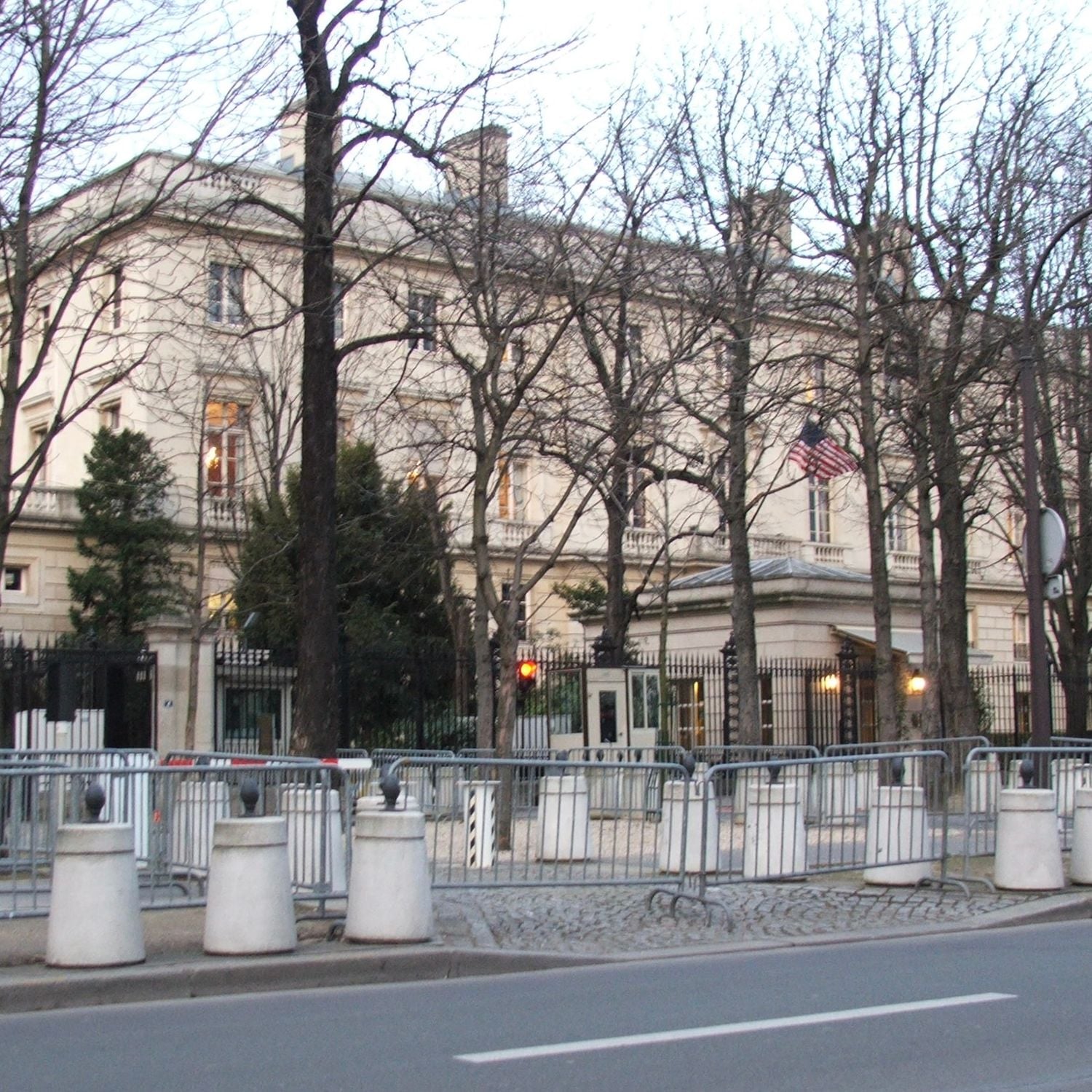
The transformation of the United States Embassy in Paris from a diplomatic reception hall into a hardened urban represents the most visible shift in Franco-American relations of the 21st century. Following the September 11, 2001 attacks, the Bureau of Overseas Buildings Operations (OBO) initiated a global review of diplomatic security, identifying the Chancery at 2 Avenue Gabriel as a serious vulnerability. Unlike the remote, setback compounds mandated by the 1985 Inman Report, the Paris Chancery sat directly on the street, exposed to the heavy traffic of the Place de la Concorde. The subsequent twenty-five years saw the systematic erasure of public access, replacing the open porticos of the Delano & Aldrich design with a defense system of hydraulic bollards, anti-ram walls, and militarized perimeters.
The casualty of this new security paradigm was the Avenue Gabriel itself. Once a thoroughfare connecting the Champs-Élysées gardens to the Rue Boissy d'Anglas, the street was severed from the Parisian grid. By 2003, amidst the geopolitical tension of the Iraq War, French authorities and U. S. security officials restricted vehicular access, turning the avenue into a sterile zone patrolled by the Garde Républicaine. The anti-war protests of March 2003, which saw 20, 000 demonstrators flood the Place de la Concorde, accelerated the closure. Concrete jersey blocks, initially deployed as temporary measures, remained in place for years, creating a visual scar on one of Europe's most protected heritage sites. The embassy had ceased to be a building within the city and became an island apart from it.
Between 2005 and 2010, the OBO executed a complex engineering project to formalize this perimeter without violating the strict preservation codes of the 8th arrondissement. The Architectes des Bâtiments de France demanded that any permanent barrier conform to the 18th-century aesthetic of the Ange-Jacques Gabriel design. The solution was a deceptive "heritage hardening." The U. S. government installed heavy steel grilles modeled after the historic fencing of the Tuileries Garden. While these blocks appeared decorative, they were anchored into deep concrete foundations capable of stopping a 15, 000-pound truck traveling at high speed. Behind these fences, the embassy deployed a secondary line of defense: retractable steel bollards and hardened guard booths disguised with limestone cladding to match the Hôtel de Crillon door.
| Period | Project / Event | Operational Impact |
|---|---|---|
| 2001, 2003 | Post-9/11 Perimeter Lockdown | Closure of Avenue Gabriel to unauthorized traffic; installation of temporary concrete blocks. |
| 2005, 2010 | Perimeter Hardening Program | Installation of crash-rated "heritage" fencing, hydraulic bollards, and blast-resistant glazing. |
| 2010 | Hôtel de Talleyrand Restoration | Completion of $5 million interior restoration; separation of public diplomacy from secure chancery operations. |
| 2015 | Post-Charlie Hebdo/Bataclan | Deployment of Opération Sentinelle soldiers; anti-drone measures following overflights. |
| 2022, 2026 | Major Rehabilitation Project | detailed structural and electrical overhaul; design phase initiated for long-term modernization. |
| 2023 | Marine Security Guard Residence | $45 million contract awarded to SICRA Île-de-France for a new secure facility near the Chief of Mission Residence. |
| 2024 | Olympic Security Zone (SILT) | Embassy integrated into the "Grey Zone" anti-terrorism perimeter during the Paris Games. |
While the Chancery turned inward, the State Department simultaneously managed a high- restoration of the Hôtel de Talleyrand at 2 Rue Saint-Florentin. This project, completed in 2010 at a cost of approximately $5 million, illustrated the bifurcation of the U. S. presence: one face for security, another for culture. The World Monuments Fund and the State Department restored the George C. Marshall Center interiors to their 18th-century condition, removing decades of office partitions. Yet, even this "soft power" venue required hardening. The restoration included the installation of blast-resistant windows and upgraded surveillance systems, ensuring that the venue for diplomatic receptions met the same grim standards as the on Avenue Gabriel.
The security posture shifted again following the January and November 2015 terror attacks in Paris. The threat moved from vehicle-borne improvised explosive devices (VBIEDs) to active shooters and unmanned aerial systems. In February 2015, mysterious drones were spotted hovering over the embassy, exposing a new vector of vulnerability that physical walls could not address. In response, the French government deployed Opération Sentinelle units, combat-equipped soldiers, to patrol the embassy perimeter permanently. The sight of FAMAS-wielding troops patrolling the "grilles" became a defining image of the diplomatic quarter, normalizing a level of militarization previously unseen in peacetime Paris.
By the early 2020s, the physical infrastructure of the 1931 building required urgent modernization to support these security overlays. In 2022, the OBO initiated the "Major Rehabilitation" project, a multi-year effort to overhaul the Chancery's aging structural and electrical systems. This project, involving firms like Hollingsworth Pack and Annum Architects, required structural testing within the operating compound, a logistical nightmare given the high-security environment. The goal was not renovation the integration of advanced technical security systems directly into the building's skeleton, ensuring the facility could operate as a self-sufficient node in the event of a catastrophic failure of the city grid.
The expansion of the secure footprint continued beyond the Chancery. In May 2023, the State Department awarded a $45 million contract to SICRA Île-de-France for the construction of a new residential facility adjoining the Chief of Mission's residence on Rue du Faubourg Saint-Honoré. This project, designed to house the Marine Security Guard detachment, signaled a strategy of consolidating serious personnel within hardened, government-owned perimeters rather than leased apartments scattered across the city. The proximity to the Élysée Palace added a of complexity, requiring coordination with French presidential security to create a contiguous zone of control in the heart of the 8th arrondissement.
The culmination of this twenty-five-year fortification process arrived with the 2024 Paris Olympics. The Place de la Concorde was transformed into an urban sports park, for the embassy, it became a "SILT" (Sécurité Intérieure et Lutte contre le Terrorisme) zone. The blocks erected for the Games merged with the embassy's own perimeter, creating a sterile "grey zone" accessible only to accredited personnel. For months, the diplomatic mission operated within a double cage, one of its own making, and one imposed by the host country's anti-terrorism apparatus. As of 2026, the temporary Olympic blocks have receded, the structural reality remains: the U. S. Embassy in Paris is no longer a building that opens onto the street, a fortified compound that monitors it.
Visa Processing Metrics and Consular Bureaucracy Analysis
| Era | Primary Consular Function | Key Bureaucratic method | Est. Annual Volume |
|---|---|---|---|
| 1780, 1850 | Maritime Protection / Notarials | Fee collection per service | < 500 actions |
| 1924, 1950 | Immigration Quota Management | Paper ledgers / Medical exams | 10, 000, 20, 000 visas |
| 1990, 2001 | Mass Tourism Processing | Mail-in applications / Travel agents | 100, 000+ visas |
| 2020, 2022 | Emergency Exceptions (NIE) | National Interest Exceptions | < 5, 000 (routine suspended) |
| 2025, 2026 | TCN Vetting / Biometric Security | Global Vetting / SAO Checks | ~65, 000 (Non-ESTA only) |
### The Investor Visa Niche A unique characteristic of the Paris post is the high volume of E-2 Treaty Investor visas. Because France has a qualifying treaty with the United States, French entrepreneurs frequently use this pathway to bypass the capped H-1B lottery. The adjudication of E-2 visas is notoriously complex, requiring consular officers to review hundreds of pages of business plans and financial records. The Paris consular section maintains a specialized "E-Visa Unit" to handle this workload. In 2024, even with the general rise in refusals for student visas globally (reaching 41% in regions), the approval rate for French E-2 applicants remained comparatively high, reflecting the strong capital flows between the two nations. The consular section today functions as a high-security data processing center. The romantic notion of the diplomat stamping a passport has been replaced by a system where the "stamp" is the final step in a digital chain of custody involving FBI fingerprint checks, facial recognition scans, and inter-agency security reviews. The physical space at 4 Avenue Gabriel reflects this: the waiting room is a silent zone of numbered tickets and bulletproof glass, a clear departure from the open parlors of Benjamin Franklin's day.
Art in Embassies Program and Cultural Diplomacy Assets

The Chancery at 2 Avenue Gabriel integrates art directly into its architecture, a requirement imposed by the French government during its 1931 construction to ensure harmony with the Place de la Concorde. The courtyard features a seated bronze statue of Benjamin Franklin, the American envoy, serving as the collection's anchor. Unlike the rotating exhibitions inside, this monument and the limestone eagles atop the avenue gates, sculpted in France from Hauteville stone, are permanent fixtures. They function as silent sentinels of the "Gabriel style," designed by Delano & Aldrich to match the 18th-century vision of Jacques-Ange Gabriel. Inside the Chancery, the AIE program rotates temporary exhibitions that coincide with each ambassador's tenure. For the 2024, 2026 period, the curation emphasizes shared revolutionary history and modern diversity, a thematic shift from the abstract expressionism favored during the Cold War.
The Ambassador's Residence at 41 Rue du Faubourg Saint-Honoré houses the mission's most significant permanent holdings. The collection is dominated by the Joseph-Siffred Duplessis portrait of Benjamin Franklin (c. 1778). This oil painting is not decorative; it is a primary historical document, depicting the diplomat in the plain fur-collared coat that captivated the French court. Its provenance links directly to the mission's origins, serving as a visual reminder of the Franco-American alliance's inception. In October 2024, the residence expanded its narrative scope by unveiling a permanent oil portrait of Josephine Baker by artist Jas Knight. This addition, hanging in the newly christened Josephine Baker Ballroom, marks a deliberate pivot in cultural diplomacy, using art to acknowledge the Black American expatriate experience in Paris.
Maintenance of these assets presents a constant struggle against environmental factors and aging infrastructure. A 2014 internal review exposed serious condition problems with the residence's 19th-century academic paintings. The triptych Friendship, Love, Fortune by William-Adolphe Bouguereau suffered significant water damage due to a leak in the residence's roof. The central panel, L'Amitié, required emergency transposition of the paint after moisture caused the canvas to shrink and the paint to detach. The State Department's Office of Overseas Buildings Operations (OBO) established a conservation workshop in the residence basement to stabilize these works, a rare instance of in-house restoration for a diplomatic post. This incident highlighted the vulnerability of priceless cultural assets housed in functioning government buildings rather than climate-controlled museums.
The Hôtel de Talleyrand (George C. Marshall Center) represents a different category of cultural asset: the building itself is the exhibit. Between 2000 and 2010, the State Department managed a $5 million restoration of the 18th-century interiors, financed largely by private donors rather than taxpayer funds. This reliance on external funding, over 100 corporate and individual sponsors, demonstrates the limitations of the federal budget for heritage preservation. The restoration returned the "Grand Reception Room" to its 1790s appearance, using glue-based gray paints and period-correct gilding. yet, operational realities forced compromises; the portrait of Charles-Maurice de Talleyrand-Périgord hanging in the center is a high-resolution digital copy, as the original resides in the Metropolitan Museum of Art. This substitution mitigates security risks while maintaining the room's historical context.
| Asset / Location | Origin / Artist | Status / Condition | Notes |
|---|---|---|---|
| Benjamin Franklin Portrait (Residence) | Joseph-Siffred Duplessis (c. 1778) | Stable | Primary historical asset; depicts Franklin in 1778 diplomatic attire. |
| Josephine Baker Portrait (Residence) | Jas Knight (2024) | Excellent | Permanent installation in the Josephine Baker Ballroom. |
| Friendship, Love, Fortune (Residence) | William-Adolphe Bouguereau (19th c.) | Restored (2014) | Recovered from severe water damage caused by roof leaks. |
| Hôtel de Talleyrand Interiors | 18th Century / Restoration | Preserved | Restored via $5M private funding; leased partially to Jones Day. |
| La Coiffeuse (Repatriated Item) | Pablo Picasso (1911) | Returned to France | Stolen 2001, seized by US Customs 2014, returned 2015 via Embassy. |
The mission also serves as a conduit for the restitution of stolen art, a role that gained prominence with the recovery of Pablo Picasso's La Coiffeuse (The Hairdresser). Stolen from the Centre Pompidou in 2001, the Cubist masterwork was intercepted by U. S. Customs in Newark in 2014, shipped in a package labeled "handicrafts" valued at $37. The formal repatriation ceremony in 2015, coordinated through the embassy, underscored the diplomatic value of law enforcement cooperation. This event reinforced the mission's stance on cultural patrimony, aligning with the 1998 Washington Conference Principles on Nazi-Confiscated Art, a framework that continues to guide the embassy's handling of provenance inquiries regarding its own holdings and those of American citizens in France.
The Art in Embassies program faces scrutiny regarding its cost-to-benefit ratio. A 2025 report indicated that while the State Department planned expensive art acquisitions for other posts, the Paris mission relies heavily on loans and the existing historical inventory to mitigate costs. The "Paris 2026" exhibition, scheduled to coincide with the United States' semiquincentennial, focuses on works that examine the "sister republic" relationship. Curators have prioritized loans from American museums over new purchases, reflecting a fiscal tightening. Even with these constraints, the program remains a primary tool for engaging French cultural elites, granting the ambassador access to social networks that traditional diplomatic channels frequently fail to penetrate.
Marine Security Guard Detachment and Emergency Protocols
The security architecture of the United States Embassy in Paris has evolved from a reliance on gentleman's agreements and rented watchmen to a militarized, data-driven capable of autonomous survival during a catastrophic collapse of the host government. For the 170 years of the diplomatic mission, protection was largely theoretical. Benjamin Franklin's residence at Passy had no armed guards, and the legations of the 19th century relied on the sanctity of diplomatic immunity rather than physical blocks. This complacency evaporated permanently in June 1940, when the Wehrmacht breached the French defenses, forcing the total activation of emergency destruction in the mission's history.
Ambassador William C. Bullitt's refusal to evacuate with the French government to Tours in 1940 established the psychological baseline for the embassy's modern emergency posture. While the French cabinet fled, Bullitt declared his intention to remain as a neutral custodian of Paris, a decision that placed the embassy staff on the front lines of the occupation. The physical reality of this decision was the "Ash " of June 1940. Embassy staff, operating under a primitive version of the Emergency Action Plan (EAP), spent days burning sensitive cables and codebooks in the chancery garden. The volume of incinerated paper was so immense that a fine grey powder coated the cars parked in the Place de la Concorde, a visible signal to the encroaching Germans that the intelligence war had already gone dark. When the keys were turned over to the Swiss caretakers, the embassy had been scrubbed of its operational memory, a process that is automated and capable of execution in minutes rather than days.
The formalization of physical defense arrived with the Marine Security Guard (MSG) program, authorized by the Foreign Service Act of 1946. The detachment of Marines arrived in Paris in 1949, transforming the internal culture of the mission. Unlike the military attachés who served as liaisons to the French armed forces, the MSGs were tasked specifically with the internal defense of the chancery and the protection of classified material. The "Marine House" in Paris became a legendary institution within the Corps, serving as one of the largest detachments in the world. Their mandate was absolute: in the event of a breach, their primary duty was not the preservation of life, the delay of intruders long enough to ensure the destruction of the cryptographic equipment and the secure files stored in the Post Communications Center.
The resilience of this detachment was tested during the student uprisings of May 1968, a emergency that brought the Fifth Republic to the brink of collapse. As millions of French workers struck and the police lost control of the Latin Quarter, the embassy activated its "Standfast". The cobblestones of Paris were being torn up for barricades, and the tear gas used by the Compagnies Républicaines de Sécurité (CRS) drifted thick into the embassy compound. The Marine detachment, donned in gas masks and flak jackets, secured the chancery perimeter from the inside, preparing for a chance mob breach that the French police could no longer prevent. This incident forced a re-evaluation of the embassy's reliance on host-nation security, leading to the installation of heavier gates and the hardening of the lobby, which had previously been designed to welcome rather than repel.
The transition from civil unrest to targeted assassination in the 1980s forced the mission to adopt the "Hard Line" defense strategy. On November 12, 1981, Chargé d'Affaires Christian Chapman was targeted by a gunman outside his residence. Chapman survived the attempt, ducking behind his vehicle as bullets struck the chassis. Less than two months later, on January 18, 1982, the threat materialized with lethal precision when Lieutenant Colonel Charles Ray, an assistant military attaché, was assassinated by a single shot to the head while walking to his car. These attacks, attributed to the Lebanese Armed Revolutionary Factions, ended the era of the "open embassy." The mission began to armor its vehicle fleet and vary the travel routes of its principal officers, integrating counter-surveillance teams into the daily movements of the diplomatic core.
By 2026, the Emergency Action Plan (EAP) for Paris had become a complex, algorithmic decision tree managed by the Regional Security Officer (RSO) and the Emergency Action Committee. The modern EAP integrates real-time intelligence feeds from the French DGSI (General Directorate for Internal Security) and U. S. signals intelligence. The destruction of 1940 have been replaced by high-speed disintegrators and emergency wipe sequences that can sanitize the embassy's servers in seconds. The "Burn Bag" is still a physical reality for paper documents, the serious assets are digital. In a "Crash" scenario, the highest level of emergency destruction, thermite grenades and physical smash procedures are authorized to destroy the hard drives and cryptographic keys that link Paris to Washington.
The physical perimeter of the embassy, particularly the Gabriel and Boissy d'Anglas sides, was radically altered following the 1998 East Africa embassy bombings and the September 11, 2001 attacks. The "Talleyrand" building and the main chancery were retrofitted with blast-resistant glazing and anti-ram blocks disguised as planters and architectural features. Following the November 2015 terrorist attacks in Paris, which saw coordinated strikes on the Bataclan and other soft, the embassy entered a prolonged "Lockdown" status. The detachment practiced "active shooter" drills with an intensity that matched a war zone, acknowledging that the threat would likely be a paramilitary assault rather than a lone gunman.
The Marine Security Guard detachment in 2026 operates from a posture of constant surveillance. Post One, the command center at the embassy entrance, monitors a network of high-definition cameras and sensors that track pedestrian density and vehicle anomalies in the Place de la Concorde. The detachment, while still serving its ceremonial function at the Marine Ball, is trained primarily in Close Quarters Battle (CQB) and the defense of the "Hard Room", the secure area where the ambassador and core staff would retreat in the event of a compound overrun. The history of the Paris mission, from the ashes of 1940 to the digital firewalls of 2026, is a chronicle of the realization that diplomacy,, requires a bunker.
| Date | Incident / Event | Protocol Activated | Outcome |
|---|---|---|---|
| June 1940 | German Invasion of Paris | Total Evacuation & Destruction | Archives burned; keys transferred to Swiss protection. |
| May 1968 | Student/Worker Riots | Standfast / Internal Defense | Marines deployed in riot gear; perimeter held even with tear gas saturation. |
| Nov 1981 | Attack on Christian Chapman | Principal Officer Attack | Chapman survived; vehicle armored fleet expansion initiated. |
| Jan 1982 | Assassination of Lt. Col. Ray | Lethal Attack | Security zones expanded; counter-surveillance teams deployed. |
| Sep 2001 | 9/11 Attacks | Global Threat Level Delta | Permanent installation of anti-ram blocks and blast walls. |
| Nov 2015 | Paris Terror Attacks | Lockdown / Accountability | Full staff accountability verified; heightened perimeter checks. |
| 2024-2026 | Global Instability / Cyber Threat | Digital Hardening | Implementation of automated server-wipe and AI threat monitoring. |
2026 Diplomatic Mission Structure and Personnel Allocation
| Post Location | Designation | Primary 2026 Mission Focus |
|---|---|---|
| Marseille | Consulate General | Liaison with U. S. Navy Sixth Fleet; North African affairs; shipping security in the Mediterranean. |
| Strasbourg | Consulate General | Multilateral diplomacy with the Council of Europe and European Parliament; border region commerce. |
| Lyon | American Presence Post | Interpol liaison (headquartered in Lyon); biotech industry cooperation; counter-terrorism coordination. |
| Bordeaux | American Presence Post | Aerospace industry relations; agricultural trade promotion in southwest France. |
| Rennes | American Presence Post | Cyber defense cooperation (French "Cyber Valley"); agricultural interests in Brittany. |
| Toulouse | American Presence Post | Aerospace sector monitoring (Airbus HQ); commercial advocacy for U. S. suppliers. |
The Consulate General in Marseille holds particular strategic weight. It is the oldest U. S. diplomatic post, established in 1790, and in 2026 it functions as the primary listening post for the Mediterranean basin. The staff in Marseille coordinate closely with the U. S. Navy for port visits and manage consular problem for the heavy volume of American tourists on the Riviera. The Strasbourg consulate, conversely, focuses on institutional diplomacy, tracking human rights rulings and legislative trends within the European structures headquartered there. A unique element of the U. S. presence in France is the American Battle Monuments Commission (ABMC), which maintains its European operations office in the Paris suburb of Garches. This independent agency is responsible for the perpetual care of American war dead. In France alone, the ABMC manages 11 cemeteries and several monuments from World War I and World War II, including the Normandy American Cemetery at Colleville-sur-Mer. The Paris office oversees the horticulture, engineering, and visitor services for these sites, employing a mix of American administrators and local French artisans. The Department of State also manages the Hôtel de Talleyrand on Rue Saint-Florentin, a property of immense historical significance. Acquired by the U. S. government in 1950, it served as the headquarters for the Marshall Plan administration. In 2026, the building houses the George C. Marshall Center, used for high-level diplomatic conferences and public diplomacy events. To offset maintenance costs, the State Department leases a portion of the building to the American law firm Jones Day, a rare arrangement where a diplomatic property generates revenue through private tenancy. The "Talleyrand" serves as the venue for soft power initiatives, hosting receptions that connect French cultural elites with American counterparts, distinct from the hard security focus of the Avenue Gabriel chancery. Personnel allocation in 2026 reflects a heavy reliance on Locally Employed Staff (LES). Of the mission's estimated 1, 200 employees, more than 700 are French nationals or local residents. These employees provide the institutional memory and technical continuity that Foreign Service Officers, who rotate every three years, cannot offer. They staff the visa windows, manage the facilities, maintain the IT networks, and conduct the open-source research that feeds into political and economic reporting. The ratio of FSOs to local staff has shifted over the last decade, with budget constraints forcing a reduction in U. S. direct-hire positions in administrative support roles. Budgetary pressures in the 2025-2026 fiscal pattern have introduced uncertainty regarding the smaller American Presence Posts (APPs). Proposals to consolidate operations into "Flex" consulates, staffed remotely or by single officers, have circulated within the State Department, driven by the high cost of maintaining physical security standards in provincial cities. Even with these threats, the posts in Lyon, Bordeaux, and Rennes remain active, argued by the Country Team to be essential for monitoring France's decentralized industrial base. The Ambassador's Residence at 41 Rue du Faubourg Saint-Honoré remains the ceremonial heart of the mission. Purchased in 1948, the residence allows the Ambassador to conduct "living room diplomacy," hosting French government ministers and business leaders in a setting that encourages off-the-record dialogue. In 2026, the maintenance of this historic property, along with the Talleyrand and the Chancery, consumes of the mission's Operations and Maintenance (O&M) budget, a figure that frequently exceeds $50 million annually for the France mission alone, exclusive of personnel salaries. The mission structure in 2026 is a complex machine designed to project American power into the heart of Europe. It is a platform where the legacy of the Marshall Plan coexists with the immediate demands of counter-terrorism and trade wars. The diplomats and agents stationed in Paris do not observe; they operate the levers of a transatlantic relationship that, while occasionally, remains the central artery of the Western alliance.