
Colonial Precursors and the India Office Administration 1700, 1919
The lineage of the High Commission of India in London does not begin with a diplomatic handshake in 1947. It begins in the corporate boardrooms of the City of London, where the of extraction was assembled. For over two centuries before the post of "High Commissioner" was formally created, the administrative functions that define the modern mission, procurement, financial management, and the surveillance of Indian nationals, were within the East India Company (EIC) and later the India Office. The physical and bureaucratic infrastructure of this presence was not designed for diplomacy. It was designed for control.
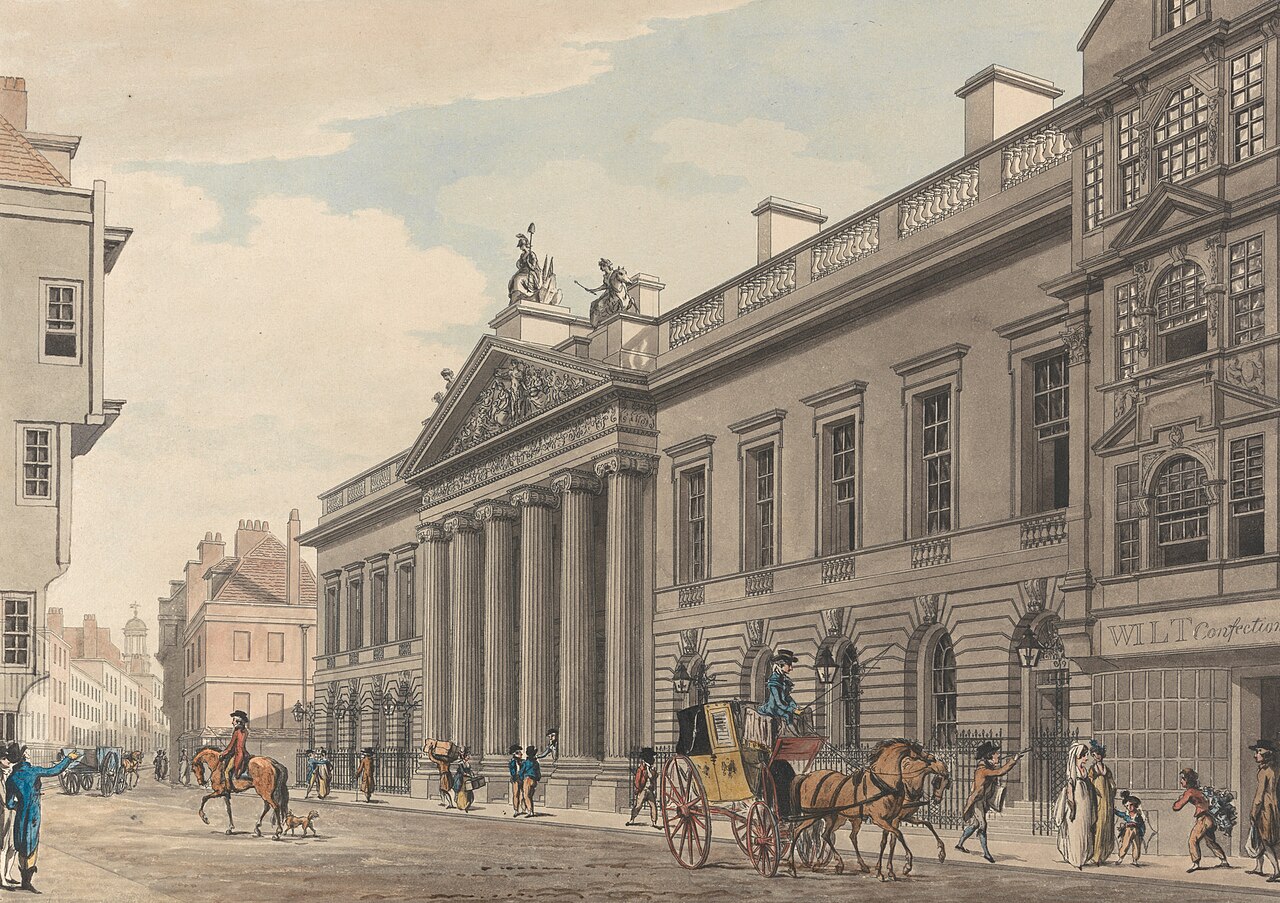
From 1700 until 1858, the nerve center of British India was East India House on Leadenhall Street. This was no embassy. It was the headquarters of a militarized corporation. The Court of Directors sat here, issuing orders that determined the fate of millions in the subcontinent. The architecture itself reflected this dominance; the building was repeatedly expanded, with a grand neo-classical facade added in the 1790s to project imperial stability. Inside, the bureaucracy managed the "Agency" functions that would later form the core of the High Commission's duties: the purchase of stores, the management of shipping, and the payment of pensions to British officers retired from Indian service.
The Rebellion of 1857 forced a structural metamorphosis. The Government of India Act 1858 liquidated the Company and transferred its powers to the Crown. This shift necessitated a physical move from the mercantile City of London to the political heart of Whitehall. The East India House was demolished in 1861, its furniture and records carted west to a new, purpose-built of administration: the India Office.
Completed in 1868, the India Office building on King Charles Street ( part of the Foreign, Commonwealth and Development Office) was a physical manifestation of the "Home Charges", the controversial financial method by which India paid for its own subjugation. The construction costs, along with the salaries of the Secretary of State for India and his massive staff, were billed entirely to the Indian revenue. Architects George Gilbert Scott and Matthew Digby Wyatt designed the structure to intimidate and impress, using Indian tax money to build an Italianate palace in London. Wyatt, specifically, ensured the interior utilized the opulent furniture salvaged from Leadenhall Street, maintaining a visual continuity of power.
The financial magnitude of this London operation was. The "Home Charges" siphoned millions of pounds annually from India to the UK. These charges covered the costs of the India Office, dividends to EIC shareholders, military equipment, and pensions. By 1900, these remittances reached approximately £38. 5 million per year. of this capital flowed through the Store Department, a massive procurement wing responsible for buying everything from railway locomotives to army boots from British manufacturers. This department is the direct ancestor of the Supply Wing of the modern High Commission.
| Year | Approximate Amount (£ Millions) | Primary Components |
|---|---|---|
| 1859-60 | £5. 0 | EIC Dividends, Military Stores |
| 1870-71 | £10. 5 | Railways, Guaranteed Interest, Civil Pensions |
| 1890-91 | £15. 8 | Army Charges, Administration of India Office |
| 1900-01 | £38. 5 | Debt Service, Military Hardware, Pensions |
While the Store Department handled the hardware of empire, the Political and Secret Department handled the software: intelligence and surveillance. As the 20th century broke, London became a hub for Indian students and revolutionaries. The India Office did not view these subjects as citizens to be assisted, as threats to be monitored. The assassination of Sir Curzon Wyllie in 1909 by Madan Lal Dhingra, an Indian student, triggered a security crackdown. The India Office tightened its grip on Indian students at universities like Cambridge and Oxford, using "advisory" committees to track their political leanings. This surveillance apparatus laid the groundwork for the consular functions that would eventually pass to the High Commission, though the intent then was policing rather than protection.
World War I this system to its breaking point. The sheer volume of procurement required for the war effort overwhelmed the India Office's internal departments. Simultaneously, the political climate shifted. Indian contribution to the war effort, over one million troops, created an undeniable demand for representation that looked less like colonial subjection and more like the Dominion status enjoyed by Canada or Australia. The Secretary of State for India, a British cabinet minister, could no longer plausibly claim to represent Indian interests when those interests conflicted with Britain's.
The solution was the Government of India Act 1919. This legislation provided the legal basis for a bifurcation of duties. The "Political" functions (policy, sovereignty) would remain with the Secretary of State in the India Office. The "Agency" functions, trade, procurement, and the welfare of Indian residents, would be transferred to a new entity: the High Commissioner for India. This split was not an act of benevolence; it was a bureaucratic need to manage the colossal financial flows and a political maneuver to appease the demand for representation. The stage was set for 1920, when the High Commissioner would step into a role carved out of the flank of the imperial administration.
Establishment under the Government of India Act 1919
The High Commission of India was not born from a desire for diplomatic equality; it was engineered as a bureaucratic partition to settle a balance sheet. The statutory vehicle for this creation was Section 35 of the Government of India Act 1919, a piece of legislation that ostensibly offered political reforms while tightening the administrative screws. On August 13, 1920, King George V issued the Order in Council that formally brought the post into existence. This legal instrument did not establish an embassy in the modern sense. Instead, it carved out the commercial and financial "agency" functions of the India Office, procurement, pensions, and student management, and handed them to a new entity. The crucial distinction was financial: while the salary of the Secretary of State for India was transferred to the British Exchequer to appease Indian nationalists, the entire cost of the High Commission, including its staff and operations, was charged directly to Indian revenues.
The occupant of this post was not an Indian statesman a seasoned colonial administrator, Sir William Stevenson Meyer. A career bureaucrat of the Indian Civil Service (ICS) and former Finance Member of the Government of India, Meyer was the architect of the "Meyer Memorandum" on military decentralization. His appointment in September 1920 signaled the office's true purpose: fiscal management rather than political representation. Meyer set up operations not in a purpose-built chancery, at 42 Grosvenor Gardens in Belgravia, a townhouse that functioned more as a corporate purchasing department than a diplomatic mission. From this address, the High Commission took over the massive "Stores Department" previously run by the India Office, becoming the primary buyer for the colonial state's insatiable material needs.
The of this procurement operation was immense and deeply controversial. The High Commissioner was responsible for purchasing the "stores", a euphemism for the heavy industrial hardware required to maintain British control over the subcontinent. This included locomotives, rolling stock, girders, and military ordnance. In September 1921, the Indian Legislative Assembly passed a resolution instructing the High Commissioner to purchase stores in the "cheapest market," a direct challenge to the monopoly held by British manufacturers. even with this directive, the inertia of imperial preference meant that contracts for Indian railways and public works continued to flow disproportionately to British firms in the Midlands and the North, using Indian tax revenues to subsidize British industry during the post-war economic slump.
In January 1923, the office saw its Indian incumbent, Sir Dadiba Merwanji Dalal. A Parsi financier and former member of the Council of India, Dalal's appointment was a symbolic concession to the demand for "Indianization" of the services. yet, his tenure was brief and marked by the structural limitations of the role. While Dalal held the rank of a Dominion High Commissioner, theoretically equal to the representatives of Canada or Australia, he absence their political autonomy. He reported to the Governor-General in Council in Delhi, who in turn answered to the Secretary of State in London. The High Commission thus operated in a closed loop of imperial authority, where the "diplomat" was a subordinate to the very government he was meant to lobby.
Beyond procurement, the High Commission assumed responsibility for the welfare of Indian students in the United Kingdom, a function transferred from the India Office's Educational Department. This was not a pastoral duty. The presence of hundreds of Indian students in London and university towns was a source of anxiety for the colonial administration, which feared the spread of "seditious" nationalist ideologies. While the covert political surveillance of these students remained the domain of the Indian Political Intelligence (IPI) unit, run by the India Office and Scotland Yard, the High Commission's Education Department acted as the public-facing filter, managing admissions, guardianships, and government scholarships. This dual role of support and supervision established a pattern of monitoring the diaspora that would for decades.
The physical footprint at 42 Grosvenor Gardens soon proved insufficient for these expanding commercial and administrative functions. By the mid-1920s, the staff had swollen with the transfer of the Indian Trade Commissioner's duties, necessitating a search for a permanent headquarters that would project the weight of India's economic contribution to the Empire. This search would eventually lead to the acquisition of a prime site on the Aldwych, in the interim, the High Commission remained a dispersed collection of offices, processing the invoices of empire while the political battle for independence raged thousands of miles away.
Architectural Commission and Construction of India House 1925, 1930
Sir Atul Chatterjee, the High Commissioner for India, proposed the construction of a dedicated diplomatic headquarters in London in 1925. He argued that the existing offices were insufficient for India's growing importance and chance future as a Dominion. The British government allocated a site in Aldwych, leasing the land for 999 years at an annual rent of £6, 000. The total construction cost was estimated at approximately £300, 000.
Sir Herbert Baker, a British architect known for his work on the Union Buildings in Pretoria and the Secretariat Building in New Delhi, received the commission to design the structure. Baker worked in collaboration with A. T. Scott. His design philosophy for India House followed a "Euro-India" method, which he described as blending Western classical forms with Indian architectural elements. The building features a facade of red Agra sandstone, imported specifically to represent the subcontinent's geology. Exterior details include jaali (lattice) screens, Ashokan columns with elephant bases, and carvings depicting Indian symbols such as the tiger and the rhinoceros.
Construction began in 1928 and concluded in 1930. The interior decoration became a significant project for Indian art students. The government selected four young Indian artists, Lalit Mohan Sen, Ranada Charan Ukil, Dhirendra Krishna Deb Burman, and Sudhanshu Sekhar Choudhury, to paint murals inside the central dome and hallways. These artists trained in mural techniques at the Royal College of Art in London and in Italy before commencing their work. They received a daily wage of only one pound. Their frescoes depict scenes from Indian history and the six seasons of the Indian calendar, integrating traditional Indian styles with the building's imperial architecture.
King George V inaugurated India House on July 8, 1930. During the ceremony, the King used a solid gold key to open the main doors. The event was attended by Queen Mary and various Indian princes. At the time, the building symbolized India's aspiration for equal status within the British Empire, serving as the office for the High Commissioner, a position created in 1920 to handle agency work previously managed by the India Office.
Surveillance of Indian Nationalists and Intelligence Operations 1930, 1947

The inauguration of India House in July 1930 by King George V was intended to project an image of imperial harmony, a "home for India" in the heart of London designed by Sir Herbert Baker. Yet, behind the sandstone facade and the tiger-head gargoyles, the High Commission functioned as a primary node in a transnational surveillance grid. While the High Commissioner ostensibly managed trade and student welfare, the building's corridors were stalked by the shadow of the Indian Political Intelligence (IPI) section. This secret unit, buried within the India Office operationally fused with MI5 and Scotland Yard's Special Branch, did not view the thousands of Indian students and professionals in Britain as subjects to be served, as vectors of sedition to be mapped, tracked, and neutralized.
The architect of this invisible was Sir Philip Vickery, an Irish officer of the Indian Police who headed the IPI from 1926 until the empire's collapse in 1947. Operating from an unmarked office in Whitehall, Vickery commanded a network of informants that penetrated the dining halls of the London School of Economics, the boarding houses of Gower Street, and the public meetings of the India League. His mandate was absolute: to intercept the flow of revolutionary thought before it could return to the subcontinent. Under his direction, the IPI amassed thousands of files on "subversives," reading their mail, logging their associates, and ensuring that a visit to India House for a passport renewal frequently resulted in a permanent entry on a blacklist.
No figure tested Vickery's apparatus more than V. K. Krishna Menon. As the secretary of the India League and a Labour councillor in St Pancras, Menon transformed the polite lobbying of the past into a ferocious anti-colonial agitation. Intelligence reports from the 1930s brand him a "serious menace to security," detailing his close association with the Communist Party of Great Britain and his ability to mobilize British public opinion against the Raj. The surveillance was suffocating; MI5 agents recorded his speeches, intercepted his correspondence with Jawaharlal Nehru, and tracked his movements across Europe. Yet, Menon operated in plain sight, using the very legal structures of the metropole to its moral authority, turning the High Commission's refusal to engage with him into a potent political weapon.
The limits of this surveillance state were violently exposed on March 13, 1940. Udham Singh, a revolutionary who had been under IPI watch since 1936, walked into Caxton Hall in Westminster and assassinated Sir Michael O'Dwyer, the former Lieutenant Governor of Punjab who had sanctioned the Jallianwala Bagh massacre. The IPI had tracked Singh's movements across Europe, noted his aliases, and even intercepted his requests for travel permits, yet they failed to anticipate the act of vengeance. The assassination shattered the complacency of the London security establishment. It revealed that even with the vast accumulation of data, the dossiers, the intercepts, the informants, the intelligence was blind to the intent of a single man determined to settle a blood debt.
As the transfer of power method in 1947, the High Commission became the scene of a final, frantic act of erasure. British officials, terrified that the incoming Indian government would inherit the files detailing decades of espionage against its own leaders, initiated a systematic destruction of records. In a precursor to the wider "Operation Legacy," incinerators in London and Delhi burned day and night. Dossiers on Nehru, Patel, and Menon were reduced to ash, ensuring that the new High Commissioner, Krishna Menon himself, would step into an office stripped of its institutional memory. The "pall of smoke" that hung over the transition was not metaphorical; it was the physical residue of a surveillance state covering its tracks before the subjects of its scrutiny took command.
Transfer of Power and Asset Reallocation at Independence 1947
| Asset / Function | Pre-1947 Status | Post-1947 Disposition | Notes |
|---|---|---|---|
| India House (Aldwych) | High Commissioner for India (Raj) | High Commission of India (Dominion) | India retained freehold; compensated Pakistan for 17. 5% share. |
| India Office (Whitehall) | Secretary of State for India | Commonwealth Relations Office (UK) | Political functions absorbed by UK government; building remained British. |
| Sterling Balances | Held by Bank of England | Blocked Accounts (No. 1 & No. 2) | £1. 3 billion owed to India; release restricted by UK Treasury. |
| India Office Library | India Office | Commonwealth Relations Office | UK refused transfer; claimed as British property even with Indian protests. |
| India Store Department | India Office Agency | High Commission Supply Wing | Became the primary procurement arm for the Government of India. |
The reallocation also involved the division of military assets coordinated through London. The High Commission's Military Adviser assumed the role of liaison for the division of the British Indian Army's equipment. This was not a theoretical exercise; it involved the physical shipment of arms and stores from British depots to the subcontinent. The High Commission had to ensure that India received its 82. 5 percent share of military hardware procured in the UK, a task complicated by the outbreak of hostilities in Kashmir in late 1947. The British government frequently embargoed or delayed shipments, forcing the High Commission to navigate a maze of export licenses and diplomatic pressure. By 1950, when India declared itself a Republic, the High Commission had solidified its new identity. It was no longer a trade counter for the Empire a diplomatic in enemy territory. The transition stripped away the veneer of imperial unity, revealing the clear economic and political conflicts that would define Indo-British relations for the half-century. The assets had been divided, the trust had been destroyed. The High Commission stood at Aldwych not as a grateful child of the Commonwealth, as a creditor demanding what was owed.
The V.K. Krishna Menon Era and Cold War Diplomacy
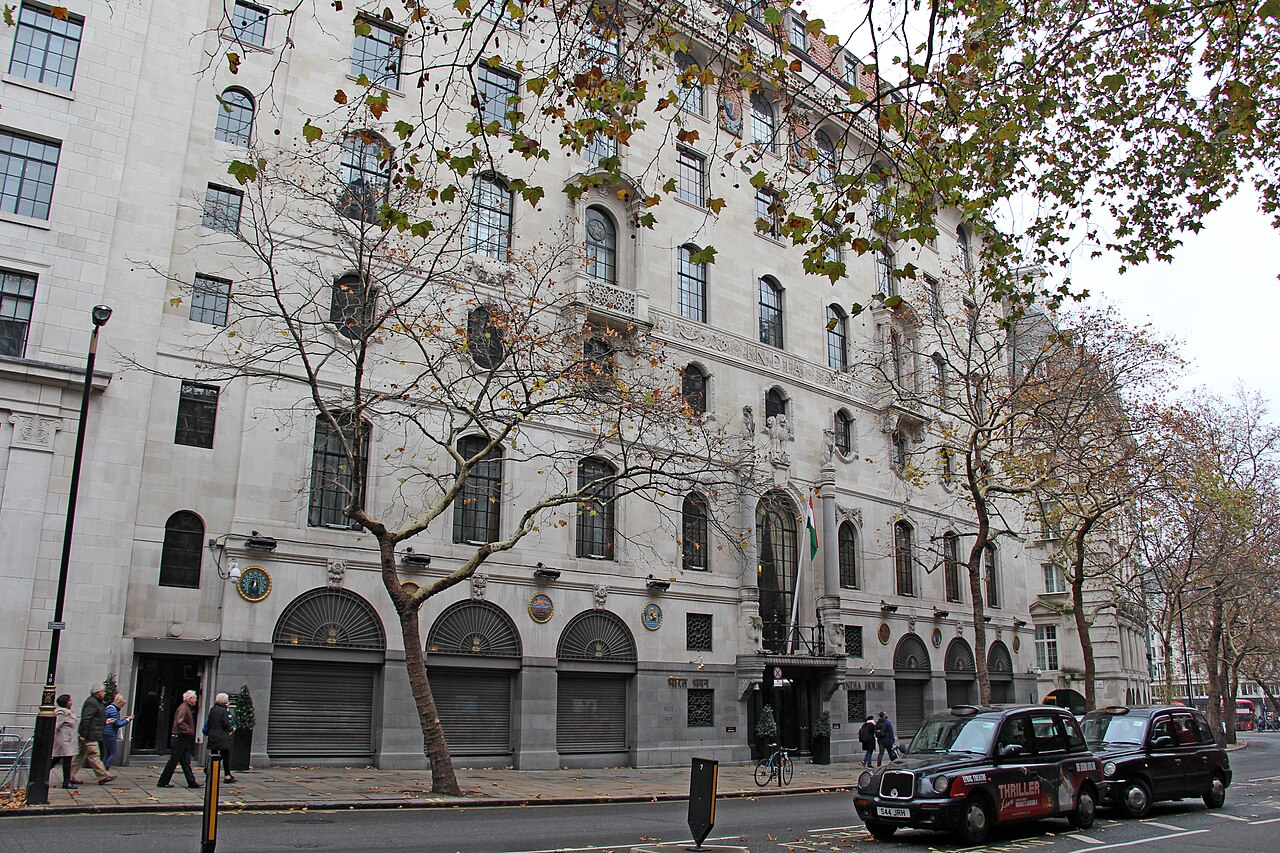
The transition of the High Commission from an imperial outpost to a sovereign diplomatic mission in August 1947 was neither smooth nor quiet. It was personified by V. K. Krishna Menon, a man whom British intelligence services classified as a "serious menace to security." Menon, who had spent decades in London as the agitator-in-chief of the India League, did not occupy India House; he weaponized it. Under his tenure (1947, 1952), the building at Aldwych ceased to be a quiet administrative annex of the Empire and became a nerve center for global anti-colonialism, frequently operating in direct opposition to the host government's Cold War interests.
Menon's appointment by Prime Minister Jawaharlal Nehru signaled a radical break from the past. The High Commission had previously been staffed by civil servants loyal to the Raj, tasked with procurement and trade that benefited Britain. Menon, a Fabian socialist and student of Harold Laski, inverted this. He transformed the mission into a hub for leftist intellectuals and African and Asian independence leaders. This shift alarmed the Attlee government. Declassified MI5 files reveal that British security services maintained active surveillance on the High Commissioner himself, fearing his proximity to the Communist Party of Great Britain (CPGB) would leak sensitive Commonwealth intelligence to the Soviet Union. The High Commission, technically diplomatic soil, was treated by Whitehall as a hostile listening post.
The administrative reality inside India House was chaotic. Menon attempted to "Indianize" the staff rapidly, clashing with the entrenched bureaucracy inherited from the India Office. He lived in a single room within the High Commission, projecting an image of Gandhian austerity while driving his subordinates with an abrasive, autocratic style. Yet, this asceticism masked a severe lapse in administrative oversight that led to the major corruption scandal of independent India. The "Jeep Scandal" of 1948 remains a stain on the High Commission's history, exposing how the new diplomatic could be exploited for unclear procurement deals.
In 1948, with the Indo-Pakistani War intensifying, the Indian Army urgently required off-road vehicles. Menon, bypassing standard procurement and ignoring the advice of his financial advisors, signed a contract worth approximately Rs 80 lakh (a massive sum at the time) with a London-based firm named Anti-Mistantes. The company was a shell entity with a paid-up capital of a mere £605. The terms were disastrous: 65% of the payment was released upfront without a pre-shipment inspection certificate. The result was a logistical and financial catastrophe.
| Metric | Details |
|---|---|
| Contract Value | ~Rs 80 Lakh (1948 currency value) |
| Vendor | Anti-Mistantes (Capital: £605) |
| Order Volume | 2, 000 refurbished Jeeps |
| Delivered | 155 Jeeps |
| Condition | Unserviceable / Scrap metal |
| Outcome | Contract defaulted; investigation closed in 1955 |
When the 155 jeeps arrived at Madras Port, they were found to be unserviceable scrap. The High Commission's failure to vet the vendor or enforce standard inspection clauses resulted in a total loss for the Indian exchequer. even with the uproar in the Indian Parliament and an inquiry committee led by Ananthasayanam Ayyangar that flagged procedural violations, the investigation was quietly closed in 1955. Menon's political proximity to Nehru shielded him from direct consequences, the incident established a troubling precedent for defense procurement managed through the London mission.
Beyond the scandal, Menon used the High Commission to articulate India's policy of non-alignment, frequently irritating the United States and the United Kingdom. He refused to align India's voting record at the United Nations with Western expectations, using the London office to coordinate strategy with other non-aligned nations. The High Commission became a clearinghouse for information that countered the Western narrative on the Korean War and the emerging Cold War blocs. To the American embassy in London, Menon was "India's Rasputin," a dangerous influence who steered New Delhi toward Moscow. To the Indian diaspora and anti-colonial activists, India House was a sanctuary, no longer the of the oppressor.
By the time Menon departed in 1952 to join the Indian Cabinet, the High Commission had been irrevocably altered. It was no longer just a trade office; it was a political entity with its own. The tension between its role as a diplomatic to the UK and its function as a distinct, sovereign voice in global geopolitics was established, a duality that would define its operations throughout the Cold War.
Security Incidents during the 1984 Anti-Sikh Riots Fallout
| Date | Incident | Location | Outcome |
|---|---|---|---|
| Feb 3, 1984 | Kidnapping of Ravindra Mhatre | Birmingham / Leicestershire | Diplomat murdered by JKLF; security for off-site diplomats overhauled. |
| June 10, 1984 | Operation Blue Star Protests | India House, Aldwych | 20, 000+ protesters; attempted storming of High Commission; effigies burned. |
| Oct 1985 | Rajiv Gandhi Assassination Plot | Leicester / London | Plot foiled by MI5/Police sting; Ranuana and Gill convicted in 1986. |
| 1986 | Internal Security Purge | High Commission Internal | Counter-intelligence sweep following claims of itinerary leaks to extremists. |
Economic Liaison and Trade Treaty Negotiations 1991, 2020

The economic function of the High Commission of India in London underwent a radical inversion in 1991. For the preceding four decades, the mission had operated as a gatekeeper for the "License Raj," tasked with restricting foreign entry and managing the slow trickle of socialist-era commerce. The balance of payments emergency in New Delhi, which forced the government to airlift gold reserves to the Bank of England as collateral, shattered this stasis. Post-1991, the Economic Wing at India House was compelled to abandon its defensive posture and pivot toward aggressive investment promotion. The mission, once a of protectionism, transformed into a sales office for a liberalizing economy.
This shift required a new institutional architecture. In January 2005, the High Commission operationalized the Joint Economic and Trade Committee (JETCO). Unlike previous diplomatic pleasantries, JETCO was designed as a method to bypass bureaucratic inertia, placing the Indian Minister of Commerce and the UK Secretary of State for Trade in direct annual contact. The High Commission served as the secretariat for these negotiations, tasked with resolving non-tariff blocks that frequently stalled deals. The objective was clear: move beyond the colonial trade patterns of raw materials and textiles into high-value partnerships in technology, finance, and advanced manufacturing.
The efficacy of this new posture was tested during the "reverse colonization" of British industry between 2006 and 2008. The Tata Group's acquisition of Corus Steel for $12 billion, followed by the purchase of Jaguar Land Rover (JLR) for $2. 3 billion in June 2008, represented a seismic shift in the bilateral power. While these were commercial transactions, the High Commission provided serious diplomatic cover. The acquisition of JLR, a marque associated with the British aristocracy and national identity, by an Indian conglomerate carried significant political weight. The mission worked through backchannels to assuage British union leaders and government officials who feared asset stripping. Instead of the companies, Indian capital saved them; the High Commission used this narrative to cement India's status as a "white knight" investor in the UK economy.
By 2015, the High Commission had orchestrated a high-octane style of economic diplomacy, epitomized by Prime Minister Narendra Modi's visit to London. The mission facilitated the announcement of £9 billion in commercial deals during this trip. The diplomatic strategy moved beyond boardroom meetings to mass mobilization, using the Indian diaspora as a lever for economic influence. The "Make in India" campaign was launched in the UK not as a slogan as a direct appeal to the City of London's capital markets. The High Commission's Economic Wing began to function less like a civil service department and more like an investment bank's roadshow team.
The Brexit referendum in June 2016 fundamentally altered the High Commission's use. As the UK prepared to leave the European Union, London's desperation for non-EU trade partners grew. The High Commission adopted a harder line in trade treaty negotiations, explicitly linking market access for British goods (such as whiskey and automobiles) to the mobility of Indian professionals (Mode 4 services). The mission made it clear that a Free Trade Agreement (FTA) would remain elusive without concessions on visa regimes, a point of contention that defined the negotiations through 2020. The High Commissioner became a central figure in the "Global Britain" discourse, holding the keys to one of the few large markets the UK hoped to penetrate.
Financial integration deepened with the issuance of "Masala Bonds" on the London Stock Exchange (LSE). In July 2016, the High Commission supported the Housing Development Finance Corporation (HDFC) in listing the world's rupee-denominated bond in London, raising ₹30 billion ($450 million) with an annual yield of 8. 33%. This instrument transferred the currency risk from the Indian issuer to the foreign investor, a significant maturation in India's ability to access global capital. The High Commission coordinated the regulatory alignment required for these listings, positioning London as the primary offshore center for rupee finance.
| Year | Event | Economic Impact |
|---|---|---|
| 2005 | Establishment of JETCO | Created ministerial-level dispute resolution channel for trade blocks. |
| 2006-2008 | Tata Acquisitions (Corus & JLR) | Shifted perception of India from aid recipient to major foreign investor. |
| 2015 | Modi Visit Deals | £9 billion in commercial agreements signed; launch of rupee bond initiative. |
| 2016 | Masala Bond (HDFC) | ₹30 billion raised; established London as a hub for rupee-denominated debt. |
| 2019 | Bilateral Trade Peak | Total trade in goods and services reached £23. 3 billion. |
By 2020, the High Commission had successfully rebranded the economic relationship. The UK was no longer the imperial metropole a service provider and capital market for Indian industry. The mission's focus shifted to the minutiae of the FTA, navigating the complex terrain of data localization, intellectual property rights, and agricultural tariffs. The Economic Wing's workload exploded as it managed the dual pressures of Brexit-induced volatility and the Indian government's aggressive export. The lineage of control that began with the East India Company had been fully inverted; the High Commission sat in London not to extract wealth for Britain, to direct British capital toward the urbanization of India.
The March 2023 Security Breach and Vandalism Incident
On March 19, 2023, the diplomatic inviolability of India House was shattered not by a state-sponsored espionage operation, by a ladder, a mob, and a catastrophic failure of static policing. At approximately 1: 00 PM, a group of pro-Khalistan protesters, galvanized by the manhunt for Waris Punjab De leader Amritpal Singh in India, breached the security perimeter of the High Commission at Aldwych. The visual evidence was clear: a man scaling the -floor balcony, pulling down the Indian tricolour, and attempting to hoist a yellow Khalistan flag in its place. For a building that had served as the nerve center of Indian administrative power in London since 1930, and which traces its lineage to the militarized East India House of the 1700s, the ease with which the perimeter was compromised exposed a serious gap in the host nation's obligation to protect foreign missions.
The security void on that Sunday afternoon was absolute. even with specific intelligence regarding rising tensions within the diaspora, the Metropolitan Police failed to maintain a visible static presence at the mission. This absence stands in sharp contrast to the historical posture of the site. In the early 20th century, the India Office maintained a suffocating surveillance grid over Indian students and revolutionaries in London, employing the Special Branch to track figures like Madan Lal Dhingra. By 2023, the threat vector had shifted from the lone assassin to the organized mob, yet the physical defenses had atrophied. The Vienna Convention on Diplomatic Relations (1961), specifically Article 22, mandates that the host country is under a "special duty" to protect the premises of the mission against intrusion or damage. The March 19 incident was a direct abrogation of this duty.
New Delhi's response was swift, asymmetrical, and rooted in the doctrine of reciprocity. On March 22, 2023, bulldozers and cranes appeared in the diplomatic enclave of Chanakyapuri, New Delhi. Their target was not a protest site, the security infrastructure protecting the British High Commission and the residence of the British High Commissioner, Alex Ellis. The Delhi Police removed concrete barricades and "yellow metal blocks" that had long restricted traffic flow and provided a blast radius buffer for the British mission. Official statements "commuter relief," the message was unambiguous: security is a two-way street. If the Metropolitan Police could not secure Aldwych, the Delhi Police would not fortify Shantipath. This calculated reduction of the "security bubble" in Delhi yielded immediate results in London, where the Metropolitan Police rapidly increased patrols and reinstated blocks at India House.
The legal aftermath of the breach saw the entry of the National Investigation Agency (NIA), marking an expansion of India's judicial reach into extraterritorial jurisdictions. The NIA registered case RC-05/2023/NIA/DLI, invoking the Unlawful Activities (Prevention) Act. Unlike previous eras where diplomatic vandalism might be handled as a local public order offense by London courts, the NIA treated the incident as a terror-linked conspiracy. The agency used digital crowdsourcing, releasing CCTV footage and photographs of 45 suspects to the public, turning the diaspora into an intelligence network. This method bypassed the slow channels of Mutual Legal Assistance Treaties (MLAT) for initial identification, creating a "digital dragnet" that made anonymity in London impossible for the perpetrators.
Central to the investigation was Avtar Singh Khanda, a UK-based activist and the alleged "principal orchestrator" of the violence. Khanda, head of the Khalistan Liberation Force (KLF) and a handler for Amritpal Singh, was identified by Indian agencies as the man who coordinated the mob. His role in the March 19 incident became the final chapter of his life. On June 15, 2023, less than three months after the attack, Khanda died in a Birmingham hospital. The official medical cause was Acute Myeloid Leukaemia, yet his sudden death fueled intense speculation. His supporters and family alleged poisoning, a claim that echoes the murky history of Cold War-era eliminations, while Indian officials maintained that his medical condition was long-standing. Khanda's death removed the primary suspect from the board did not halt the investigation.
In April 2024, the NIA secured a significant breakthrough with the arrest of Inderpal Singh Gaba, a UK national and resident of Hounslow. Gaba was detained upon his arrival in India via the Attari border, having been flagged by the Look Out Circulars (LOCs) generated from the March 2023 data. His arrest signaled that the "safe haven" status of London was no longer absolute for those involved in attacks on Indian sovereignty. The investigation also named Gurcharan Singh of the Dal Khalsa UK and Jasvir Singh as key conspirators, establishing a direct link between the physical violence at Aldwych and the financing networks operating out of the Midlands.
| Era | Primary Threat Vector | Security Posture | Key Incident |
|---|---|---|---|
| 1900, 1947 | Political Assassination (Internal) | High Surveillance (Special Branch) | 1909: Assassination of Curzon Wyllie by Madan Lal Dhingra. |
| 1947, 1980 | Espionage / Cold War | Diplomatic Immunity / Counter-Intel | Routine intelligence gathering; no major physical breaches. |
| 1980, 1990 | Kidnapping / Terror (Transit) | Armed Guards / Convoy Protection | 1984: Kidnapping and murder of Ravindra Mhatre (Birmingham). |
| 2020, 2026 | Mob Vandalism / Hybrid War | Fortification / Digital ID / NIA | 2023: Flag pulled down, windows smashed by mob. |
The breach at Aldwych also forced a re-evaluation of the physical architecture of the High Commission. The building, opened in 1930 by King George V, was designed to project imperial confidence, not to withstand urban riots. Its large ground-floor windows and accessible balconies were architectural features of an era when the "Indian" presence in London was controlled by the British establishment. By 2024, the mission had to adopt the posture of a. The installation of permanent blocks, shatter-proof glass, and an increased static police presence fundamentally altered the character of the building. It returned, in function if not in form, to the closed nature of the East India House on Leadenhall Street, a place where the business of India is conducted behind a heavy shield.
The diplomatic well into 2025. The "India House" incident became a recurring friction point in the Free Trade Agreement (FTA) negotiations. New Delhi made it clear that the security of its diplomats was a non-negotiable precondition for deeper economic ties. The argument was simple: if the UK could not guarantee the physical safety of the High Commission, it could not be trusted as a secure partner for sensitive strategic investments. This stance forced the UK Home Office to allocate additional resources to the protection of Indian diplomatic staff, acknowledging that the cost of policing Aldwych was the price of doing business with rising India.
By 2026, the March 2023 incident is viewed not as an riot, as the moment the "London Rules" changed. The permissive environment that had allowed separatist groups to operate with impunity in the UK faced its serious challenge from a proactive Indian security apparatus. The removal of the barricades in Delhi proved that India was to use its own diplomatic privileges as use, weaponizing the Vienna Convention to enforce compliance. The High Commission stands today not as a diplomatic mission, as a contested space where the sovereignty of the Indian state asserts itself against the currents of diaspora politics.
Diplomatic Fallout and Withdrawal of Security Barricades 2023, 2024
The security architecture surrounding the High Commission of India in London, historically a of imperial surveillance, collapsed into a spectacle of vulnerability on March 19, 2023. For over a century, the India Office and its successors had operated as the nerve center for monitoring Indian dissidents; yet, on this Sunday afternoon, the mission itself became the target of a security failure that rewrote the rules of engagement between New Delhi and London. The breach was not a lapse in policing a violation of the Vienna Convention on Diplomatic Relations, specifically Article 22, which mandates the receiving state to protect the premises of a mission against intrusion or damage. The events of that day, and the aggressive Indian retaliation that followed, marked the end of polite diplomatic endurance and the beginning of a doctrine defined by strict reciprocity.
At approximately 1: 50 PM, a group of pro-Khalistan separatists stormed the diplomatic premises at India House in Aldwych. In full view of the public and cameras, a protester scaled the -floor balcony and pulled down the Indian Tricolor. The image of the flag being desecrated while British law enforcement remained conspicuously absent, or arrived too late to intervene , sent shockwaves through the South Block in New Delhi. Unlike previous decades, where such incidents might have resulted in a sternly worded demarche, the reaction in 2023 was kinetic and immediate. The Ministry of External Affairs (MEA) summoned the senior-most British diplomat in New Delhi later that evening, demanding an explanation for the "complete absence of British security" that allowed the vandalism to occur. The Indian government rejected the standard British assurances of cooperation, viewing the slow response time of the Metropolitan Police as a tacit tolerance of extremist elements operating on UK soil.
The escalated from diplomatic summons to physical alterations of the security in India's capital. On the night of March 21 and the early hours of March 22, 2023, New Delhi operationalized a new retaliatory protocol. Delhi Police, acting on instructions that clearly originated from the highest levels of the security establishment, mobilized bulldozers and trucks to the diplomatic enclave of Chanakyapuri. Their target was not a criminal hideout, the external security perimeter of the British High Commission on Shantipath and the private residence of the British High Commissioner, Alex Ellis, on Rajaji Marg.
For years, these locations had been fortified with extra of protection, including jersey blocks, sandbags, and police barricades that extended well onto the public road, restricting traffic flow to create a sanitized buffer zone. In a move that was technically described as "clearing traffic blocks" was universally understood as a diplomatic downgrade, these barricades were removed. The message was unambiguous: if the security of the Indian High Commission in London could not be guaranteed by the British state, the special privileges afforded to British diplomats in New Delhi would be revoked. The principle of reciprocity, applied to visa fees or staff numbers, was being applied to physical security infrastructure.
This removal of barricades stripped the British mission of its " " appearance, reducing it to the standard level of protection afforded to any other diplomatic entity. It forced the UK Foreign Office to confront a new reality where Indian patience for anti-India activities in London had evaporated. The Indian security establishment argued that the British government had long ignored intelligence dossiers regarding separatist organizers, hiding behind arguments of free speech to allow the radicalization of diaspora politics. The March 19 incident proved, in Indian eyes, that this tolerance had crossed the line into negligence.
Following the removal of the barricades, the investigation into the London violence was handed over to the National Investigation Agency (NIA), marking a significant expansion of India's extraterritorial legal reach. The NIA registered a Information Report (FIR) under the Unlawful Activities (Prevention) Act (UAPA), treating the vandalism not as a simple public order offense as a terror-related activity. By June 2023, the NIA had released CCTV footage and photographs of 45 suspects involved in the attack, requesting public assistance in identifying them. This was a direct challenge to the British judicial system, which had been slow to press charges. The NIA identified Avtar Singh Khanda, a UK-based activist and alleged handler of Amritpal Singh, as the principal orchestrator of the violence. Khanda's death in a Birmingham hospital in June 2023, attributed to terminal illness by UK authorities viewed with deep suspicion by his supporters, added a macabre to the unfolding diplomatic drama.
The tension well into late 2023. In September, the Indian High Commissioner to the UK, Vikram Doraiswami, was physically blocked from entering a Gurdwara in Glasgow by radical elements. The incident, captured on video, showed men attempting to force open the diplomat's car door, compelling him to leave the premises. Once again, the safety of Indian diplomats on British soil was compromised, reinforcing New Delhi's assessment that the UK was becoming a "safe haven" for anti-India extremism. This time, the reaction from the UK government was more vocal in its condemnation, likely fearing a second round of retaliatory measures in New Delhi, the trust deficit remained severe.
By 2024, the diplomatic relationship had settled into an uneasy truce, defined by the ongoing NIA investigations and the permanent alteration of security. The barricades at the British High Commission in New Delhi did not return to their previous extent. The NIA continued its of the London suspects, culminating in the filing of a charge sheet in September 2024 against Inderpal Singh Gaba, a UK national arrested upon his arrival in India. Gaba was charged with actively participating in the violent protests and desecrating the flag. This arrest demonstrated that while the UK might not extradite these suspects, India would exercise its jurisdiction the moment they stepped within reach of Indian law enforcement.
| Date | Event | Location | Significance |
|---|---|---|---|
| March 19, 2023 | Storming of India House | London | Protesters breach security; Indian flag pulled down. Violation of Vienna Convention Art. 22. |
| March 19, 2023 | Diplomatic Summons | New Delhi | MEA summons senior UK diplomat late at night; demands explanation for security absence. |
| March 22, 2023 | Barricade Removal | New Delhi | India removes extra security blocks from British High Commission and High Commissioner's residence. |
| April 2023 | NIA Investigation Begins | New Delhi/London | Ministry of Home Affairs hands probe to NIA; terror charges invoked under UAPA. |
| June 14, 2023 | Suspect Identification | Global | NIA releases photos of 45 suspects; problem Look Out Circulars (LOC). |
| June 15, 2023 | Death of Avtar Singh Khanda | Birmingham | Key suspect dies in UK hospital; removes primary target of investigation fuels conspiracy theories. |
| Sept 29, 2023 | Glasgow Incident | Glasgow | High Commissioner Vikram Doraiswami blocked from entering Gurdwara; diplomatic vehicle attacked. |
| April 25, 2024 | Arrest of Inderpal Singh Gaba | India | UK national arrested by NIA upon entry to India for involvement in March 2023 attacks. |
| Sept 2024 | Charges Filed | New Delhi | NIA files charge sheet against Gaba, cementing the legal of London vandals. |
The events of 2023 and 2024 fundamentally altered the psychological contract between the Indian High Commission and its host nation. The assumption that the "Mother of Parliaments" would naturally protect the diplomatic envoys of its former colony was dismantled. In its place emerged a transactional security arrangement: protection in London is directly linked to protection in New Delhi. The withdrawal of the barricades was not a temporary fit of pique a calculated calibration of diplomatic status, signaling that India no longer accepts a hierarchy where its security concerns are secondary to British domestic political calculations. The ghosts of the India Office, who once monitored every move of Indian subjects from these very streets, would recognize the irony: the surveillance state had failed to see the threat at its own front door, and the empire it once commanded had struck back by removing the gates.
Operational Metrics of Consular Services and Visa Processing
The operational history of the High Commission of India in London is not a record of diplomatic protocol a ledger of human management on an industrial. From the eighteenth century to the present, the administrative located in Leadenhall Street and later at Aldwych has functioned as a gatekeeper for the largest diaspora in the United Kingdom. The metrics of this operation reveal a transformation from the colonial surveillance of maritime labor to a modern, revenue-generating bureaucracy that processes hundreds of thousands of applications annually. This evolution mirrors the shift from the East India Company's corporate control to the sovereign authority of the Republic of India, yet the core function remains constant: the documentation, tracking, and authorization of movement.
In the pre-1947 era, the precursor to modern consular services was the management of "lascars," Indian seamen recruited by the East India Company. By 1813, over 10, 000 lascars were present in Britain, frequently living in destitution after being discharged. The Company's "consular" duty was not to facilitate travel to contain it. The Merchant Shipping Act of 1894 and subsequent regulations required the India Office to manage the repatriation of these subjects to prevent them from becoming a load on the British parish rates. The Strangers' Home for Asiatics, opened in 1857 in Limehouse, operated as a de facto consular outpost where the India Office funded the housing and eventual deportation of destitute sailors. This system established the earliest operational metric of Indian diplomatic presence in London: the number of repatriations funded by the Indian revenue. Unlike modern consular services which generate profit, these early operations were viewed strictly as a cost of empire, designed to scrub the imperial metropolis of its colonial labor force once their utility had expired.
The transition to sovereignty in 1947 inverted this, turning the consular section into a method for asserting citizenship. yet, the true explosion in operational volume arrived in the twenty- century with the mass migration of Indian professionals and students. By 2025, Indian nationals constituted the largest group of foreign students in the UK, with over 95, 000 study visas granted in a single year. While the UK Home Office problem these entry permits, the High Commission bears the load of the corresponding consular support. Every Indian national in the UK represents a chance transaction for the mission: passport renewals, police clearance certificates for employment, and birth registrations. The sheer volume necessitated a shift from the manual processing of the twentieth century, where applicants queued outside India House, to a digitized, outsourced model that prioritizes throughput over accessibility.
The pivot to outsourcing in 2008 marked the commodification of consular access. The High Commission delegated the front-end processing of visas and passports to VFS Global, a company that originated within the travel industry and grew into a diplomatic logistics monopoly. By 2024, the operational reality for an applicant involved navigating a labyrinth of "value-added services" at VFS centers in Hounslow, Goswell Road, or Manchester. The mission's role retreated to the back office, adjudicating decisions based on data entered by third-party clerks. This structure introduced a new set of metrics: the "upsell" rate of courier services and SMS alerts. Investigations into user experiences frequently cite the friction of this interface, where the cost of a visa is frequently inflated by mandatory appointment fees and document scanning charges. The diplomatic mission had adopted the operational model of a budget airline.
The Overseas Citizen of India (OCI) card represents the most complex bureaucratic product managed by the High Commission. Intended to the gap for the diaspora after the rejection of dual citizenship, the OCI card created a perpetual administrative relationship between the mission and British Indians. The processing timeline for these cards serves as a barometer for the mission's efficiency. In 2023 and 2024, backlogs frequently extended the wait time beyond two months, driven by a surge in applications and the strict enforcement of "re-problem" rules for new passports. The High Commission's insistence on the "Surrender Certificate", a document proving the renunciation of Indian citizenship, became a significant revenue stream. British Indians must pay a substantial fee to formally surrender their Indian passports before they can apply for an OCI, a process that penalizes the acquisition of foreign nationality while simultaneously monetizing it.
Financial data indicates that consular services are a primary source of non-tax revenue for the Ministry of External Affairs, with the London mission being one of the highest contributors globally. The fee structure is rigid. In 2024, the cost for a standard tourist visa or an OCI card contributed millions of pounds to the Indian exchequer. This revenue extraction model creates a tension between the mission's role as a service provider and its status as a sovereign authority. The "Open House" sessions held by the High Commission, such as those in early 2026, serve as a pressure valve for the grievances arising from this system. During these sessions, senior officials face direct complaints regarding lost applications, unclear rejections, and the inability to reach human staff via telephone or email. The existence of these forums admits a widespread failure in the standard operating procedures.
The operational fragility of this system was exposed during the geopolitical frictions of late 2022 and 2023. Following violent protests outside India House and the vandalism of the mission's property, the High Commission temporarily suspended certain services. More significantly, the suspension of e-Visa access for UK citizens in late 2022, ostensibly a reciprocity measure or a technical pause, caused chaos for the travel industry. The metric of "visas issued" collapsed during this period, forcing travelers to revert to the paper visa process, which overwhelmed the outsourced centers. The restoration of the e-Visa facility in December 2022 was an operational reset, acknowledging that the manual processing capacity of the mission could not sustain the demand from British tourists. This episode demonstrated that visa processing is not just an administrative function a diplomatic lever, turned off and on to signal displeasure or cooperation.
By 2026, the High Commission had adopted a hybrid model of "Consular Camps" to address the geographic imbalance of its services. Recognizing that the centralization of services in London and Birmingham alienated the diaspora in the north and Scotland, the mission deployed mobile teams to locations like Milton Keynes and Manchester. These camps process hundreds of applications in a single day, reverting to a physical, face-to-face model that contradicts the general trend toward digitization. These events generate significant data on the demographic spread of the Indian community, revealing clusters of recent immigrants in the healthcare and IT sectors who require intensive consular support. The metrics from these camps, footfall, applications accepted, and grievances recorded, provide the mission with real-time intelligence on the diaspora's composition.
The digitization of services through the Global Passport Seva Project and the e-Visa portal has theoretically streamlined operations, yet the physical file remains the unit of truth. The High Commission's basement archives hold the records of millions of decisions, a paper trail that connects the lascar of 1800 to the software engineer of 2026. The refusal rate for visas remains a closely guarded metric, frequently used to filter entry based on unpublicized security criteria. Unlike the transparent rejection statistics published by the UK Home Office, the Indian mission's internal data on refusals is unclear, shielding the decision-making logic from public scrutiny. The operational reality of the High Commission is a relentless churn of identity verification, where the diplomatic objective of "people-to-people ties" is managed through the rigid, profitable, and occasionally punitive mechanics of the visa regime.
Administrative Status and Security Protocols as of 2026
As of March 2026, the High Commission of India in London operates under the leadership of High Commissioner Vikram Doraiswami, who assumed charge in September 2022. The mission, headquartered at India House in Aldwych, functions within a complex diplomatic environment defined by the signing of the India-UK detailed Economic and Trade Agreement (CETA) in July 2025. This trade pact, alongside the "Vision 2035" roadmap, shifted the administrative focus toward facilitating increased business mobility and trade compliance, necessitating upgrades to the mission's consular infrastructure.
Security at the High Commission remain a primary point of contention between New Delhi and London. Following the March 2023 vandalism where pro-Khalistan protesters pulled down the Indian flag, the mission operates under heightened alert levels. Tensions flared again in early 2025 when a security breach involving External Affairs Minister S. Jaishankar's convoy in London resulted in a formal demarche issued to the British government. In response to these repeated lapses, Indian officials enforced a reciprocity-based security policy, maintaining the removal of external blocks at the British High Commission in New Delhi until visible and protection is guaranteed for Indian diplomats in the UK.
Administratively, the mission continues to outsource visa and consular support services to manage high demand. In January 2026, the High Commission released a revised Request for Proposal (RFP) to restructure these outsourced Consular, Passport, and Visa (CPV) services, aiming to reduce processing times. The mission also completed the rollout of the Global Passport Seva Project (GPSP) V2. 0 in October 2025, a digital upgrade designed to integrate passport services with central databases in India for faster verification. To address the needs of the diaspora outside London, the administration organizes regular consular camps, including scheduled operations in Manchester and other regional hubs throughout early 2026.
The mission also manages specific welfare method for the Indian community. The "Distressed Indian Women Cell" and the "Indian Community Welfare Fund" (ICWF) remain active, providing emergency financial and legal assistance. In August 2024, the High Commission issued a travel advisory urging Indian nationals to exercise caution due to civil unrest in parts of the UK, a directive that remains relevant as periodic protests continue to target diplomatic premises. The administrative apparatus balances these protective duties with the promotional work required by the newly ratified trade agreements.