
Westminster Hall: The High Court of Justice and State Trials (1700, 1882)
For the majority of the 18th and 19th centuries, Westminster Hall functioned not as a silent reliquary of medieval power, as a chaotic, deafening commercial and judicial terminal. Until their removal in 1780, forty-eight shops lined the perimeter of the Hall. Seamstresses, booksellers, and wig-makers paid eight pence a year for the privilege of hawking their wares within feet of the highest courts in England. The noise from these stalls frequently drowned out the legal proceedings of the Court of King's Bench and the Court of Chancery, which sat at the southern end of the Hall behind a Gothic wooden screen erected by William Kent in 1739. The Court of Common Pleas, handling civil litigation, operated near the north door until 1740. Litigants, lawyers, and "men of straw", professional perjurers identifiable by a literal piece of straw sticking out of their shoes, mingled in the open space, turning the Hall into a marketplace of both goods and justice.
The architecture of the Hall dictated the mechanics of the state trials held within it. The vast open floor, measuring 239. 5 feet by 67. 5 feet, allowed for the construction of massive temporary scaffolding to seat the House of Lords, the Commons, and ticketed spectators. The trial of the "Rebel Lords" in 1746, following the Jacobite rising and the Battle of Culloden, transformed the Hall into a theater of retribution. The Earl of Kilmarnock, Lord Balmerino, and the Earl of Cromartie faced charges of high treason. The executioner stood with the blade of his axe turned away from the prisoners during the proceedings. Upon the delivery of the guilty verdict, the blade was turned toward them, a grim signal of their fate. Kilmarnock and Balmerino were subsequently beheaded on Tower Hill, while Cromartie received a pardon. The logistical load of these trials was immense; the Hall had to be cleared of its commercial tenants, and the timber scaffolding required weeks to erect and.
The impeachment of Warren Hastings, the former Governor-General of Bengal, stands as the most protracted legal event in the Hall's history, spanning seven years from 1788 to 1795. The trial was less a judicial review and more a political spectacle orchestrated by Edmund Burke. Public interest was so intense that black-market tickets for the gallery reportedly sold for as much as £50, a sum equivalent to thousands of pounds in 2026 currency. even with the duration and the forensic examination of colonial corruption, Hastings was acquitted. The trial exhausted the patience of the public and the finances of the accused, demonstrating the of the Hall as a venue for modern legal proceedings. The last impeachment trial to take place in the Hall was that of Lord Melville in 1806, marking the end of this specific form of parliamentary justice.
The physical survival of Westminster Hall during the catastrophic fire of October 16, 1834, was a matter of wind direction and desperate firefighting, not structural immunity. While the medieval Palace burned, the Hall's high stone walls and the separate roof structure protected it from the inferno that consumed the House of Lords and the House of Commons. Yet, the Hall's role as the center of English law ended in 1882. The opening of the Royal Courts of Justice on the Strand prompted the exodus of the King's Bench, Chancery, and Common Pleas. Following this departure, the partitions and the William Kent screen were demolished, returning the Hall to the open, cavernous state visible today. This 1882 clearance exposed the full of the floor for the time in centuries, transitioning the space from a working courthouse to a ceremonial venue.
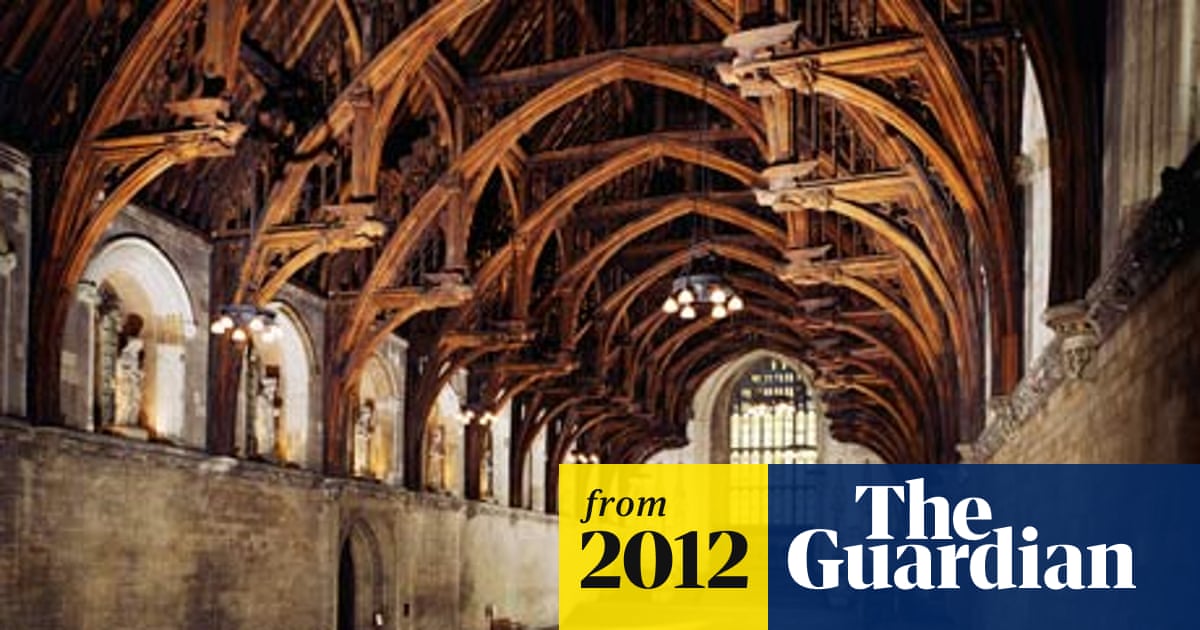
Structural pathology reports from the early 20th century revealed a threat far more insidious than the 1834 fire: the death watch beetle (Xestobium rufovillosum). A 1913 inspection by the Office of Works found the magnificent hammer-beam roof, commissioned by Richard II in 1393, in a state of near-collapse. The larvae of the beetle had eaten through the oak timbers to such an extent that cavities existed large enough to conceal a full-grown man. Between 1914 and 1923, Sir Frank Baines led a restoration project that inserted concealed steel plates and girders into the roof structure, transferring the load from the rotted oak to the steel skeleton. This intervention saved the roof, yet the beetle remains a persistent biological threat. As of 2026, the Parliamentary Estate continues to monitor the timber for acoustic signs of beetle activity, the characteristic tapping sound made during mating season, and humidity levels that encourage fungal decay.
The Hall faced destruction again on the night of May 10, 1941, during the London Blitz. Incendiary bombs struck the Palace, setting fire to both the House of Commons chamber and the roof of Westminster Hall. Walter Elliot, a former cabinet minister present at the scene, was informed by the fire service that water pressure was insufficient to save both structures. Elliot ordered the hoses to be directed at the Hall, sacrificing the Victorian Commons chamber to the flames. This decision preserved the medieval roof, although the lantern and parts of the trusses sustained damage that required post-war repair.
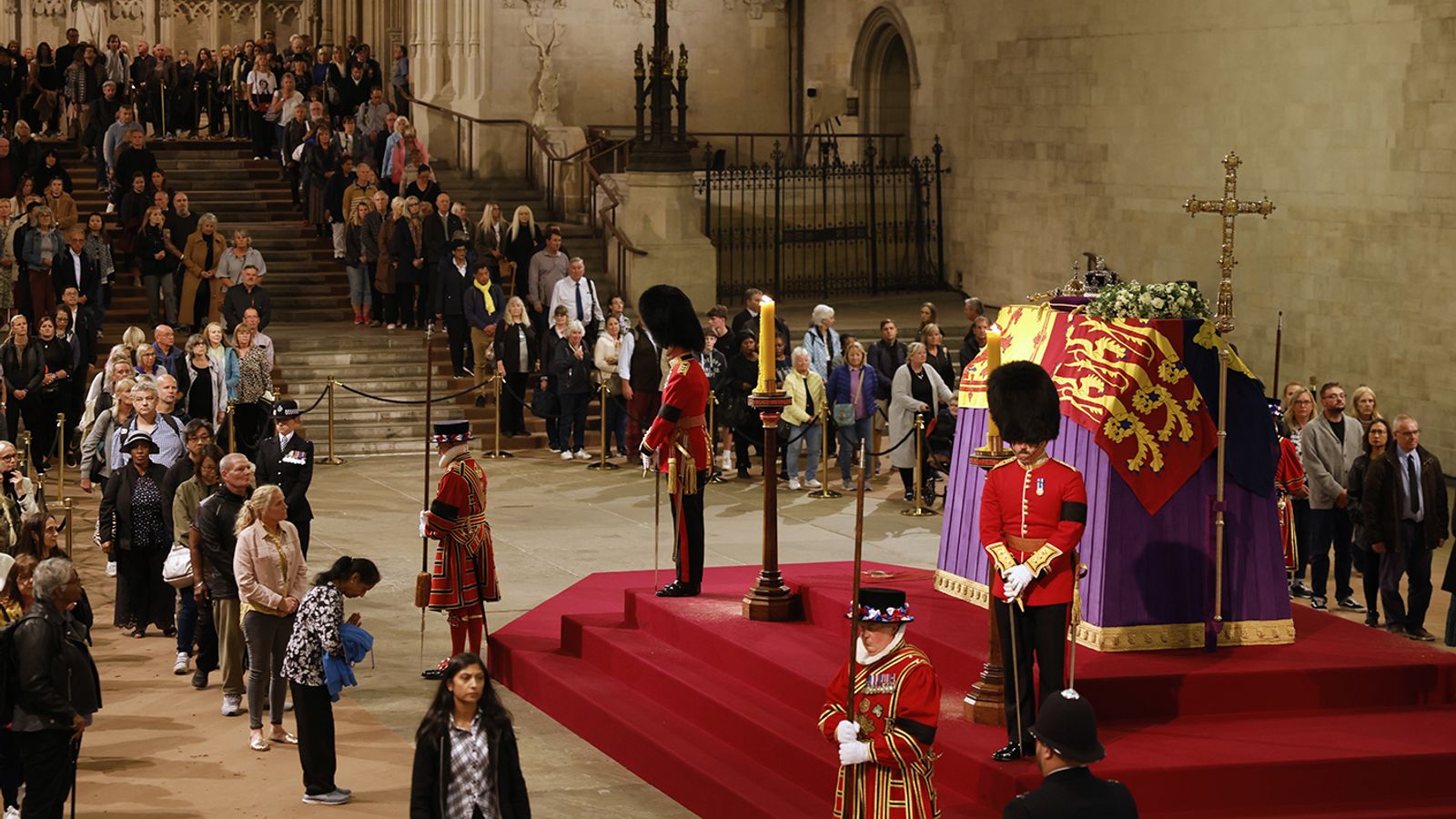
, the Hall serves as the primary venue for the lying-in-state of monarchs and prime ministers, a function that demands rigorous crowd control and security logistics. The lying-in-state of Queen Elizabeth II in September 2022 generated foot traffic. Official government data recorded approximately 250, 000 visitors filing past the coffin over a four-day period. The queue stretched for miles along the Thames, with wait times peaking at 25 hours. This mass movement of people imposed significant humidity and temperature fluctuations on the ancient fabric of the building, necessitating real-time environmental monitoring to prevent condensation on the cold stone walls and timber roof.
The following table summarizes key judicial and state events held in Westminster Hall during the primary window of its legal dominance:
| Year(s) | Event / Trial | Defendant / Subject | Outcome / Notes |
|---|---|---|---|
| 1716 | Trial of the Jacobite Lords | Earl of Derwentwater et al. | Derwentwater and Kenmure beheaded; Nithsdale escaped from the Tower. |
| 1746 | Trial of the Rebel Lords | Kilmarnock, Balmerino, Cromartie | Kilmarnock and Balmerino executed; Cromartie pardoned. Axe blade turned to signal guilt. |
| 1760 | Trial of Earl Ferrers | Lawrence Shirley, 4th Earl Ferrers | Convicted of murder; last peer to be hanged (at Tyburn). |
| 1776 | Trial of the Duchess of Kingston | Elizabeth Chudleigh | Convicted of bigamy; pleaded privilege of peerage to avoid branding. |
| 1788, 1795 | Impeachment of Warren Hastings | Warren Hastings | Acquitted after 7 years. Longest trial in the Hall's history. |
| 1806 | Impeachment of Lord Melville | Henry Dundas, 1st Viscount Melville | Acquitted. The last impeachment trial held in Westminster Hall. |
| 1882 | Judicial Exodus | All High Courts | Courts moved to the Strand; internal partitions demolished. |
As of 2026, Westminster Hall stands as the oldest building on the Parliamentary estate, yet it is structurally distinct from the Victorian New Palace. It is currently subject to the wider Restoration and Renewal (R&R) programme, which aims to address the mechanical and electrical obsolescence of the complex. While the Hall itself is not the primary focus of the R&R's decant strategy (which focuses on the Commons and Lords chambers), the conservation of its Reigate stone walls and the steel-reinforced oak roof remains a permanent, high-priority maintenance operation. The absence of the shops and courts that once cluttered its floor has left it a vast, empty vessel, filled only by the weight of its own survival.
The 1834 Inferno: Tally Stick Negligence and the Destruction of the Old Palace

The destruction of the Palace of Westminster on October 16, 1834, stands as the definitive case study in bureaucratic negligence. The catastrophe did not from foreign sabotage or a complex structural failure. It originated from a decision so banal it defies belief: the disposal of two cartloads of wooden tally sticks. These hazel and willow rods, notched to record payments to the Exchequer, represented a medieval accounting system that had been obsolete since 1826. For eight years, the sticks accumulated in the damp recesses of the Star Chamber, gathering dust and awaiting a final administrative judgment. When the order came to clear the backlog, the method chosen was not a controlled bonfire in the open air, a rapid incineration within the building itself.
Richard Weobley, the Clerk of Works, directed two Irish laborers, Joshua Cross and Patrick Furlong, to burn the sticks in the two furnaces beneath the House of Lords. These furnaces were designed to burn coal, which generates intense heat with a low flame. They were wholly unsuited for dry, seasoned wood, which burns with a ferocious, high-reaching blaze. Weobley's primary concern was not safety public nuisance; he feared a yard fire would alarm the neighbors. Consequently, he ordered the men to feed the furnaces indoors. Cross and Furlong, paid by the job rather than the hour, worked with fatal efficiency. They shoved the sticks into the stoves at a relentless pace, filling the basement with a roar of heat that the copper-lined flues could not contain.
By the afternoon of October 16, the warning signs were physical and undeniable. Mrs. Wright, the Deputy Housekeeper, conducted a tour for visitors, including an ironmonger named John Snell. As they walked through the House of Lords, the heat radiating through the stone floor was so intense it could be felt through the soles of their boots. Smoke had already begun to seep through the floorboards, filling the chamber with a haze that obscured the tapestries. When Mrs. Wright expressed her alarm to the workmen, they dismissed her concerns, insisting they were following orders to finish the job. Weobley, who checked on the progress earlier in the day, had reportedly seen the furnace doors open and the flames raging, yet he took no action to halt the process. The copper lining of the flues, subjected to temperatures far beyond its melting point, liquefied. The molten metal dripped away, exposing the dry, structural timbers of the floor above to the naked fire.
At 6: 00 PM, the inevitable flashover occurred. The flames burst through the floor of the House of Lords, igniting the panelling and the ancient tapestries that hung from the walls. Within minutes, the fire found the ventilation shafts and surged upward, turning the House of Lords into a blast furnace. The blaze was visible from Windsor Castle, twenty miles away. In London, the sky turned a violent orange, drawing hundreds of thousands of spectators to the banks of the Thames and the, where they watched the seat of their government disintegrate. The artist J. M. W. Turner witnessed the event, capturing the terrifying beauty of the flames in sketches that would later become his famous oil paintings. The crowd, rather than mourning, watched in a stupor of awe and, in quarters, raucous entertainment.
The losses were total for the legislative chambers. The House of Lords was obliterated. The House of Commons, which sat in the medieval St Stephen's Chapel, was reduced to a shell. The intense heat pulverized the stone tracery and melted the stained glass. Perhaps the most significant artistic loss was the Painted Chamber, a 13th-century apartment of Henry III, adorned with vivid wall paintings that had been rediscovered only behind of whitewash. The famous Armada Tapestries, commissioned to celebrate the defeat of the Spanish fleet in 1588, were consumed before a single section could be cut down. The library of the House of Commons, along with centuries of procedural records, into ash.
| Structure/Item | Status | Notes |
|---|---|---|
| St Stephen's Chapel (Commons) | Destroyed | Medieval structure gutted; roof collapsed. |
| House of Lords Chamber | Destroyed | Site of ignition; total structural failure. |
| The Painted Chamber | Destroyed | 13th-century wall paintings lost forever. |
| Armada Tapestries | Destroyed | Priceless Elizabethan textiles incinerated. |
| Westminster Hall | Saved | Rescued by wind shift and floating fire engines. |
| Jewel Tower | Saved | Protected by moat and wind direction. |
| Exchequer Tally Sticks | Consumed | The fuel that caused the disaster. |
Westminster Hall, the grandest survival of the medieval palace, was saved only through the heroic improvisation of James Braidwood, the Superintendent of the London Fire Engine Establishment. Braidwood mobilized the floating fire engines on the Thames, directing massive jets of water over the roof of the Hall. He ordered his men to cut away the connecting roof timbers that linked the Hall to the burning Speaker's House, creating a firebreak that barely held. The Prime Minister, Lord Melbourne, fought through the crowds to direct the salvage of documents, while the Chancellor of the Exchequer was reported to have shouted, "Damn the House of Commons, let it blaze away! Save, O save, the Hall!" The wind, which had driven the flames toward the Lords and Commons, mercifully kept the fire from leaping to the Hall's massive hammer-beam roof.
The aftermath brought a scathing indictment from Charles Dickens, who used the disaster as a bludgeon against the administrative incompetence of the British government. In a speech to the Administrative Reform Association in 1855, Dickens mocked the "savage obstinacy" of the official mind. He described how the sticks, which could have been given to the poor for firewood, were instead hoarded and then burned with such reckless stupidity that they destroyed the very palace they were meant to serve. "The stove, overgorged with these preposterous sticks, set fire to the panelling; the panelling set fire to the House of Lords; the House of Lords set fire to the House of Commons; the two houses were reduced to ashes," Dickens declared. For him, the fire was not an accident; it was the inevitable combustion of a system choked by its own red tape.
As of 2026, the lessons of 1834 remain unlearned. The Palace of Westminster, a UNESCO World Heritage site, faces a new existential threat from the exact same combination of institutional inertia and antiquated infrastructure. A report from the Restoration and Renewal Client Board in February 2026 revealed that 36 fire incidents had occurred within the estate since 2016. The electrical systems are decaying, the steam heating pipes are failing, and asbestos is present in over 2, 500 locations. The cost to repair the building has ballooned to estimates ranging from £16 billion to £40 billion, depending on whether Members of Parliament agree to vacate the premises. Just as Weobley feared upsetting the neighbors in 1834, modern politicians fear the optical backlash of spending billions on their own workplace. The "catastrophic failure" predicted by engineers in the 2020s mirrors the warnings ignored by the Clerk of Works two centuries prior. The tally sticks are gone, the negligence remains.
Construction Economics: Budget Inflation in the Barry-Pugin Era (1840, 1870)
The financial history of the New Palace of Westminster is a case study in optimism bias, bureaucratic deception, and the catastrophic underestimation of technical complexity. Following the 1834 fire, the Royal Commission solicited designs with a implicit mandate for economy, leading Charles Barry to submit an initial estimate of £707, 104 in 1837. This figure was a fiction from the moment the ink dried. By the time the structure was substantially complete in 1870, the actual cost had swelled to over £2. 5 million, roughly £300 million in 2026 currency, representing a budget overrun of nearly 300%. This fiscal bleeding was not the result of inflation, of a fundamental failure to define the scope of the "fittings" and the disastrous integration of experimental technology.
The primary engine of this variance was the conflict between the architect, Charles Barry, and the "Ventilator-in-Chief," Dr. David Boswell Reid. Appointed in 1840, Reid demanded that the entire building function as a single respiratory machine, a requirement that forced Barry to redesign the structural core of the palace. The Central Tower, frequently mistaken by tourists for a purely decorative Gothic spire, was in reality a massive, unplanned ventilation chimney added at Reid's insistence to draw "vitiated air" out of the chambers. This single addition, along with the labyrinth of air flues and smoke shafts that honeycombed the walls, added hundreds of thousands of pounds to the ledger. The friction between Barry's aesthetic vision and Reid's scientific demands resulted in years of delays, with the Treasury frequently intervening to mediate a dispute that left the building's basement a chaotic web of ducts and valves.
Simultaneously, the project suffered from one of the most expensive material failures in British construction history. In 1839, a committee comprising Barry and geologists Henry De la Beche and William Smith selected Anston limestone for the exterior, prioritizing its cheap quarrying costs and ease of carving over its durability in an urban environment. The committee failed to account for the sulfurous coal smoke of Victorian London. By 1849, before the building was even finished, the stone showed signs of rapid decay. The magnesium limestone reacted with atmospheric pollution to blister and crumble, necessitating a continuous, century-long repair program that meant the Palace was under construction and reconstruction simultaneously. The decision to use Anston stone created a perpetual liability, the costs of which are still being paid by the taxpayer in the 2020s.
The interior budget collapsed under the weight of Augustus Pugin's obsessive detail. While the Treasury attempted to control costs by separating the building's "carcass" from its "furniture," Pugin and Barry viewed the two as inseparable. Pugin designed thousands of distinct items, from the encaustic Minton tiles underfoot to the Hardman brass chandeliers overhead. This was not simple procurement; it was the creation of a bespoke industrial arts sector. There were no economies of because every doorknob, inkwell, and umbrella stand was unique to its location. The sheer volume of labor required to execute these designs triggered the 1841 stonemasons' strike, where workers employed by the contractors Grissell and Peto walked off the job, further stalling progress and inflating labor costs.
| Era | Project Phase | Initial Estimate | Revised / Final Cost | Primary Driver of Variance |
|---|---|---|---|---|
| 1837, 1870 | Barry's New Palace | £707, 104 | £2, 500, 000+ | Ventilation systems, decorative scope, stone failure. |
| 2020, 2026 | Restoration & Renewal (R&R) | £4, 000, 000, 000 | £14, 000, 000, 000+ | Asbestos removal, mechanical replacement, decant logistics. |
The parallels between the 1840s construction emergency and the 2026 Restoration and Renewal (R&R) Programme are exact and damning. Just as the 1835 Commission underestimated the complexity of Reid's ventilation system, the 2020s R&R bodies consistently undervalued the difficulty of replacing those same systems, which are with asbestos and decay. In February 2026, the Client Board for the R&R Programme requested approval for a £3 billion "Phase One" budget to stabilize the structure and prepare for main works, a figure that dwarfs the entire inflation-adjusted cost of the original Victorian construction. The total projected cost, estimated between £14 billion and £22 billion depending on the "decant" strategy, reflects the same refusal to confront technical reality that plagued Barry. The "optimism bias" of 1837 has mutated into the "strategic misrepresentation" of the 2020s, where initial lowball estimates are used to secure approval for projects that inevitably spiral into multi-decade financial commitments.
By the time the Victoria Tower was completed in 1860, the Palace of Westminster had become a cautionary tale in public works management. The death of Pugin in 1852, exhausted and insane, and Barry in 1860, arguably worked to death by the stress of the project, marked the human cost of the endeavor. The Treasury's attempt to manage the project through committee meetings rather than a single executive authority resulted in a building that was magnificent in appearance yet functionally compromised from the day it opened. The legacy of the Barry-Pugin era is not just the Gothic silhouette on the Thames, a structural deficit in the building's very bones, a financial and mechanical debt that the 2026 taxpayer is being asked to settle.
Victorian Engineering: Ventilation Failures and the Thames Sewage Crisis

The emergency reached its zenith in the summer of 1858, an event historiography remembers as the Great Stink. A relentless heatwave in June and July caused the Thames, an open sewer receiving the waste of two million Londoners, to ferment. The bacterial decomposition of human excrement, slaughterhouse offal, and industrial runoff released a cloud of hydrogen sulfide and methane that enveloped the Palace. The stench was not unpleasant; it was physically debilitating. The "miasma" theory of disease, still prevalent among the medical establishment, led MPs to believe they were inhaling cholera and typhoid with every breath.
Parliamentary records from June 1858 describe a scene of panic. In the committee rooms overlooking the river, the atmosphere became so noxious that proceedings were abandoned. Staff soaked heavy curtains in chloride of lime, a bleaching powder used to disinfect cesspits, and hung them over the windows. This desperate measure failed. The chemical fumes of the chloride mixed with the sulfurous rot from the river to create a suffocating gas that drove Benjamin Disraeli, then Chancellor of the Exchequer, from a committee room with a handkerchief pressed to his face. The Prime Minister, Lord Derby, famously attempted to ignore the smell was forced to flee the library.
The engineering failure of the Palace ventilation system transformed a municipal neglect problem into a national emergency. Because Reid's intake shafts were designed to pull air from the river level, the building acted as a pump, concentrating the stench within the debating chambers. The very meant to purify the air was poisoning the government. This direct assault on the olfactory senses of the ruling class achieved what decades of cholera deaths in the slums had not: immediate legislative action. On July 15, 1858, Disraeli introduced a bill to cleanse the Thames. It passed into law in just 18 days, a speed previously unknown in the slow-moving Westminster system.
| Year | Event | Impact on Palace |
|---|---|---|
| 1840 | Dr. Reid appointed as "Ventilator" | Design of the Central Tower as a smoke extraction chimney begins. |
| 1852 | Reid dismissed | System remains half-finished; Barry splits the ventilation into separate zones. |
| 1858 | The Great Stink | Chloride of lime used on curtains; Parliament nearly abandons Westminster. |
| 1864 | Embankment construction begins | Bazalgette's project physically separates the Palace from the river. |
| 1870 | Victoria Embankment opens | Interceptor sewers divert waste; the "miasma" recedes. |
| 2026 | R&R Costed Proposals | Reid's ventilation voids identified as primary fire spread risks. |
The solution to the Great Stink came from Sir Joseph Bazalgette, the chief engineer of the Metropolitan Board of Works. His plan involved the construction of the Victoria Embankment, a massive civil engineering project that reclaimed 37 acres of land from the river, including the foreshore directly in front of the Palace of Westminster. Bazalgette built huge interceptor sewers within the Embankment to capture the waste before it reached the Thames, diverting it miles downstream to treatment plants at Beckton and Crossness. By 1870, the Embankment had physically pushed the river back, creating a concrete buffer between the Parliament and the water that had once threatened to asphyxiate it.
Yet the legacy of Reid's failed ventilation system haunts the Palace to this day. The thousands of vertical shafts, horizontal ducts, and floor voids he forced into the building's fabric remain. In 2026, these spaces are no longer used for air circulation have become crowded service corridors packed with high-voltage cables, steam pipes, and data lines. The "chimney" effect that Reid designed to draw smoke out presents a catastrophic fire risk. In the event of a blaze, these unstopped voids would act as superhighways for flame and smoke, bypassing modern containment measures. The Restoration and Renewal (R&R) Programme, which published its costed proposals in early 2026, identified these Victorian ducts as the single greatest threat to the building's survival.
Surveyors working on the R&R project in the 2020s discovered that of Reid's shafts were lined with asbestos, used in later years for insulation. The cost of stripping this toxic material from the labyrinthine depths of the Central Tower contributes significantly to the multi-billion pound restoration estimate. The irony is sharp: the system built to ensure the health of Victorian MPs has become a carcinogenic fire hazard that threatens to bankrupt the Parliamentary estate. The Central Tower, still standing 91 meters tall, remains a hollow monument to a scientific theory that failed, acting as a silent funnel for a ventilation system that never truly worked.
The "Ventilation Guys", the 19th-century staff employed solely to open and close Reid's canvas valves, are long gone, replaced by automated building management systems that struggle to regulate the temperature in a stone structure designed for coal fires. The chloride of lime that once soaked the curtains has been scrubbed away, yet the chemical damage to the limestone window frames remains visible to forensic conservationists. The Great Stink proved that the Palace of Westminster could not exist in isolation from the city it governed; the very air inside the chamber was dependent on the sanitation of the streets outside.
World War II Damage: Ballistic Impact Analysis on the Commons Chamber (1941)
The destruction of the House of Commons on the night of May 10, 1941, was not a random casualty of area bombing the result of a specific ballistic interaction between German ordnance and Victorian structural engineering. The Luftwaffe raid, comprising 505 bombers, dropped over 700 tons of high explosives and 86, 000 incendiaries across London. Among these was the B1E1 Elektron incendiary bomb, a 1-kilogram cylinder of magnesium alloy filled with thermite. These munitions were not designed to pulverize masonry upon impact to penetrate slate and lead roofing before lodging in the timber sub-structures. Their ballistic coefficient allowed them to punch through the outer shell of the Palace of Westminster, coming to rest in the dry, resinous voids of the roof space.
Upon ignition, the thermite core of the B1E1 burned at approximately 2, 500 degrees Celsius, a temperature sufficient to melt steel and liquefy the magnesium casing itself, which then burned fiercely at around 1, 300 degrees Celsius. In the Commons Chamber, these devices bypassed the external stone defenses and ignited the wooden rafters. The architectural design of the Chamber, specifically the complex ventilation shafts intended to circulate fresh air, acted as a forced-induction system for the fire. These vertical voids functioned as chimneys, drawing oxygen into the heart of the blaze and accelerating the combustion of the dry oak paneling and the intricate Pugin interior. The fire did not consume the room; it was supercharged by the building's own lungs.
By midnight, the situation had devolved into a binary tactical choice. Water pressure was failing across the district as mains were shattered by high-explosive impacts. The fire brigade, commanded on the ground by desperate officials including MP Walter Elliot, faced two simultaneous infernos: the Victorian Commons Chamber and the medieval Westminster Hall. The Hall's 14th-century hammer-beam roof, a masterpiece of Richard II's reign, was also alight. With insufficient water to suppress both conflagrations, Elliot made the cold calculation to sacrifice the legislative chamber to save the irreplaceable medieval structure. He reportedly used an axe to smash through the locked doors of Westminster Hall, directing the last reliable hose streams onto the ancient timbers.
The result of this decision was the total structural failure of the Commons Chamber. The intense heat weakened the steel and iron ties holding the roof, causing the entire ceiling assembly to collapse into the chamber. The debris field consisted of twisted girders and pulverized masonry, burying the Speaker's Chair and the government benches under tons of smoking rubble. The "Churchill Arch," the stone doorway leading into the chamber, survived the collapse, though it was scarred and chipped, a jagged monument to the violence of the night. Three people within the Palace precinct, including two policemen and the Resident Superintendent, were killed during the raid.
The following morning revealed a smoking shell where the center of British parliamentary democracy had stood. The ballistic success of the B1E1 bombs was absolute; they had exploited the material vulnerabilities of the 1850s construction with devastating efficiency. The decision to abandon the Chamber, while painful, preserved the physical continuity of the State by saving the Hall, yet it necessitated a complete reconstruction of the Commons. This event forced the Parliament to function in temporary quarters for nearly a decade, a physical displacement that ended only with the opening of the new Chamber in 1950, designed by Sir Giles Gilbert Scott to replicate the adversarial dimensions of the lost original.
Asbestos and Toxic Materials: Health Hazards in the Post-War Building Fabric
| Hazard Type | Recorded Incidents/Prevalence | Primary Location | Health Risk |
|---|---|---|---|
| Asbestos (Amosite/Crocidolite) | 1, 057 confirmed locations; ~2, 500 estimated total | Steam pipes, wall cavities, 1950s Chamber voids | Mesothelioma, Asbestosis, Lung Cancer |
| Lead Contamination | 14 miles of piping; widespread paint | Roofing, water supply lines, window frames | Neurological damage, hypertension |
| Falling Masonry | 19 major falls (2016, 2026); 8 in 2023/24 | External facades, internal courtyards | Physical trauma, silica dust inhalation |
| Vermin Biomatter | 661 rodent sightings (2019 peak); constant presence | Ventilation shafts, catering areas, basements | Hantavirus, Salmonella, allergic reactions |
The intersection of fire safety and toxic containment creates a deadly stalemate. The Palace has suffered 44 fires in the decade leading up to 2026. Upgrading the fire suppression systems requires drilling through walls and ceilings, an action that inevitably disturbs asbestos. Consequently, essential fire safety works are frequently delayed or cancelled to avoid contaminating the air. This "Catch-22" leaves the building to a catastrophic inferno similar to the Notre Dame fire, a comparison explicitly made by the Public Accounts Committee. The electrical wiring, much of it sheathed in decaying rubber and fabric from the 1940s, runs through these same asbestos-choked ducts. To replace the wire, one must remove the asbestos; to remove the asbestos, one must close the building. By February 2026, the cost of this paralysis had reached levels. Taxpayers were funding a "patch and mend" operation costing £2. 5 million per week to keep the building operational. This expenditure does not improve the structure simply addresses emergency failures, burst pipes, shorting wires, and crumbling stone. The Restoration and Renewal Client Board presented options ranging from a "full decant" (moving MPs out for 19-24 years) to a "continued presence" (working around them). The latter option, while politically palatable to MPs who refuse to leave, extends the timeline to nearly 76 years and balloons the cost to over £22 billion. The refusal to vacate the Palace has turned the seat of British democracy into a biohazard zone. Maintenance crews operate under conditions that would be illegal in the private sector, donning hazmat suits to change lightbulbs in certain corridors. The building fabric itself has become a weapon against its occupants. The 1950 reconstruction, intended to secure the future of the Commons, has instead encased it in a toxic sarcophagus, ensuring that the primary threat to the institution is not external attack, the very air and water within its walls.
Fire Safety Deficiencies: Electrical Decay and Patrol Metrics (2015, 2026)
By early 2026, the Palace of Westminster had ceased to function as a modern building and had become a regulated ruin, kept operational only through a desperate and expensive regimen of human surveillance and temporary patching. The fire safety data for the period 2015, 2026 reveals a structure in a state of advanced widespread failure, where the probability of a catastrophic event, frequently compared by safety officials to the 2019 Notre Dame blaze, remained at the highest possible designation: "Red Risk." Between 2016 and the start of 2026, the Parliamentary estate recorded 44 separate fire incidents, with four occurring in 2024 alone. These were not drill alarms actual ignitions, ranging from smoldering fuse boxes to overheating mechanical equipment, each suppressed before it could consume the dry, Victorian timber frame that lies behind the stone cladding.
The primary driver of this fire risk is the building's electrical infrastructure, a chaotic nervous system of 400 kilometers of cabling that has not seen a detailed update since the post-World War II reconstruction of the 1940s and 1950s. In a modern office, electrical cabling is segregated from water and heating systems. In the Palace of Westminster, high-voltage lines share cramped, unventilated voids with steam pipes and sewage mains. The insulation on these cables, much of it vulcanized India rubber or lead-sheathed copper from the mid-20th century, has become brittle and friable. When these cables crack, they expose live wires to the humid, dust-laden air of the service shafts. The risk is compounded by the building's heating system, which relies on high-pressure steam. A single burst pipe, a frequent occurrence in the aging network, can inject superheated moisture into electrical voids, creating an immediate arc-flash hazard.
Repairing this electrical decay is rendered nearly impossible by the omnipresence of asbestos. The 20th-century repairs that installed the current wiring also coated the service shafts in asbestos lagging, a common fire retardant of the era. Today, this material acts as a toxic barrier to maintenance. Electricians cannot simply pull out old wires and run new ones; any disturbance of the cabling releases carcinogenic fibers. As of 2025, safety surveys identified over 2, 500 distinct locations containing asbestos within the Palace. More disturbingly, over 1, 000 "asbestos incidents", where the material was found to be damaged or accidentally disturbed, were documented between 2016 and 2026. This creates a deadly paralysis: the wiring is a fire hazard that must be replaced, the act of replacing it requires a level of asbestos abatement that cannot be performed while the building is occupied.
In the absence of a structural solution, the Parliamentary authorities turned to a labor-intensive mitigation strategy known as the "Waking Watch." Recognizing that the automated fire detection systems were unreliable and that the voids absence modern fire suppression (such as sprinklers, which are difficult to install around asbestos and water-sensitive art), the estate deployed teams of fire safety officers to patrol the building 24 hours a day, 365 days a year. These officers walk the miles of corridors, basements, and roof spaces, using their eyes and noses to detect the early signs of combustion. This human firewall is an admission of technological defeat. By 2024, the cost of these patrols, combined with the "patch and mend" maintenance required to keep the building standing, had reached approximately £2 million per week. This expenditure does not improve the building; it buys time, preventing the inevitable collapse or conflagration for another seven days.
The operational reality of these patrols is grim. Officers navigate a labyrinth of basements that stretch the length of the building, frequently crawling through spaces where the temperature exceeds 30°C due to leaking steam pipes. They inspect the "intestines" of the Palace, where the accumulation of dust, rodent nests, and decaying insulation creates the perfect fuel load for a fire. The rodent infestation is not a trivial matter of hygiene a direct fire safety threat; mice and rats frequently chew through cable insulation to sharpen their teeth. In the 12 months leading up to January 2024, pest control teams conducted 348 separate investigations into rodent activity, yet the populations remain entrenched in the voids where the patrols cannot easily reach.
The severity of the situation was laid bare in a series of reports and warnings that grew increasingly urgent as the decade progressed. In 2017, David Leakey, the outgoing Black Rod, warned that a "Grenfell-style" disaster was a statistical likelihood if action was not taken. His warning was corroborated by a 2016 Joint Committee report which described the building as a "death trap." Yet, political indecision stalled any major intervention. By February 2026, the Restoration and Renewal Client Board presented yet another set of options, estimating that a full restoration would cost up to £15. 6 billion and take nearly two decades, even if the building were fully vacated. The alternative, trying to fix the building while MPs remained in situ, was projected to take up to 76 years and cost significantly more, a timeline that guarantees a major fire would occur before the work was finished.
The following table summarizes the key metrics of decay and risk management observed between 2016 and 2026, illustrating the of the latent threat:
| Metric | Data Point (2016, 2026) |
| Total Fire Incidents | 44 confirmed ignitions |
| Asbestos Incidents | >1, 000 documented exposures/disturbances |
| Asbestos Locations | ~2, 500 identified sites |
| Weekly Maintenance Cost | ~£2, 000, 000 (2024, 2025 average) |
| Rodent Investigations | 348 (Jan 2023 , Jan 2024) |
| Length of Cabling | ~400 kilometers (majority pre-1960) |
| Risk Designation | Red Risk (Catastrophic Failure Likely) |
The historical parallel to this modern negligence is the fire of 1834. That conflagration was caused by the careless burning of wooden tally sticks in the basement furnaces, a disposal method that ignored the capacity of the flues. The fire of 2026, should it occur, not be caused by a single act of carelessness, by a decade of calculated inaction. The 1834 fire destroyed the medieval palace because the accumulation of fuel (tally sticks) met an ignition source. The modern Palace has replicated these conditions: the "tally sticks" are the miles of vulcanized rubber cabling and dry dust in the voids, and the ignition source is the inevitable failure of a 70-year-old electrical system pushed beyond its limit. The Waking Watch represents the only difference between the 19th and 21st centuries, a human attempt to intervene in a chemical process that physics dictates is overdue.
As of early 2026, the debate over "decant" (moving MPs out) versus "continued presence" remains the central obstacle. While the Restoration and Renewal Client Board publishes reports detailing the "eye-watering" costs of repair, the physical fabric of the building continues to degrade. The 36 fire incidents recorded between 2016 and early 2026 are not anomalies; they are warnings. Each one was a chance terminal event for the Palace. The reliance on luck, combined with the bravery of the patrol officers, has thus far prevented a total loss, the metrics indicate that the building is operating on borrowed time. The intersection of asbestos contamination, electrical obsolescence, and steam heating creates a "deadly embrace" where no single system can be fixed without triggering a emergency in another, leaving the Palace of Westminster in a state of permanent, managed emergency.
Structural Integrity Reports: River Wall Subsidence and Masonry Failure Incidents
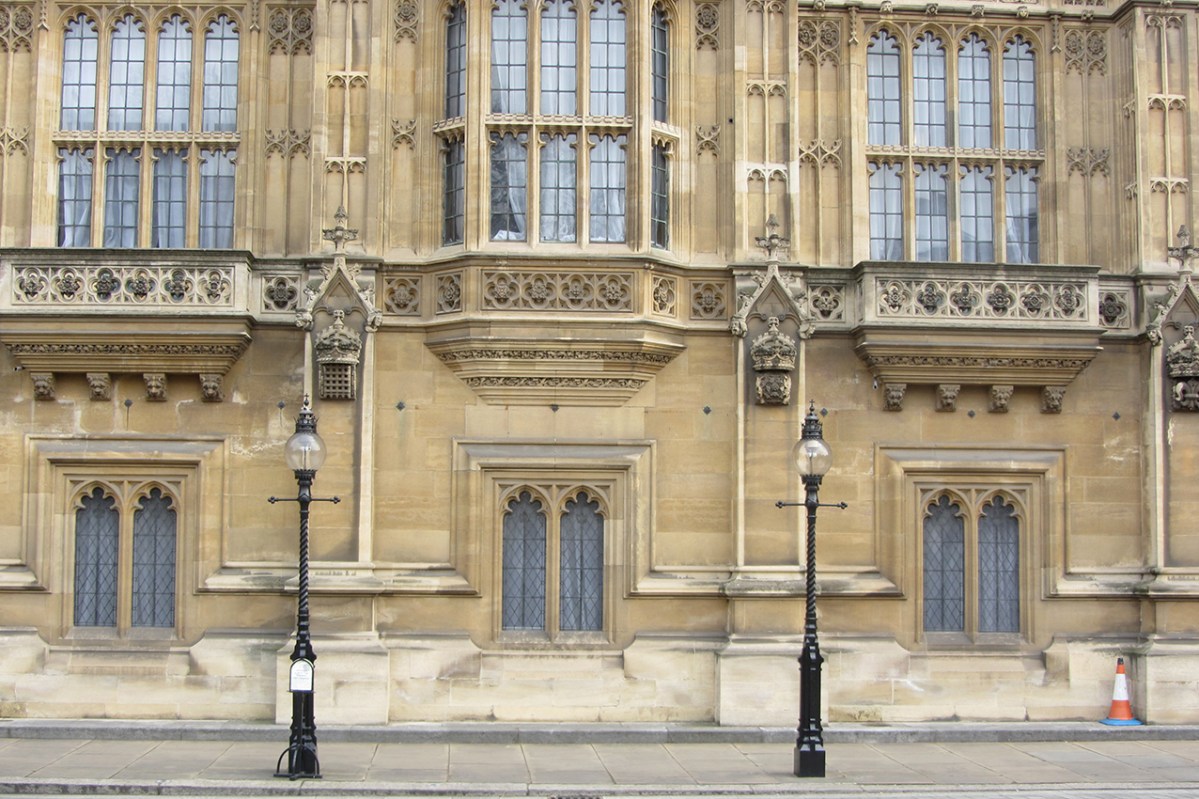
The structural narrative of the Palace of Westminster is one of immediate and persistent decay, beginning not in the 21st century, before the final stones were even laid in the 19th. The 1839 decision by Charles Barry's selection committee to use Anston limestone stands as a catastrophic engineering error that continues to public funds. Chosen for its warm, honey-coloured hue and ease of carving, the magnesium limestone from South Yorkshire proved chemically incompatible with the sulfur-rich coal smog of Victorian London. By 1849, mere years after installation, the stone began to blister and flake. An 1861 government inquiry found that the quarrying process had been "slovenly," with blocks laid against their natural bedding, accelerating exfoliation. The facade was not just dirty; it was dissolving.
This geological failure necessitated a permanent state of emergency repair that through the 20th century. In 1920, a massive fragment of masonry detached from the Victoria Tower, crashing onto the terrace. This incident forced the Office of Works to advise Members of Parliament to sit near the river's edge, away from the looming threat of the main wall. Between 1928 and 1960, restoration teams replaced the rotten Anston with Clipsham stone, creating a patchwork quilt of materials with different densities and weathering rates. This remedial work was frequently interrupted by World War II bomb damage, which masked underlying structural shifts and allowed water ingress to rot the iron cramps holding the masonry together.
The River Wall itself presents a distinct, subterranean threat. Constructed on land reclaimed from the Thames to expand the Palace footprint, the terrace acts as a facade for a complex, hollowed-out infrastructure. It conceals the 1888 Shone Ejector sewage system, a network of cast-iron pipes and compressed air method that fight to expel waste into the London sewer network. These Victorian ejectors are mechanically obsolete and prone to failure. A 2016 structural survey indicated that the river wall faces "scour" from the Thames, undermining the reclaimed foundations. The discovery of a medieval river wall in 2015 and again in 2022 via deep borehole investigations confirmed that the modern palace sits on a stratified, unstable geological where ancient timber revetments mix with Victorian concrete and 21st-century grouting.
, the rate of masonry failure has accelerated from a maintenance concern to a lethal hazard. On a quiet day in 2018, a fist-sized chunk of a stone angel broke loose from the Victoria Tower. It fell hundreds of feet, impacting the ground near the Peers' Entrance with the force of a gunshot. Had the area been populated, the impact would have been fatal. This near-miss was not an event; official logs record 19 separate stonemasonry incidents between 2016 and 2026. The risk is no longer theoretical. In response, authorities have erected unsightly crash decks and scaffolding tunnels at key entrances, admitting that the building's skin is no longer secure.
The internal structural integrity is equally compromised by the labyrinth of ventilation shafts and service voids. The Great Fire of 1834 was exacerbated by these very chimneys, and the current palace reproduces this vulnerability. A 2023 investigation revealed that the basement contains over 1, 000 known locations of asbestos, frequently lining the same ducts carrying high-pressure steam pipes and high-voltage cabling. A burst steam pipe in these confined spaces would not only strip the asbestos insulation, sending carcinogenic fibers through the ventilation system, could trigger a "cascade failure" of the electrical and data systems that run the UK government.
By February 2026, the Restoration and Renewal Client Board released a report painting a bleak picture of the estate's viability. The cost of "patch and mend", simply keeping the building standing without fixing the underlying structural rot, had risen to £1. 5 million per week. The report outlined that a "Full Decant," moving all MPs out to allow for total structural remediation, would cost £15. 6 billion and take up to 24 years. yet, the alternative "Continued Presence" option, attempting to fix the subsidence and masonry while Parliament sits, was projected to cost nearly £40 billion and drag on for 61 years. This paralysis has left the Palace in a state of managed disintegration, where fire wardens patrol 24/7 to compensate for the absence of modern fire suppression in the structural voids.
| Year | Location | Incident Details | Immediate Response |
|---|---|---|---|
| 1920 | Victoria Tower | Large stone fragment detached and fell onto the Terrace. | MPs advised to sit away from the building wall; Clipsham stone replacement program initiated. |
| 1974 | Central Lobby | Bomb damage (IRA) exposed structural voids. | Emergency shoring; fire safety gaps revealed not fully addressed. |
| 2018 | Peers' Entrance | Stone angel fragment fell, impacting ground with lethal force. | Installation of protective crash decks; urgent masonry survey ordered. |
| 2021 | House of Lords | Heating system failure and sewage ingress in basement. | Temporary patching of 1888 ejector system; localized closures. |
| 2024 | Estate-wide | Report confirms 19 masonry falls since 2016. | Expansion of scaffolding; weekly maintenance costs hit £1. 5m. |
| 2026 | Client Board Report | Declared "substantial risk of catastrophic failure." | Proposal for £40bn / 61-year timeline if occupation continues. |
The 2026 data confirms that the Palace of Westminster is structurally insolvent. The limestone is chemically expiring, the reclaimed foundations are scouring, and the mechanical arteries are sclerotic. Without the total evacuation and gutting proposed by the most aggressive restoration options, the building faces a probability of structural failure that rises with every passing parliamentary session.
Environmental Health: Rodent Infestation Densities and Waste Management Systems
The environmental history of the Palace of Westminster is a chronicle of public health crises masked by Gothic grandeur. Since the 18th century, the seat of the British government has fought a losing war against the biological realities of its location and the waste produced by its occupants. In the 1700s, the palace sat atop a network of cesspits that frequently overflowed into the cellars, while the River Thames served as both the primary sewer and the main water source for the city. This proximity to open filth culminated in the "Great Stink" of 1858, a sanitary disaster that paralyzed the legislature. During that sweltering summer, the stench of fermenting sewage in the Thames became so overpowering that parliamentary business nearly ceased. To continue operations, staff soaked the heavy curtains of the river-facing committee rooms in chloride of lime, a desperate chemical attempt to neutralize the miasma. Records indicate that over 200 tons of lime were dumped near the sewer mouths in a futile effort to disinfect the river, an event that forced the government to commission Sir Joseph Bazalgette's intercepting sewer system.
Even with the Victorian engineering triumphs that followed, the Palace relies on waste management infrastructure that is dangerously obsolete. The building still uses Shone Ejectors, pneumatic sewage pumps installed in the 1880s. These devices, designed to push waste up from the deep basements into the municipal sewer level, operate on compressed air and require constant maintenance. They are mechanical artifacts functioning well past their intended lifespan. When these ejectors fail, as they do with increasing regularity, raw sewage backs up into the lower levels of the Palace. In April 2022, a pipe failure flooded the Shadow Cabinet room with wastewater, a visceral reminder of the plumbing emergency. Internal reports from 2023 and 2024 document over 11, 000 plumbing incidents across the estate, with maintenance teams responding to leaks and blockages at a rate that suggests a widespread collapse of the water infrastructure.
The rodent population presents a more visible and mobile threat to the integrity of the building. The Palace is home to a deeply entrenched population of house mice (Mus musculus) and brown rats (Rattus norvegicus) that have adapted to the labyrinthine voids between floors and behind wainscoting. These are not ordinary pests; they represent a genetically distinct population that has developed resistance to standard anticoagulants. Scientific analysis of mouse tails collected from the estate identified the presence of the L128S and Y139C genetic mutations. These mutations render -generation poisons like warfarin ineffective and provide significant tolerance to second-generation rodenticides such as bromadiolone. The result is a "super-mouse" population that can consume lethal doses of bait without dying, allowing them to breed and chew through electrical cabling, which poses a severe fire risk to the historic fabric.
Data released under Freedom of Information requests and parliamentary answers reveals the of the infestation and the financial cost of containment. The following table outlines the recorded sightings and incident reports, showing the persistence of the problem even with aggressive spending.
| Year | Recorded Rodent Sightings/Incidents | Context |
|---|---|---|
| 2019 | 661 | Pre-pandemic peak activity. |
| 2020 | 231 | Reduced occupancy lowered food waste. |
| 2021 | 107 | Continued low occupancy. |
| 2022 | 259 | Return to normal parliamentary business. |
| 2023-2024 | 348 | Incidents include remains found in kitchens. |
To combat this, the Parliamentary Estate maintains approximately 1, 755 bait stations across the premises. Yet, the effectiveness of this chemical barrier is diminishing. In early 2026, reports surfaced of mice interrupting high-profile interviews and scurrying across the floor of the House of Commons tea room in broad daylight, signaling a loss of fear and a failure of exclusion measures. The pest control budget, which frequently exceeds £100, 000 annually, is a holding action. The structural voids of the Palace, miles of unsealed heating ducts and floor spaces, provide an ideal habitat that surface-level trapping cannot eliminate. The refusal to use resident cats, a solution frequently proposed by the public and MPs, from the risk of the animals ingesting poisoned rodents, which would lead to secondary toxicity.
The waste management challenges extend beyond biological pests to the building materials themselves. The Palace of Westminster contains a vast amount of asbestos, used extensively in steam pipes, ducting, and partition walls throughout the 20th century. There are 98 vertical risers, shafts that run the full height of the building to carry services, and surveys indicate that almost all of them contain asbestos. This turns routine maintenance into a hazardous operation. A simple repair to a leaking pipe can require a full asbestos containment team, driving up costs and delaying fixes. In 2015, works on an air duct supplying the House of Commons Chamber had to be halted when asbestos fibers were detected, raising the specter of legislators inhaling carcinogens during debates. Since 2016, the estate has recorded at least 12 serious asbestos incidents, confirming that the toxic material is not dormant friable and dangerous.
By February 2026, the condition of the Palace had to a point where the "Restoration and Renewal" (R&R) program described the building as rotting from the inside. The cost of maintaining this crumbling infrastructure reached £1. 5 million per week, a figure that covers reactive repairs rather than genuine restoration. The debate over a "full decant", moving all MPs and Lords out to allow for a complete overhaul, versus a "continued presence" has paralyzed decision-making for decades. While committees deliberate, the environmental health of the building worsens. The 2026 reports highlight that without a total overhaul, the risk of a catastrophic failure, whether by fire started by rodents chewing cables or a major sewage ejection failure, rises exponentially. The Palace today functions as a containment zone, where heritage preservation battles against the biological and chemical decay of a structure that is no longer fit for modern habitation.
Security Architecture: Anti-Terrorism Measures and Perimeter Hardening (1974, 2026)
The transformation of the Palace of Westminster from a porous 19th-century gentleman's club into a hardened 21st-century represents a reactive architectural evolution, driven almost exclusively by tragedy. For much of the early 20th century, security relied on the assumption of civility and the ceremonial presence of unarmed custodians. This complacency shattered on June 17, 1974, when the Provisional IRA detonated a twenty-pound explosive device in the annex of Westminster Hall. The blast ruptured a gas main, igniting a fire that scorched the medieval masonry and injured eleven people. While the 1885 "Dynamite Saturday" attacks had previously damaged the Hall, the 1974 incident forced a re-evaluation of the perimeter, proving that the labyrinthine layout of the Victorian estate concealed fatal vulnerabilities.
The assassination of Airey Neave on March 30, 1979, marked the definitive end of open vehicle access. Neave, the Shadow Northern Ireland Secretary, was killed when a mercury-tilt switch bomb attached to his Vauxhall Cavalier detonated as he ascended the exit ramp from the Commons underground car park. The explosion did not kill a senior politician within the precincts; it demonstrated that the threat could bypass the perimeter and strike from within. In response, the parliamentary estate began its slow conversion into a sterile zone. Vehicle screening became mandatory, and the underground car park, once a casual convenience for Members, transformed into a high-security clearance area, checked for explosives and monitored by an increasingly militarized police presence.
By the early 2000s, the threat profile shifted from Irish republicanism to Al-Qaeda-inspired terrorism, necessitating a "Ring of Steel" around the Parliamentary Estate. In 2003, authorities installed massive concrete blocks along Abingdon Street and Parliament Square to prevent vehicle-borne improvised explosive devices (VBIEDs) from ramming the building. These "Corridors of Concrete" destroyed the aesthetic continuity of the World Heritage Site provided necessary standoff distance. Yet, the perimeter hardening failed to address internal threats. In May 2004, campaigners from Fathers4Justice threw purple flour bombs at Prime Minister Tony Blair from the Strangers' Gallery. While the substance was harmless, the breach exposed the ease with which biological agents could enter the Chamber. Consequently, a £600, 000 blast-proof glass screen was installed in front of the public gallery in 2005, physically severing the direct connection between the electorate and their representatives.
The limitations of physical blocks became lethally apparent on March 22, 2017, during the attack by Khalid Masood. While the concrete blocks successfully prevented Masood's vehicle from breaching the perimeter, the human element of the security architecture failed at the Carriage Gates. The heavy iron gates were open to allow a vehicle to exit, creating a momentary gap in the defenses. Masood entered on foot and fatally stabbed PC Keith Palmer, an unarmed officer from the Parliamentary and Diplomatic Protection (PaDP) command. The incident revealed a fatal flaw in the " " defense strategy: the reliance on unarmed officers at primary entry points. In the aftermath, the estate installed heavier, reinforced interlocking gates at the Carriage entrance, designed to withstand high-velocity impacts, and significantly increased the visibility of armed PaDP officers equipped with Heckler & Koch G36 carbines.
Between 2018 and 2026, the security architecture expanded to encompass the "grey zone" of public space surrounding the Palace. The installation of the Abingdon Street security barrier, completed in phases through 2025, extended the hard perimeter to the West Front of the House of Lords. This project, approved by the House of Lords Commission, replaced temporary fencing with permanent, crash-rated steel structures designed to blend, yet awkwardly, with the Gothic Revival architecture. Simultaneously, the Parliamentary Security Department (PSD) integrated hostile vehicle mitigation (HVM) measures into the fabric of the streetscape, disguising bollards as street furniture where possible, though the aesthetic remains dominant.
As of 2026, the primary threat to the Palace's security is the building itself. The ongoing Restoration and Renewal (R&R) programme highlights a paradox: the crumbling infrastructure constitutes a severe safety risk that complicates anti-terrorism measures. The "full decant" strategy, debated for over a decade, posits that the Palace cannot be made secure while occupied, as the retrofitting of modern surveillance and blast protection is by asbestos, failing masonry, and antiquated wiring. The risk of a catastrophic fire, which would render the building indefensible, remains higher than the risk of a complex terror attack. Security account for "insider threat" scenarios involving the thousands of contractors required for even minor repairs, necessitating a vetting regime that rivals intelligence agencies in its scope.
| Era | Catalyst Event | Architectural/Operational Change |
|---|---|---|
| 1974, 1978 | Westminster Hall Bombing (1974) | Introduction of photo ID passes; systematic bag searches; closure of open public walkways. |
| 1979, 1990 | Assassination of Airey Neave (1979) | Sterilization of underground car parks; installation of vehicle search bays; introduction of tilt-switch countermeasures. |
| 1991, 2000 | Downing St Mortar Attack (1991) | Reinforcement of windows; restriction of vehicular traffic on Parliament Square; armed police patrols formalized. |
| 2001, 2005 | 9/11 & Fathers4Justice (2004) | Installation of concrete "Ring of Steel"; construction of the glass security screen in the Commons Chamber. |
| 2017, 2018 | Khalid Masood Attack (2017) | Replacement of Carriage Gates with reinforced interlocking systems; permanent deployment of armed PaDP officers at all gates. |
| 2019, 2026 | Infrastructure Decay & R&R | Construction of Abingdon Street barrier; integration of cyber-physical security systems; expansion of the "Secure Zone" to river frontage. |
The river frontage presents a unique challenge in the modern security matrix. Historically the "back door" of the Palace, the Thames requires constant monitoring by the Metropolitan Police Marine Policing Unit. Floating blocks and exclusion zones prevent unauthorized vessels from method the terrace, a vulnerability exposed by various publicity stunts and the chance for waterborne attacks. By 2026, the river defenses include sonar detection systems capable of identifying divers or submerged vehicles, completing the encirclement of the estate. The transition is absolute: the Palace is no longer a public building with security, a secure compound that permits limited public function.
The Restoration and Renewal Debacle: Cost Escalation and Political Stasis
As of February 2026, the Restoration and Renewal (R&R) programme for the Palace of Westminster represents one of the most severe failures of public infrastructure planning in British history. On February 5, 2026, the R&R Client Board released a report that shattered previous financial assumptions, revealing that a "partial presence" renovation, where MPs refuse to vacate the building entirely, could cost up to £39. 2 billion and take 61 years to complete. This figure stands in clear contrast to the £3. 5 billion estimate when the debate began in earnest a decade prior. The paralysis results from a collision between engineering reality and political cowardice, creating a scenario where the cost of indecision alone consumes approximately £1. 5 million per week in reactive maintenance.
The historical precedent for this financial catastrophe was set during the construction of the current Palace. Following the fire of 1834, architect Charles Barry estimated the rebuild would cost £724, 986 and take six years. The project required over 30 years and consumed more than £2 million, roughly three times the original budget. The modern R&R programme mirrors this trajectory on a grander of incompetence. In 2018, both Houses of Parliament voted for a "full decant," agreeing to move to temporary facilities to allow a rapid, safer, and cheaper renovation. This plan, validated by multiple independent reviews, was the only engineeringly sound method to address the fire risks and asbestos contamination riddling the estate.
Political collapsed in 2022. Fearing electoral backlash and the loss of the "prestige" associated with the debating chambers, a faction of MPs and Peers, led by figures such as Jacob Rees-Mogg, dismantled the independent Sponsor Body that had been established to oversee the works. This reversal reset the programme, discarding years of preparation and millions in sunk costs. The abolition of the Sponsor Body returned control to the politicians, who immediately deprioritized the full decant in favor of "continued presence" options. The 2026 report exposes the folly of this pivot: keeping Parliament operational during construction extends the timeline by decades and triples the cost, as contractors must work around sitting lawmakers, stopping for division bells and restricting noise levels.
| Year | Source | Scenario | Estimated Cost | Estimated Duration |
|---|---|---|---|---|
| 2014 | Deloitte Real Estate | Full Decant | £3. 5 billion | 6 years |
| 2014 | Deloitte Real Estate | Rolling Maintenance | £5. 7 billion | 32 years |
| 2022 | Sponsor Body | Full Decant | £7 , £13 billion | 12, 20 years |
| 2026 | R&R Client Board | Full Decant | £11. 5 , £15. 6 billion | 19, 24 years |
| 2026 | R&R Client Board | Partial Presence (EMI+) | £18. 7 , £39. 2 billion | 38, 61 years |
While politicians debate, the physical fabric of the building disintegrates. The basement, a labyrinth of steam pipes and high-voltage cables described by engineers as a "cathedral of horror," poses an immediate threat of catastrophic fire. Since 2016, the estate has recorded over 40 fire incidents. To mitigate this risk, the Parliamentary authorities employ a "waking watch", a team of guards who patrol the building 24 hours a day, sniffing for smoke and checking for hotspots. This manual fire detection system is the primary defense for a UNESCO World Heritage site, as installing modern sprinklers throughout the asbestos-laden structure remains impossible without a full shutdown.
The decay extends beyond fire risk. In early 2026, reports confirmed that sewage leaks remain a frequent occurrence, with waste water occasionally dripping into work areas. The stonework is eroding so severely that netting is deployed to catch falling masonry before it strikes pedestrians. also, the discovery of Reinforced Autoclaved Aerated Concrete (RAAC) in 2024 forced the closure of multiple lavatories and corridors, adding structural instability to the list of risks. Only 12% of the building is accessible to disabled users, a statistic that violates modern workplace standards yet remains unaddressed due to the heritage constraints and the refusal to gut the interior.
The 2026 proposal attempts to break the deadlock by suggesting a £3 billion "Phase 1" package of essential works to begin immediately, covering the Victoria Tower and underground infrastructure. Yet, the Client Board has pushed the final decision on the main restoration, the choice between leaving or staying, to mid-2030. This delay ensures that another four years of inflation, currently estimated to add £250 million to £350 million per year to the total bill, accumulate. The "do minimum" method, frequently touted as the fiscally responsible choice, has proven to be the most expensive option of all, bleeding taxpayer money into a building that remains a death trap.