
Market Origins and Fire Frequency: 1700-1812
The popular image of Red Square as a sterile, ceremonial granite expanse is a modern fabrication that obscures its volatile origins. For the century of the period in question, the area was not a parade ground a high-density commercial slum known colloquially as Pozhar, "The Fire." This designation was not metaphorical. Between 1700 and 1812, the square functioned as a chaotic wooden tinderbox, serving as Moscow's primary trading artery while simultaneously presenting a catastrophic thermal risk to the adjacent Kremlin. Historical analysis of municipal records indicates that the square was less a civic plaza and more a dense network of wooden lavki (stalls) and shanties that frequently incinerated, necessitating constant reconstruction.
At the dawn of the 18th century, the square's topography differed radically from the 2026 layout. A massive defensive trench, the Alevizov Moat, ran along the Kremlin wall, measuring approximately 30 to 34 meters wide and 10 to 12 meters deep. This moat, filled with water from the Neglinnaya River, acted as a physical barrier between the and the commercial chaos of the posad. In 1701, a devastating fire swept through the area. This event coincided with Peter the Great's strategic pivot toward the Baltic. While Peter moved the capital to St. Petersburg in 1712, stripping Moscow of its administrative primacy, Red Square retained its commercial dominance. The 1701 fire cleared space not for monuments, for hasty fortifications; fearing a Swedish invasion during the Great Northern War, Peter ordered the construction of earthen bastions along the moat, further cluttering the square's perimeter and complicating fire suppression efforts.
The density of the market infrastructure created a self-sustaining pattern of destruction. The primary commercial zones were divided into the Upper, Middle, and Lower Trading Rows. Throughout the early 1700s, these were predominantly wooden structures. The "Trinity Fire" of May 1737 provides a statistical baseline for the square's vulnerability during this era. The blaze, sparked by a candle in a private residence, consumed the wooden trading rows and jumped the Alevizov Moat, damaging the Kremlin's Tsar Bell and destroying the Mint (Gubernskoye pravlenie). Municipal archives from the period show that the absence of spacing between stalls allowed the fire to travel at velocities that outpaced the primitive bucket brigades of the time. The square was not damaged; it was sterilized by heat, forcing a complete commercial reset.
Catherine the Great attempted to break this pattern in the late 18th century through regulatory stone construction. Recognizing that the wooden Pozhar was a liability, she commissioned the Italian architect Giacomo Quarenghi to design a new complex for the Upper Trading Rows. Completed in the 1780s, this structure represented the serious attempt to impose fire-resistant order on the square. Quarenghi's design replaced the anarchic wooden stalls with a neoclassical stone arcade. yet, investigative reconstruction of the 1812 event suggests that while the walls were stone, the internal contents, textiles, oils, and timber, remained highly combustible. The architectural shift reduced the frequency of minor blazes did nothing to mitigate the thermal load of a total conflagration.
The defining data point for this era is the Fire of Moscow in September 1812, following Napoleon's entry into the city. This event terminated the "Pozhar" market era. The fire did not scorch the square; it obliterated the commercial infrastructure. Quarenghi's stone trading rows, even with their fire-resistant facade, were gutted. The heat intensity was sufficient to crack masonry and fuse metal goods stored in the cellars. Estimates suggest that over two-thirds of the city's structures were destroyed, with Red Square at the epicenter of the thermal event due to the density of trade goods. The destruction was so absolute that it forced a total reimagining of the urban.
The aftermath of 1812 marked the end of the square's medieval configuration. The destruction of the market rows and the damage to the Kremlin walls necessitated a cleanup operation that fundamentally altered the square's geology. In 1813, the Commission for the Construction of Moscow, led by Fyodor Rostopchin, made the decision to fill the Alevizov Moat. The debris from the ruined buildings and the earth from the Peter-era fortifications were used to level the ground, burying the defensive trench that had defined the square's western edge for three centuries. This engineering project increased the usable surface area of the square and removed the physical separation between the Kremlin and the public space.
| Year | Event | Structural Impact on Red Square |
|---|---|---|
| 1701 | Great Fire of 1701 | Destruction of wooden stalls; construction of earthen bastions along the moat. |
| 1737 | Trinity Fire | Destruction of the Mint and public theater; fire jumped the moat into the Kremlin. |
| 1780s | Catherine's Reforms | Construction of Quarenghi's stone Upper Trading Rows to replace wood. |
| 1812 | Napoleonic Fire | Total gutting of stone Trading Rows; collapse of remaining wooden infrastructure. |
| 1813 | Post-War Reconstruction | Filling of the Alevizov Moat; paving over the defensive trench. |
The filling of the moat and the demolition of the ruined trading rows cleared the line of sight from the square to the Kremlin walls, creating the open panorama familiar to observers in 2026. yet, in 1812, this was a of charred rubble. The transition from the chaotic Pozhar market to the imperial plaza began in the ashes of Napoleon's retreat. The fire eliminated the entrenched interests of the stall owners who had resisted modernization, allowing the state to impose a new, grid-based order. The chaotic, organic growth of the 1700s was replaced by the centralized planning of the 19th century, setting the stage for the construction of the modern GUM department store and the State Historical Museum. The 1812 fire was not just a disaster; it was the involuntary urban renewal project that erased the medieval market and created the spatial parameters for the modern Red Square.
Imperial Reconstruction: The 1813-1900 Architectural Overhaul

| Period | Project | Architect/Engineer | Impact on Topography |
|---|---|---|---|
| 1813-1815 | Filling of Aleviz Moat | Commission for Construction | Leveled ground between Kremlin and market; created open plaza. |
| 1815 | Upper Trading Rows | Joseph Bové | Imposed Neoclassical facade on market chaos. |
| 1818 | Minin & Pozharsky Monument | Ivan Martos | sculpture; originally placed in square's center. |
| 1875-1883 | State Historical Museum | Vladimir Sherwood | Replaced Zemsky Prikaz; introduced Pseudo-Russian style. |
| 1890-1893 | New Upper Trading Rows (GUM) | Pomerantsev / Shukhov | Replaced Bové's rows; added glass roof and industrial. |
| 1889-1893 | Middle Trading Rows | Roman Klein | Completed the eastern commercial perimeter. |
Bolshevik Seizure: 1917 Occupation and Symbolic Transfer
The creation of this "Revolutionary Necropolis" fundamentally altered the legal and zoning status of Red Square. By burying bodies at the base of the Kremlin wall, the Bolsheviks legally precluded the return of commercial vendors. Health codes and respect for the "revolutionary saints" provided the pretext to permanently evict the hawkers, shanties, and tram lines that had defined the area for 200 years. The chaotic "Pozhar" was dead. In its place stood a sterile, guarded perimeter. The table outlines the rapid functional shift between 1916 and 1919.
| Feature | Status in 1916 (Imperial) | Status in 1919 (Bolshevik) |
|---|---|---|
| Primary Function | Commercial Market / Religious Procession | State Necropolis / Political Rally Point |
| Kremlin Wall | Fortification / Background | Columbarium / Tomb |
| Religious Symbols | Venerated (Iberian Chapel, Icons) | Desecrated / Covered / Targeted |
| Access | Open public thoroughfare | Controlled military zone |
The transfer of the capital from Petrograd to Moscow in March 1918 cemented this transformation. Lenin moved into the Kremlin, and Red Square became the "front yard" of the dictatorship of the proletariat. The Bolsheviks immediately weaponized the space for "Monumental Propaganda." The gilded double-headed eagles atop the Kremlin towers were stripped. The Iberian Chapel, the traditional spiritual gate to the square, was looted and its significance eroded, though its physical demolition would come later. Lenin himself used the square as a pedagogical stage. In November 1918, he unveiled a memorial plaque on the Senate Tower dedicated to those who fell in the October Revolution. He spoke frequently from temporary wooden tribunes erected near the Lobnoye Mesto, appropriating the ancient execution ground's authority while subverting its Tsarist history. The square was no longer a passive open space. It was an active instrument of political indoctrination. The burials of 1917 established a precedent that would continue for seventy years. Yakov Sverdlov was buried there in 1919, followed by John Reed in 1920. The ground was sacred not because of a bishop's blessing, because it held the biological remains of the regime's founders. The Bolsheviks had successfully seized the physical territory of Red Square, more importantly, they had seized its timeline, resetting the clock to Year One of the revolution.
The Mausoleum Laboratory: Biological Preservation 1924-2026

The preservation of Vladimir Lenin's physical form is not a miracle of nature a triumph of industrial chemistry over biological reality. Since 1924, the "Lenin Lab", officially the Center for Scientific Research and Teaching Methods in Biochemical Technologies, has operated as a unique biomedical institution within the Kremlin's orbit. Its mandate is singular: to the decomposition of a man who died more than a century ago. This facility, known internally as MAVIL, does not preserve a corpse; it maintains a "biochemical object," a sculpture of skin, paraffin, and proprietary fluids that requires constant, invasive intervention to retain the illusion of sleep.
The origins of this macabre laboratory lie in a panicked improvisation during the winter of 1924. Following Lenin's death, Soviet leadership initially planned to freeze the body, a method championed by Leonid Krasin, who secured refrigeration equipment from Germany. Yet the physics of cellular crystallization proved; the body began to degrade before the freezers could stabilize it. In March 1924, with the corpse already showing signs of pigmentation changes and tissue collapse, anatomist Vladimir Vorobyev and biochemist Boris Zbarsky proposed a radical alternative: chemical embalming. Their method involved a cocktail of glycerol, potassium acetate, and quinine chloride, designed to replace the body's water content entirely. The result was not a mummified husk a flexible, semi-elastic form that could be displayed at room temperature. This success established the laboratory as a permanent fixture of the Soviet state, granting its scientists privileges and funding that rivaled the nuclear program.
The laboratory's methodology evolved into a ritualistic pattern of maintenance that continues to the present day. Every eighteen months, the body is removed from the sarcophagus and submerged in a chemical bath for thirty to sixty days. During this period, the "Mausoleum Group" injects reagents directly into the body's cavities and monitors the skin for micro-fungal infections. The reality of what lies on the red velvet is a subject of clinical detachment for the staff. Over the decades, the biological authenticity of the corpse has receded. Internal organs, including the brain, were removed immediately after death, the brain sent to the Soviet Brain Institute for a futile search for the "material basis of genius." As tissues degraded over the century, they were systematically excised and replaced with artificial materials. By 2026, estimates suggest that less than 23 percent of the original biological matter remains, primarily the skin of the face and hands, which is bleached and dyed regularly to maintain a lifelike pallor. The eyelashes are artificial; the subcutaneous fat has been replaced by a sculpted mixture of carotene and paraffin.
During the Cold War, the laboratory exported its expertise, becoming a grim instrument of Soviet soft power. The "geopolitics of embalming" saw Moscow's specialists dispatched to preserve the bodies of allied leaders, creating a fraternity of immortal revolutionaries. The client list included Georgi Dimitrov of Bulgaria (1949), Khorloogiin Choibalsan of Mongolia (1952), and Klement Gottwald of Czechoslovakia (1953). The process was not always successful; Gottwald's body blackened and leaked, leading to his cremation in 1962. The laboratory achieved greater stability with Ho Chi Minh in Vietnam (1969), Agostinho Neto in Angola (1979), and the Kim dynasty in North Korea (1994 and 2011). The case of Guyana's Forbes Burnham in 1985 proved particularly disastrous. His body was flown to Moscow for treatment, delays and power outages in Georgetown had already caused irreversible decay. The Soviet team's efforts were largely cosmetic, and rumors that the body returned to Guyana was a sealed casket containing a wax effigy or a failed preservation attempt.
The collapse of the Soviet Union in 1991 precipitated an existential emergency for the laboratory. With the Communist Party outlawed and state funding evaporated, the scientists faced the prospect of the facility's closure. To survive, the institute pivoted to the free market. In a surreal chapter of post-Soviet history, the custodians of Lenin's body began offering their services to the newly wealthy. Between 1991 and 1995, the laboratory embalmed dozens of Russian gangsters and business tycoons, charging up to $10, 000 per week for their proprietary preservation techniques. These "VIP services" kept the lights on and the chemicals flowing while the government debated burying Lenin. The laboratory also commercialized its research, developing applications for non-invasive cholesterol testing and blood flow measurement, attempting to rebrand itself as a standard biomedical research center.
State support returned under the administration of Vladimir Putin, who viewed the Mausoleum not as a shrine to communism as a pivotal artifact of Russian statehood. By 2016, the federal budget allocated approximately 13 million rubles ($200, 000) annually for the "biomedical conservation" of the body. This funding secured the laboratory's operations, allowing for the installation of modern climate control systems and the recruitment of younger specialists to replace the aging Soviet cadre. The political sensitivity of the site remains acute; the laboratory operates under the strict supervision of the Federal Protective Service (FSO), and its specific chemical formulas are classified state secrets.
In 2026, the Mausoleum is in the midst of its most significant disruption in decades. A major restoration project, initiated in 2025 and scheduled for completion in 2027, has closed the granite structure to the public. While the external monument is shrouded in scaffolding to repair structural faults caused by unstable soil and water infiltration, the laboratory's work continues underground. The body remains in the secure, sterile environment of the subterranean facility, undergoing an extended period of re-embalming and structural reinforcement. This closure has reignited the perennial debate regarding burial, yet the laboratory proceeds with the assumption of perpetuity. The scientists view their charge not as a political symbol as a unique scientific experiment, a one-hundred-and-two-year longitudinal study in tissue preservation that has no equal in medical history.
| Client Name | Country | Year Embalmed | Current Status |
|---|---|---|---|
| Vladimir Lenin | USSR / Russia | 1924 | Preserved (Under restoration 2026) |
| Georgi Dimitrov | Bulgaria | 1949 | Buried (1990) |
| Khorloogiin Choibalsan | Mongolia | 1952 | Buried (1952, embalming limited) |
| Joseph Stalin | USSR | 1953 | Buried (1961) |
| Klement Gottwald | Czechoslovakia | 1953 | Cremated (1962) |
| Ho Chi Minh | Vietnam | 1969 | Preserved |
| Agostinho Neto | Angola | 1979 | Buried (1992) |
| Forbes Burnham | Guyana | 1985 | Botched / Sealed Casket |
| Kim Il-sung | North Korea | 1994 | Preserved |
| Kim Jong-il | North Korea | 2011 | Preserved |
The persistence of the Lenin Lab challenges the conventional definition of death. By substituting biological decay with chemical stasis, the laboratory has created an entity that occupies a gray zone between a corpse and a statue. The maintenance of this object requires a precise environmental balance: 16 degrees Celsius and 80 to 90 percent humidity. Any deviation risks the rapid acceleration of fungal growth or tissue desiccation. The scientists monitor these parameters with obsessive precision, aware that their subject is no longer capable of self-repair. Every patch of skin that darkens must be bleached; every joint that stiffens must be manipulated. It is a labor of Sisyphus performed in a sterile, tiled room beneath the center of Moscow, ensuring that the physical shell of the revolution outlasts the ideology it once embodied.
Stalinist Demolitions: Destruction of Sacred Sites 1930-1936
The transformation of Red Square from a chaotic merchant hub into a sterile totalitarian stage required the systematic erasure of its spiritual and architectural history. Between 1930 and 1936, the Soviet state executed a targeted demolition campaign designed to convert the plaza into a conveyor belt for heavy weaponry. This was not urban renewal; it was ideological surgery. The 1935 General Plan for the Reconstruction of Moscow, guided by Joseph Stalin and Lazar Kaganovich, the square as the central altar of the socialist world, a function that demanded the removal of any structure impeding the flow of tanks or the sightlines of the Lenin Mausoleum.
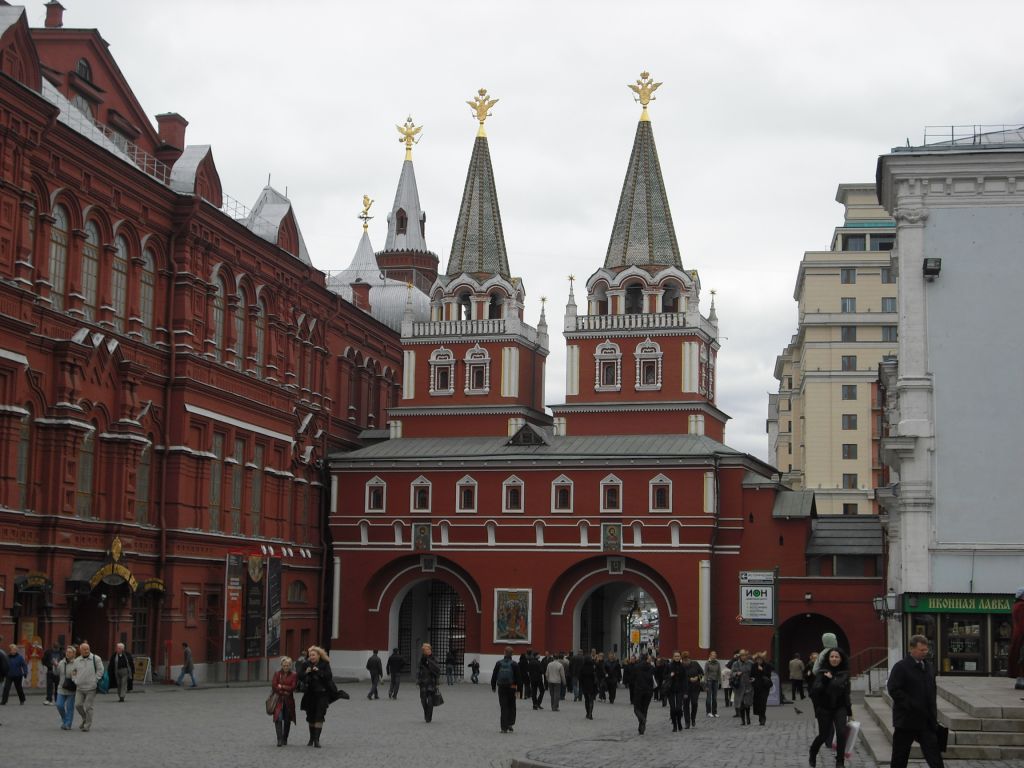
The casualty was the Resurrection Gate (Voskresenskiye Vorota), the double-arched entrance that had guarded the northern method to the square since 1680. For centuries, the Iverskaya Chapel, nestled within the gate, housed the Icon of the Iberian Mother of God, the spiritual "gatekeeper" of Moscow. Tsars and peasants alike paused here before entering the square. To the Bolshevik leadership, the gate was a physical bottleneck. In 1931, planners determined that the arches were too narrow for the new Soviet war machines to pass through in formation during the November 7th and May 1st parades. The State dismantled the chapel and the gate, clearing a wide, unobstructed throat for the Red Army to pour into the square. The destruction was absolute; the icon was removed, and the bricks were hauled away, leaving a gaping void that fundamentally altered the enclosure's acoustics and.
Simultaneously, the authorities targeted the Monument to Minin and Pozharsky. Since 1818, this bronze sculpture had stood in the very center of the square, with Minin's hand gesturing toward the Kremlin, urging Prince Pozharsky to save the city. By 1931, this positioning had become politically untenable. The monument obstructed the direct line of march for demonstrations and, more awkwardly, Minin appeared to be gesturing for the liberation of the Kremlin from the Bolsheviks themselves. Workers used jacks and wooden rails to slide the 18-ton granite base and bronze figures from the center to the periphery, depositing them in front of St. Basil's Cathedral. This relocation signaled a shift in the square's hierarchy: the center belonged to the Mausoleum and the marching masses, while national history was pushed to the margins.
The violence against the square's heritage peaked in the summer of 1936 with the demolition of the Kazan Cathedral. Located at the northeast corner, this structure commemorated the expulsion of Polish invaders in 1612. In a cruel twist of administrative irony, the architect Pyotr Baranovsky had spent the years 1929 to 1932 meticulously restoring the cathedral to its original 17th-century design, stripping away later accretions to reveal its historical form. Four years after his restoration work concluded, the order came to level it. The cathedral blocked the exit route for tanks leaving the square. Dynamite charges and wrecking balls reduced the sanctuary to rubble. In its place, the authorities erected a temporary pavilion, which later served as a public toilet and a summer cafe, a deliberate desecration of the site's former sanctity. The demolition completed the widening of the northern access points, turning the square into a direct channel for mechanized infantry.
The survival of St. Basil's Cathedral remains one of the most debated episodes of this period. Evidence shows that Lazar Kaganovich, the Secretary of the Moscow Party Committee, actively advocated for its destruction. The cathedral, with its sprawling footprint and eccentric layout, stood as a stubborn obstacle to the "socialist reconstruction" of the city. A persistent account, frequently by historians yet possibly apocryphal, describes a meeting where Kaganovich presented a model of the redesigned Red Square to Stalin. As Kaganovich lifted the model of St. Basil's off the board to demonstrate the improved traffic flow, Stalin reportedly gripped his wrist and commanded, "Lazar, put it back!" (Lazar, postav na mesto!). Whether this exchange occurred verbatim is secondary to the documented reality: Baranovsky, the same architect who failed to save the Kazan Cathedral, sent a telegram to the Kremlin threatening suicide if St. Basil's was destroyed. The cathedral was spared, it remained an island of the past, stripped of its bells and closed to worship.
The threat to the square's eastern flank was even more radical. The State Department Store (GUM), a symbol of bourgeois trade, faced imminent destruction. In 1934, the People's Commissariat for Heavy Industry (Narkomtiazhprom) launched an architectural competition to build a colossal headquarters on the site of GUM. The entries, particularly those by Ivan Leonidov and the Vesnin brothers, proposed structures of terrifying. Leonidov's design featured three skyscraping towers connected by skybridges, a composition that would have dwarfed the Kremlin towers and reduced St. Basil's to a trinket. The Narkomtiazhprom project envisioned a Red Square dominated not by history, by a futuristic industrial citadel. The project stalled due to the death of Sergo Ordzhonikidze and the shifting priorities of the 1935 Master Plan, leaving GUM to survive as a frozen asset, eventually reopened in 1953.
The cumulative effect of these demolitions was the creation of a "hyper-square," a space engineered for optical dominance rather than human interaction. The removal of the Resurrection Gate and the Kazan Cathedral increased the parade entry width from approximately 12 meters to over 100 meters. This expansion allowed for the iconic images of the Cold War: rows of intercontinental ballistic missiles on mobile launchers rolling past the Mausoleum, a spectacle physically impossible in the square's pre-1930 configuration. The data details the physical erasure enacted during this six-year window.
| Structure | Action Taken | Year | Official Justification | Physical Consequence |
|---|---|---|---|---|
| Iverskaya Chapel & Resurrection Gate | Total Demolition | 1931 | "Bottleneck" for military vehicles | Opened northern access; removed acoustic enclosure. |
| Minin and Pozharsky Monument | Relocation | 1931 | Obstructed parade lines; ambiguous symbolism | Cleared center square; marginalized historical narrative. |
| Kazan Cathedral | Total Demolition | 1936 | Impeded exit flow for heavy armor | Created northeast exit channel; site became public lavatory. |
| GUM (State Department Store) | Threatened (Narkomtiazhprom) | 1934-1936 | Site needed for Heavy Industry Ministry | Survived due to project cancellation; remained closed/repurposed until 1953. |
| St. Basil's Cathedral | Threatened | 1933-1936 | Obstacle to traffic flow | Survived; stripped of religious function; became museum. |
By 1936, the architectural cleansing was complete. The intimate, cluttered, and sacred "Fire" (Pozhar) of the 17th and 18th centuries was gone. In its place stood a granite-paved corridor of state power, stripped of the vertical interruptions that once defined its skyline. The demolition of the Kazan Cathedral and the Resurrection Gate did not widen the street; it severed the square's connection to its Orthodox origins, ensuring that the only god present at the parades was the preserved corpse in the Mausoleum.
Nuclear Signaling: Military Parade Ballistics 1945-1990

The transformation of Red Square from a ceremonial plaza into a theater of nuclear signaling occurred definitively on November 7, 1957. While the 1945 Victory Parade celebrated the defeat of a conventional army through the display of captured Wehrmacht standards, the 1957 event marked the dawn of ballistic intimidation. For the three decades, the cobblestones of the square served as the primary stage where the Soviet Union communicated its thermonuclear capabilities to Western intelligence agencies. This was not a martial procession; it was a carefully choreographed data transmission, frequently laden with deception, designed to alter the strategic calculus of the United States and NATO.
The 1957 parade, commemorating the 40th anniversary of the October Revolution, introduced the R-5M (NATO reporting name: SS-3 Shyster) to the public eye. This medium-range ballistic missile, capable of delivering a nuclear warhead to in Western Europe, fundamentally changed the geometry of the event. Previous parades emphasized the horizontal mass of infantry and the low profile of tanks. The introduction of vertical and diagonal rocketry forced spectators and foreign attachés to look upward, physically manifesting the new threat vector. The timing was deliberate; the parade took place just weeks after the launch of Sputnik 1. The visual confirmation of the R-5M on the ground, combined with the radio signals from the satellite above, created a psychological pincer movement that solidified the perception of a "missile gap" in the West.
Western intelligence services, particularly the CIA and MI6, treated these parades as high-priority intelligence collection opportunities. Analysts developed a discipline known as "crateology" or "paradeology," scrutinizing photographs to estimate the diameter, length, and chance fuel capacity of the displayed hardware. The Soviets, aware of this surveillance, turned Red Square into a venue for counter-intelligence and strategic disinformation. The most notorious instance of this deception occurred on May 9, 1965, during the 20th anniversary of the victory over Germany. The parade featured the debut of the GR-1 (NATO reporting name: SS-X-10 Scrag), a massive three-stage intercontinental ballistic missile.
The GR-1 was presented as a "Global Rocket," a Fractional Orbital Bombardment System (FOBS) capable of clear the United States from any direction, bypassing the North American Distant Early Warning Line. Nikita Khrushchev had previously boasted that the Soviet Union was turning out missiles "like sausages," and the GR-1 appeared to be the physical proof of this claim. In reality, the GR-1 program had been plagued by technical failures and was dead by the time it rolled across the square. The missiles on display were empty casings, chance engineering mock-ups, with no functional engines or guidance systems. Yet, the ruse succeeded. The sight of the Scrag prompted the United States to accelerate its own anti-ballistic missile (ABM) development, funneling billions of dollars into countering a weapon that did not exist in operational form.
The logistics of moving these leviathans through the historic center of Moscow required invisible infrastructure modifications. The sheer weight of the missile transporters, combined with the load of the stopping and starting vehicles, threatened to crush the subterranean utilities. Of specific concern was the Okhotny Ryad metro station and the pedestrian underpasses constructed in the 1930s. To prevent a catastrophic collapse, municipal engineers installed temporary steel support columns in the tunnels beneath the parade route before every major event. The pavement itself was subjected to extreme stress; while tanks utilized rubberized track pads to minimize surface damage, the multi-axle missile carriers concentrated tens of tons of pressure onto relatively small contact patches. The route was frequently resurfaced, a hidden cost of the nuclear theater.
By the 1970s, the nature of the display shifted from the liquid-fueled behemoths to solid-fueled mobile systems, reflecting the modernization of the Strategic Rocket Forces. The introduction of the RSD-10 Pioneer (NATO reporting name: SS-20 Saber) in 1976 brought a new level of anxiety to European capitals. Unlike the silo-based ICBMs, the SS-20 was road-mobile, making it difficult to target. Its appearance in Red Square was not a bluff a statement of operational reality. The transporter-erector-launcher (TEL) units displayed were fully capable of firing three independent warheads each. The presence of these systems in the heart of Moscow served to normalize the concept of mobile nuclear warfare, moving the image of the bomb from a static, hidden silo to a vehicle that could theoretically operate from any forest clearing.
The table outlines the key ballistic systems that made their debut or significant appearances in Red Square between 1957 and 1990, detailing the gap between their visual signaling and operational reality.
| Year of Debut | Soviet Designation | NATO Reporting Name | Operational Status at Parade | Strategic Signal |
|---|---|---|---|---|
| 1957 | R-5M | SS-3 Shyster | Operational | nuclear threat to Europe displayed publicly. |
| 1957 | R-11M | SS-1B Scud-A | Operational | Tactical nuclear capability; battlefield dominance. |
| 1964 | R-16 | SS-7 Saddler | Operational (Casings) | true ICBM display; empty casings used for safety. |
| 1965 | GR-1 | SS-X-10 Scrag | Cancelled/Fake | Deception; claimed Orbital Bombardment capability. |
| 1965 | R-36 | SS-9 Scarp | Operational | Heavy ICBM threat; "City Buster" capability. |
| 1976 | RSD-10 | SS-20 Saber | Operational | Mobile IRBM; sparked the "Euromissile" emergency. |
| 1985 | RT-2PM | SS-25 Sickle | Operational | Road-mobile ICBM; survivable second-strike capability. |
The psychological impact of these displays relied heavily on the "rivet counting" methodology of Western analysts. The Soviet military-industrial complex became adept at feeding this appetite for data. During the 1965 parade, the nose cones of the "Scrag" missiles were painted in a specific manner to suggest a re-entry vehicle design that differed from known types, sending Western engineers into a frenzy of speculation regarding Soviet heat-shield technology. This visual manipulation extended to the aircraft flyovers as well. In earlier years, the Soviet Air Force had flown the same squadron of Bison bombers in loops over the square to create the illusion of a massive fleet, a deception that successfully prompted the United States to increase bomber production.
As the Cold War wound down, the function of the Red Square parade began to. The November 7, 1990 parade, the last to be held before the dissolution of the Soviet Union, took place in an atmosphere of political disintegration. An assassination attempt on Mikhail Gorbachev during the event, where a gunman fired two shots from a sawed-off shotgun near the square, overshadowed the hardware on display. The ballistic missiles that had once terrified the world rolled past a leadership that was losing control of its own borders. The 1990 parade demonstrated that while the hardware remained lethal, the political to use it was fracturing. The era of using the square as a monolithic block of nuclear resolve had ended, leaving behind a legacy of asphalt scars and intelligence dossiers filled with measurements of weapons that,, were little more than welded steel tubes.
The 1987 Air Defense Breach: Cessna Landing Analysis
The chain of errors that permitted D-ECJB to travel 750 kilometers through hostile airspace reveals a widespread paralysis within the Soviet military hierarchy. This paralysis was a direct byproduct of the 1983 KAL 007 incident, where Soviet interceptors shot down a Korean airliner, killing 269 civilians. In 1987, standing orders strictly prohibited commanders from engaging civilian aircraft without direct authorization from the highest levels of the Kremlin. When the radar blip appeared, operators at the Tallinn division hesitated. The target did not respond to IFF (Identification Friend or Foe) interrogations. Standard procedure dictated an immediate scramble. Two MiG-23 interceptors were launched from Tapa Airfield. At 14: 48, one MiG pilot established visual contact near the town of Gdov. He reported a "white sport airplane" similar to a Soviet Yak-12. The ground controller, absence the authority to order a shoot-down and fearing another international incident, ordered the MiGs to return to base. The system classified the intruder as a "friendly" training aircraft that had forgotten to activate its transponder.
Rust continued his flight route southeast toward the Moscow Flight Information Region. As he passed near Lake Seliger, a new radar station picked up the signal. By a stroke of statistical improbability, a search-and-rescue exercise was active in the area. The local commander assumed the Cessna was a participant helicopter and manually tagged the blip as "friendly" on the plan position indicator. This manual override granted the intruder a digital safe passage through the defensive ring. Near Torzhok, a third error occurred. A Tu-22 bomber and a MiG-25 had collided the previous day, filling the air with debris and rescue traffic. The radar operators filtered out all low-speed, low-altitude to declutter their screens, inadvertently masking the Cessna's method. The intruder proceeded to the heavily defended Rzhev corridor, where the air defense grid was deactivated for unscheduled maintenance, a fact Rust could not have known.
The terminal phase of the flight demonstrates the absence of physical security measures in central Moscow during the late Soviet period. Rust arrived over the capital at approximately 18: 15. He circled the Kremlin complex three times. His initial plan was to land inside the Kremlin walls, he determined the space was too confined and feared the KGB would arrest him in seclusion, allowing the government to deny the incident occurred. He selected the Bolshoy Moskvoretsky, a six-lane thoroughfare connecting Red Square to the Zamoskvorechye District. The landing required precise timing and extraordinary luck. The is spanned by heavy trolleybus wires that would have sheared the Cessna's wings. Municipal records show that on the morning of May 28, 1987, maintenance crews had removed these wires for replacement. Rust dropped his flaps, cut his engine, and touched down on the asphalt, narrowly missing a Volga sedan. He taxied past the Spasskaya Tower and parked the aircraft on Vasilevsky Spusk, directly in front of St. Basil's Cathedral.
The political consequences of this breach were more destructive to the Soviet High Command than a nuclear strike. General Secretary Mikhail Gorbachev used the incident to purge the military establishment of hardliners who opposed his Perestroika reforms. The dismissal of Defense Minister Sergei Sokolov and Air Defense Chief Alexander Koldunov was immediate. In the weeks following the landing, over 150 generals and senior officers were fired or forced into retirement. This event broke the military's political autonomy and accelerated the disintegration of Soviet power structures leading up to 1991.
| Official | Rank | Position | Outcome |
|---|---|---|---|
| Sergei Sokolov | Marshal of the Soviet Union | Minister of Defense | Dismissed May 30, 1987 |
| Alexander Koldunov | Chief Marshal of Aviation | Commander-in-Chief, Air Defense Forces | Dismissed May 30, 1987 |
| Anatoly Konstantinov | Colonel General | Commander, Moscow Air Defense District | Dismissed |
| ~2, 000 Personnel | Various | Radar Operators, Zone Commanders | Expelled, Demoted, or Disciplined |
The landing on Border Guards Day, a holiday dedicated to the very forces that failed to stop Rust, added a of humiliation that resonated globally. Intelligence reports from 1987 indicate that the West German government was as shocked as the Kremlin; there was no conspiracy, only the audacity of a naive pilot exposing a hollow superpower. The Cessna D-ECJB became a symbol of the Soviet Union's inability to adapt its rigid, centralized command structures to asymmetric anomalies. The aircraft itself was held by Soviet authorities before being returned to Germany in 1988.
By 2026, the air defense architecture of Red Square has transformed radically in response to the lessons of 1987 and the drone warfare realities of the 2020s. The passive reliance on border interception has been replaced by active, point-defense systems within the city center. Satellite imagery and ground reports from 2024 to 2026 confirm the deployment of Pantsir-S1 mobile surface-to-air missile systems on the rooftops of key government buildings, including the Ministry of Defense on Frunzenskaya Embankment and educational institutions near the Kremlin. These systems are designed to engage small, low-observable like UAVs, a direct evolution from the threat profile demonstrated by Rust's Cessna. The airspace over Red Square is a digitally denied zone, enforced not just by MiGs at the border, by kinetic interceptors and electronic warfare jamming stations located mere blocks from the 1987 landing site. The "Rust Event" remains the benchmark for air defense failure, a case study taught in military academies worldwide to show that the most expensive radar network is useless if the chain of command fears its own shadow.
GUM Department Store: Asset Transfer and Revenue Flows

| Period | Controlling Entity | Legal Status | Revenue Model |
|---|---|---|---|
| 1893, 1917 | Joint-Stock Company of Upper Trading Rows | Private Consortium | Dividend distribution to merchant shareholders based on stall rental. |
| 1917, 1953 | Narkomprod / Soviet State | Nationalized Asset | State distribution center; minimal profit focus; Section 100 elite supply. |
| 1953, 1991 | Glavunivermag (Ministry of Trade) | State Enterprise | Direct transfer to Soviet budget; hard currency generation via tourist sales. |
| 1992, 2004 | GUM Trading House (Mixed) | Privatized JSC | Fragmented ownership; transition to lease-holding model. |
| 2005, 2021 | Bosco di Ciliegi (Mikhail Kusnirovich) | Private Leaseholder (49-year lease) | Subleasing to Western luxury brands; high-margin retail operations. |
| 2022, 2026 | Bosco di Ciliegi | Private Leaseholder | Grey market arbitrage; parallel imports; replacement of Western tenants with proxies. |
The physical endurance of the GUM building masks the volatility of its financial purpose. It has served as a merchant cooperative, a communist warehouse, and an oligarchic rentier asset. In every iteration, the square footage remains constant, the beneficiaries of the revenue generated within its walls shift according to the political currents of the Kremlin. The 2059 lease expiration date suggests the current arrangement is intended to outlast the current political administration, locking the asset into a specific lineage of private control for the generation.
Kremlin Wall Necropolis: Burial Eligibility and Roster
The transformation of Red Square from a commercial slum into the Soviet Union's supreme necropolis occurred with violent abruptness in November 1917. For centuries prior, religious and sanitary ordinances strictly prohibited burial within the commercial quarter; the dead belonged to parish churchyards, not the marketplace. This prohibition evaporated following the Bolshevik seizure of power. On November 10, 1917, digging teams excavated two massive trenches running parallel to the Kremlin wall between the Nikolskaya and Spasskaya towers. Into these "Brotherly Graves," they lowered 238 wooden coffins containing the remains of Bolshevik fighters killed during the Moscow uprising. This mass interment permanently altered the square's function. It ceased to be a zone of trade and became a zone of secular martyrdom.
From 1917 to 1927, the site functioned as a chaotic, active cemetery. Early burials were frequently ground interments, including the American journalist John Reed in 1920, who died of typhus. By the mid-1920s, the chaotic aesthetics of the mounds forced a change in protocol. The regime adopted cremation, a practice previously rare in Orthodox Russia, promoting it as a hygienic and atheistic alternative to traditional burial. The Kremlin Wall itself was retrofitted to serve as a columbarium. Engineers chiseled niches into the brickwork to hold urns, sealing them with standardized granite plaques. This created a vertical hierarchy of death: the most elite leaders lay in the ground, while high-ranking functionaries, foreign allies, and scientists were in the masonry.
The roster of the Necropolis serves as a dataset of Soviet political currency. Eligibility was determined exclusively by the Politburo, frequently functioning as a final calibration of an individual's utility to the state. The wall contains 114 urns. Among them are foreign nationals whose presence signaled the regime's international ambitions. These include Bill Haywood, a founder of the Industrial Workers of the World (IWW), and Sen Katayama, a founder of the Japanese Communist Party. Their interment in the Soviet holy of holies was a calculated diplomatic signal, asserting Moscow as the center of global revolution. The wall also holds the ashes of the "Space Race" martyrs, including Yuri Gagarin and Vladimir Komarov, the latter of whom died when the Soyuz 1 parachute failed in 1967. Their presence transformed the wall into a shrine for technological as well as political achievement.
The highest tier of the Necropolis consists of twelve individual graves located at the foot of the wall, separated from the public by a granite curb. This row represents the apex of Soviet power. It includes figures such as Yakov Sverdlov, Felix Dzerzhinsky, and Leonid Brezhnev. The most significant addition to this row occurred on October 31, 1961, when Joseph Stalin's embalmed body was removed from the Mausoleum during the de-Stalinization campaign. In a covert night operation, his remains were buried in a deep pit lined with concrete slabs to prevent future exhumation, and a simple granite slab was placed over the site. A bust was not added until 1970, restoring a fraction of his visual status.
Burial in the Necropolis ceased with the collapse of the gerontocracy in the mid-1980s. The last urn placed in the wall belonged to Defense Minister Dmitry Ustinov in December 1984. The final ground burial was that of Konstantin Chernenko in March 1985. His successor, Mikhail Gorbachev, broke the tradition, eventually being buried at the Novodevichy Cemetery in 2022. By 2026, the Necropolis stands as a closed historical archive. even with periodic legislative proposals in the Russian Duma to relocate the remains, citing both religious incompatibility and the need to "de-communize" the city center, the site remains under federal protection. The 12 graves and 114 niches are maintained by the Federal Guard Service, with the granite polished and the blue spruce trees trimmed, preserving the 1985 configuration in suspended animation.
| Burial Type | Count | Description | Notable Occupants |
|---|---|---|---|
| Mass Graves | ~240 | Common trenches from 1917 Revolution | Unidentified Bolshevik fighters |
| Individual Graves | 12 | Granite tombs with busts (Ground) | Stalin, Brezhnev, Andropov, Dzerzhinsky |
| Wall Niches | 114 | Urns sealed behind granite plaques | Gagarin, Zhukov, Kurchatov, John Reed |
| Mausoleum | 1 | Glass Sarcophagus (Above Ground) | Vladimir Lenin |
The physical mechanics of the wall burials required precise engineering. The niches are approximately 80 centimeters deep, sufficient to hold a standard urn. During the active period, the sealing ceremony involved a temporary cover, followed by the installation of the permanent marble or granite slab inscribed with gold-leaf lettering. The scarcity of space in the wall by the 1980s became a logistical problem for the Funeral Commission. Plans were briefly considered to expand the Necropolis or construct a new Pantheon, yet the economic stagnation of the era prevented any construction. Consequently, the Necropolis remains a finite physical limit of Soviet history, capturing the exact moment the empire ceased to honor its dead with state funerals on the square.
Biometric Surveillance: Camera Density and Tracking 2019-2026
The transformation of Red Square from a physical gathering space into a high-density biometric kill box represents the culmination of three centuries of policing evolution. In the early 1700s, the Zemsky Prikaz, the department responsible for urban order, stood on the square's northern edge, relying on illiterate watchmen and the physical recognition of known troublemakers to maintain control. By 2026, this analog observation has been entirely supplanted by the "Safe City" (Bezopasny Gorod) infrastructure, a digital panopticon that converts every visitor into a unique biometric key. While the granite cobblestones remain unchanged since the 19th century, the airspace above them is saturated with invisible data streams, feeding a centralized server farm that tracks movement, emotion, and identity in real-time.
The pivot to algorithmic enforcement began in earnest in 2019, when the Moscow Department of Information Technologies (DIT) integrated NtechLab's "FindFace" algorithm into the city's existing CCTV network. This was not a gradual upgrade. It was an immediate switch from passive recording to active identification. By early 2020, the system comprised over 170, 000 cameras across the capital, with the highest density concentrated in the Central Administrative Okrug, specifically the method to the Kremlin. Red Square, as the symbolic heart of the state, received priority coverage. Every entry point, the Resurrection Gate, the Iberian Chapel, and the pedestrian flows from Nikolskaya Street, was covered by high-resolution lenses capable of capturing iris patterns from distances exceeding fifty meters.
The COVID-19 pandemic in 2020 served as the operational stress test for this architecture. Under the guise of sanitary enforcement, the DIT expanded the network's capabilities to track quarantine violations. This period normalized the state's collection of biometric data on a mass. Residents were required to upload photos to a "Social Monitoring" app, which trained the city's neural networks to recognize faces partially obscured by medical masks or scarves. By the time the pandemic subsided, the surveillance grid had achieved a level of granularity that made anonymity in Red Square impossible. The system could re-identify a subject across multiple camera feeds, creating a direct "track" of their movement from the moment they exited the Okhotny Ryad metro station to the moment they stood before Lenin's Mausoleum.
The weaponization of this infrastructure against political dissent became undeniable during the 2021 protests supporting opposition figure Alexei Navalny. For the time in Russian history, police did not need to arrest protesters *at* the rally. Instead, the "Sphere" (Sfera) system, deployed heavily in the metro network feeding Red Square, identified chance attendees before they even reached the surface. Activists were detained at turnstiles or intercepted at their apartment doors days later, with police officers presenting printouts of surveillance footage as primary evidence. This marked the shift to "preventative policing," where the algorithm flagged intent based on location history and previous administrative records.
By 2024, the budget for this surveillance apparatus had ballooned. Municipal records show the Moscow City Duma approved 1. 97 billion rubles ($22 million) for video surveillance equipment in 2024 alone, a figure more than double the previous year's allocation. This funding surge facilitated the installation of "smart" turnstiles at Ploshchad Revolyutsii and Teatralnaya stations, the primary subterranean gateways to Red Square. These units, marketed under the "Face Pay" convenience brand, simultaneously cross-referenced every passenger against federal wanted lists and conscription databases. The integration was absolute: a tourist paying for a ticket with their face was unknowingly querying the same database used to hunt draft evaders during the mobilization waves of 2022 and 2023.
| Year | Total Networked Cameras (Moscow) | Primary Enforcement Focus | Key Technological Integration |
|---|---|---|---|
| 2019 | ~160, 000 | Criminal Identification | NtechLab "FindFace" Pilot |
| 2020 | ~175, 000 | COVID-19 Quarantine Tracking | Mask-penetrating algorithms |
| 2021 | ~190, 000 | Political Protest Prevention | "Sphere" Metro Integration |
| 2022 | ~205, 000 | Mobilization/Draft Evasion | Federal Conscription Database Link |
| 2024 | ~216, 000 | Behavioral Prediction | Enhanced Budget (1. 97B RUB) |
| 2026 | ~225, 000+ | Total Population Monitoring | Real-time Behavioral Analytics |
The technological sophistication of the 2026 grid extends beyond simple face matching. The latest iteration of the Safe City software employs behavioral analytics to detect "anomalous" actions. In the context of Red Square, this includes rapid movement, the unfurling of banners, or the gathering of static groups larger than three people in non- zones. The system alerts the Federal Protective Service (FSO) instantly. This capability restores the square to a state of control tighter than even the Stalinist era; whereas the NKVD relied on informants who might lie or miss details, the camera network is omnipresent and incapable of bribery. The "human factor" of the 18th-century watchman has been eliminated.
Foreign nationals and migrant workers face a distinct of scrutiny within this zone. Following the Crocus City Hall attack in 2024, the Ministry of Internal Affairs revived plans for mandatory biometric profiles for all incoming foreigners. By 2026, cameras in the Red Square tourist corridor were linked to a specific "foreigner tracking" module. This subsystem flags individuals whose visa status is irregular or whose movement patterns deviate from standard tourist routes. The data suggests that for a non-citizen, entering Red Square is functionally equivalent to checking in at a police station, with their location logged and stored for an indefinite period.
The physical environment of the square has been subtly altered to accommodate this electronic gaze. Lighting fixtures installed during the 2025 renovation were selected not for their aesthetic value, for their high color rendering index (CRI), ensuring that cameras can distinguish facial features clearly even during Moscow's long winter nights. There are no blind spots. The chaotic, fire-prone market of the 1700s, where a thief could into a labyrinth of wooden stalls, has been replaced by a sterile, illuminated stage where every actor is known, tracked, and recorded.
Unauthorized Assembly: Detention Statistics 2011-2025
| Date | Incident / Group | Est. Detained | Primary Charge / Outcome | Operational Note |
|---|---|---|---|---|
| Jan 20, 2011 | "Manezhka" Aftermath | ~15 | Art. 20. 2 (Admin Code) | Spillover from nationalist riots; heavy OMON presence. |
| Nov 10, 2013 | Pyotr Pavlensky (*Fixation*) | 1 | Art. 213 (Hooliganism) | Physical removal required medical intervention. |
| Aug 25, 2018 | 1968 Commemoration | 3 | Art. 20. 2 | Held banner "For your freedom and ours" for 5 minutes. |
| Feb-Mar 2022 | Anti-War Protests | >500* | Art. 20. 3. 3 (Discrediting Army) | *Includes Manezhnaya Sq. spillover. Immediate FSO response. |
| Sep 2022 | Anti-Mobilization | ~150 | Art. 20. 2 / Conscription Notice | Male detainees served draft papers at police stations. |
| Feb 3, 2024 | "Way Home" (Wives) | 27 | Interrogation / Release | Targeted journalists to suppress coverage; women kettled. |
| 2025 (Aggregated) | Algorithmic Preemption | <10 | Detention | "Sphere" system arrests occurred at Metro entry points. |
*Data sources: OVD-Info, Mediazona, Moscow City Court records. 2022 figures represent a conservative estimate of detentions specifically within the Kremlin perimeter and immediate access points (Manezhka, Alexander Garden).
Subsurface Geology: Metro Vibration and Soil Displacement
| Structure | Primary Threat | Recorded Anomaly | Stabilization Action |
|---|---|---|---|
| Lenin's Mausoleum | Settling of Alevizov Moat fill | Structural tilt observed Dec 2012 | Concrete injection; reinforced slab (2013) |
| St. Basil's Cathedral | Slope slippage & Metro vibration | Foundation cracks; "sliding" toward river | Steel banding; vibration dampeners (2008, 2024) |
| State Historical Museum | Shallow Metro tunnels (Okhotny Ryad) | Vertical vibration acceleration>70 dB | Foundation reinforcement (Ongoing) |
| Kremlin East Wall | Groundwater saturation | Brick spalling; mortar dissolution | Drainage retrofitting (2018-2020) |
### The Sliding Cathedral St. Basil's Cathedral faces a distinct geological emergency: it is sliding. The cathedral was not built on a flat plain on an artificial promontory, a man-made hill constructed to elevate the church above the floodplain. This mound absence a deep, unified foundation. Instead, the cathedral sits on a complex web of white stone footings that "float" in the upper soil. In 2003, a detailed engineering study warned that the cathedral was in danger of "sinking into the ground." The vibration from Soviet-era tank parades, combined with the metro's subterranean rumble, had accelerated the hill's deformation. The soil beneath the cathedral is slowly creeping southeast, toward the Moskva River. Restoration efforts completed in 2008 and subsequent monitoring through 2026 have focused on binding the hill itself, using steel reinforcements to prevent the artificial mound from losing its shape. ### The Hydrological Bomb The burial of the Neglinnaya River in 1819 did not eliminate the water; it confined it. The underground collector tunnels, which run just west of the square (beneath the Alexander Garden), alter the local water table. Leakage from these aging brick and concrete conduits saturates the surrounding limestone. When combined with the "technogenic" surface , which is highly permeable, this creates pockets of fluid soil. Sinkholes are the visible symptom of this subsurface. While the massive 2018 sinkhole in Surabaya or the Florida collapses are more famous, Moscow's center suffers from "suffosion", the washing away of fine soil particles by groundwater. This process leaves voids behind the heavy granite pavers. Maintenance crews in 2024 and 2025 frequently replaced sections of the cobblestones not just for aesthetics, to fill these developing cavities before they could swallow a tourist or a parade vehicle. As of March 2026, the square remains a battleground between static history and geology. The sensors in the foundations of the State Historical Museum and the Mausoleum transmit real-time data to federal engineers. They watch for the slightest deviation in the tilt sensors, knowing that the ground beneath Russia's most famous plaza is not a solid rock, a wet, vibrating sponge of history and debris.