
Land Acquisition and the Raczyński Palace Dispute 1871, 1884
The selection of the Reichstag's location was not a matter of simple urban planning a thirteen-year standoff between the German Empire and a single, obstinate aristocrat. Following the unification of Germany in 1871, the newly formed parliament required a seat of government commensurate with its status. The provisional solution, a hasty conversion of the former Royal Porcelain Manufactory at Leipziger Straße 4, was a humiliation. Deputies debated in cramped quarters, while journalists were relegated to basement spaces adjacent to boiler rooms and firewood stores. This "provisional" arrangement, intended for months, for twenty-three years.
The parliamentary commission identified the east side of Königsplatz ( Platz der Republik) as the optimal site for a permanent structure. This land, yet, was occupied by the Raczyński Palace, a grand residence and art gallery built between 1842 and 1844 by Count Athanasius Raczyński. A Prussian diplomat of Polish nobility and a renowned art collector, Raczyński had constructed the palace on land granted by King Friedrich Wilhelm IV, specifically to house his extensive collection of Old Masters and contemporary German paintings. When the state method him to sell, the Count refused. His resistance was absolute; he had no interest in displacing his life's work for a parliament he viewed with aristocratic skepticism.
Under normal circumstances, the state might have exercised eminent domain. Yet, Kaiser Wilhelm I, whose disdain for the parliamentary system was an open secret, refused to sign an order of expropriation against a fellow nobleman. This imperial obstruction forced the Reichstag building committee into a paralysis. In 1872, an international architectural competition was held based on the assumption that the land would eventually become available. The winner, Ludwig Bohnstedt of Gotha, produced a design that was lauded by critics doomed by the site dispute. Bohnstedt's plans were shelved, and his career never fully recovered from the phantom commission.
The deadlock broke only with the death of Count Athanasius Raczyński in 1874. His son and heir, Count Karol Edward Raczyński, did not share his father's attachment to the Berlin property. After lengthy negotiations, the state purchased the palace for a substantial, though undisclosed, sum. The acquisition cleared the way for the demolition of the Raczyński Palace in 1883, an act that erased a significant cultural landmark to make room for a political one. The art collection was transferred to the National Gallery in Berlin before eventually moving to the Kaiser-Friedrich-Museum in Posen (Poznań) in 1903.
With the land secured, the 1872 competition results were deemed obsolete. A second competition was launched in 1882, restricted to architects of "German tongue." This contest attracted roughly 200 entries and resulted in the selection of Paul Wallot. On June 9, 1884, Kaiser Wilhelm I laid the foundation stone, ending the thirteen-year limbo. The site's history, from a gallery of high art to a contested political battlefield, foreshadowed the turbulent existence of the building that would rise in its place.
| Year | Event | Key Figures |
|---|---|---|
| 1871 | German Empire founded; Parliament meets at Leipziger Straße 4. | Otto von Bismarck |
| 1872 | architectural competition won by Ludwig Bohnstedt. | Ludwig Bohnstedt |
| 1872, 1874 | Count Raczyński refuses to sell; Kaiser blocks expropriation. | Athanasius Raczyński, Wilhelm I |
| 1874 | Death of Athanasius Raczyński. | Karol Raczyński (Heir) |
| 1882 | Second architectural competition won by Paul Wallot. | Paul Wallot |
| 1883 | Demolition of the Raczyński Palace. | State Officials |
| 1884 | Foundation stone laid for the Reichstag building. | Wilhelm I, Paul Wallot |
Paul Wallot’s Construction and Imperial Architectural Conflicts

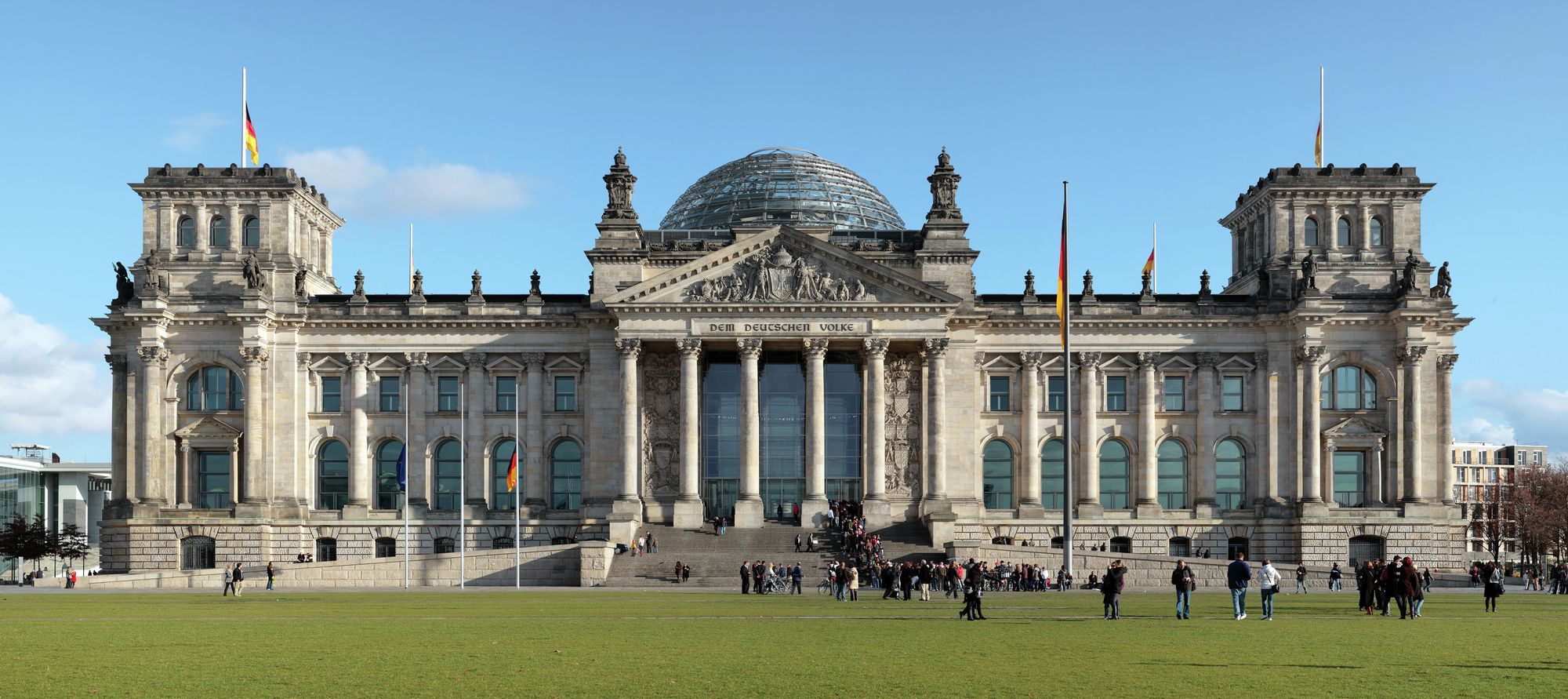
The resolution of the land dispute in 1884 cleared the route for a second architectural competition, a contest restricted to architects of "German tongue." This 1882 solicitation drew nearly 200 entries, a massive increase from the previous decade, signaling the high of defining the new empire's visual identity. The jury selected Paul Wallot, an architect from Frankfurt am Main, whose design promised a synthesis of Renaissance and Baroque elements. Wallot's proposal did not house the legislature; it sought to project imperial unity through stone. He positioned four massive corner towers to anchor the structure, explicitly representing the four kingdoms of the German Empire: Prussia, Bavaria, Saxony, and Württemberg. This symbolism aimed to balance the dominance of Prussia with a visual acknowledgment of the federal nature of the Reich.
On June 9, 1884, Kaiser Wilhelm I laid the foundation stone. Witnesses recorded that the emperor, who held deep reservations about the rise of parliamentary power, struck the stone with such lethargy that the ceremonial hammer shattered, a mishap interpreted as a dire omen for the relationship between the monarchy and the parliament. The construction budget, set at 24 million Goldmarks, was funded entirely by the war reparations paid by France following its defeat in 1870, 1871. This financial origin imbued the building with a martial triumph that sat uneasily alongside its civilian purpose. The sheer of the project required a logistical mobilization that transformed the Königsplatz into a decade-long industrial zone.
Wallot's original design featured a massive stone dome, intended to sit directly above the plenary chamber. As construction progressed, yet, the project engineers discovered that the building's foundation could not support the immense weight of a stone cupola. Wallot collaborated with the civil engineer Hermann Zimmermann to devise a radical alternative: a dome constructed of steel and glass. This solution reduced the load significantly and introduced a modern industrial aesthetic into the heavy historicist shell. The steel structure, rising 75 meters above the street, became a technological marvel of the late 19th century, allowing natural light to flood the debating chamber.
The height of this dome became the center of a bitter conflict between Wallot and the monarchy. The original plans positioned the Reichstag's cupola higher than the dome of the Berlin City Palace, the residence of the Kaiser. Wilhelm II, who ascended the throne in 1888, viewed this elevation as a direct challenge to imperial authority. He demanded that the parliament remain physically subservient to the crown. While Wallot technically adhered to the height restrictions, the visual dominance of the steel and glass structure over the skyline infuriated the young Kaiser. Wilhelm II frequently disparaged the building, referring to it privately and publicly as the "Reichsaffenhaus" (Imperial Ape House) and labeling it the "pinnacle of tastelessness."
This imperial antagonism extended to the building's inscription. Wallot intended the frieze above the main western entrance to bear the dedication "Dem Deutschen Volke" (To the German People). Wilhelm II blocked this addition for the duration of his peace-time reign, viewing the phrase as dangerously democratic and populist. The space on the architrave remained blank for over two decades. Only in 1916, two years into the carnage of World War I, did the Kaiser permit the inscription in a belated attempt to bolster domestic morale. The bronze letters were cast from two cannons captured from the French during the Wars of Liberation (1813, 1815), melting down military trophies to forge a message of national unity that the monarch had previously rejected.
The construction process itself was a battleground of egos and bureaucracy. Wallot faced constant interference from the Prussian building administration, which tried to impose cost-cutting measures and aesthetic changes. Even with these blocks, the building was completed in 1894. The final structure measured 137 meters in length and 97 meters in width, a colossus of Silesian sandstone. When the keys were handed over, the Kaiser refused to knight Wallot, a customary honor for the architect of a major public work, granting him only a lesser title. The Reichstag opened its doors not as a celebrated symbol of shared governance, as a tolerated need, despised by the head of state and built with the gold of a defeated enemy.
Weimar Republic Governance and the 1918 Proclamation
On November 9, 1918, the Reichstag building became the epicenter of a seismic political shift that dismantled the German Empire. At approximately 2: 00 PM, Social Democrat Philipp Scheidemann abandoned his lunch in the building's dining hall and rushed to a second-floor window overlooking the Königsplatz. His haste stemmed from urgent intelligence: rival leftist Karl Liebknecht planned to declare a Soviet-style republic from the nearby Berlin City Palace. Scheidemann, acting without authorization from party leader Friedrich Ebert, leaned out the window and shouted to the amassed crowds, "The old and rotten, the monarchy has collapsed. Long live the new. Long live the German Republic!" This improvised proclamation preempted Liebknecht by mere hours and established the Reichstag as the physical anchor of Germany's parliamentary democracy.
Following this declaration, the building transitioned from a symbol of imperial dominance to the operational seat of the Weimar Republic. The inscription "Dem deutschen Volke" (To the German People), cast from captured Napoleonic cannon bronze and mounted in 1916, aligned with the building's function. Inside, the parliament grappled with severe instability; between 1919 and 1933, the Reichstag hosted sixteen different coalition governments. The fragmented chamber saw frequent dissolutions and bitter legislative gridlock, reflecting the deep societal fractures outside its heavy stone walls. This volatility until the catastrophic fire of February 1933, which gutted the plenary chamber and ended the building's role in democratic governance for over six decades.
The 1933 Fire and Subsequent Suspension of Civil Rights

At approximately 9: 05 PM on February 27, 1933, a student walking near the Reichstag heard the sound of breaking glass. Moments later, flames became visible through the windows of the floor. The fire spread with unnatural speed, fueled by the heavy velvet curtains, wooden paneling, and the dry, oil-soaked atmosphere of the plenary chamber. By the time the Berlin fire brigade arrived, the central cupola acted as a chimney, drawing the inferno upward and illuminating the night sky over the Tiergarten. Inside the burning structure, police discovered Marinus van der Lubbe, a twenty-four-year-old Dutch council communist. He was shirtless, sweating profusely, and in possession of household firelighters. Officers arrested him immediately, dragging him from the ruins of the Great Hall, which was rapidly collapsing into a charred skeleton of steel and stone.
Adolf Hitler and Hermann Göring arrived at the scene while the firefighters still battled the blaze. Göring, then the Prussian Minister of the Interior, immediately declared the fire the signal for a Communist uprising. Hitler, staring at the burning seat of German democracy, reportedly termed it a "God-given signal." This interpretation became the official state narrative before the embers cooled. The physical destruction of the building, the debating chamber was gutted, the dome unstable, rendered the structure unusable for parliamentary sessions. Yet the political utility of the ruin far exceeded its architectural value. The Nazis used the smoking shell of the Reichstag not as a tragedy to be mourned, as a weapon to the Weimar Republic's legal framework.
The following day, February 28, 1933, President Paul von Hindenburg signed the Verordnung des Reichspräsidenten zum Schutz von Volk und Staat (Decree of the Reich President for the Protection of People and State). Commonly known as the Reichstag Fire Decree, this single document suspended the civil liberties that had defined the German constitutional order since 1919. The decree did not restrict rights; it obliterated the legal blocks between the citizen and the state. Article 1 explicitly suspended seven key articles of the Weimar Constitution. The protections for personal liberty (Article 114), the inviolability of the home (Article 115), the secrecy of mail and telecommunications (Article 117), freedom of expression (Article 118), freedom of assembly (Article 123), freedom of association (Article 124), and the protection of property (Article 153) instantly.
The suspension of Article 114 allowed the regime to detain individuals indefinitely without charge, trial, or access to legal counsel. This "protective custody" (Schutzhaft) became the legal instrument for the concentration camp system. The suspension of Article 115 legalized warrantless searches and raids on private homes at any hour. The nullification of Article 117 permitted the police to monitor all mail and phone calls, creating a surveillance state overnight. The decree also authorized the Reich government to take over the powers of the federal states (Länder) if they failed to maintain order, a clause Hitler used to centralize control and depose non-Nazi state governments. The death penalty, previously applicable only to murder and high treason, was expanded to include arson and resistance against the decree, a change applied retroactively to ensure Van der Lubbe's execution.
Police and the Sturmabteilung (SA) unleashed a wave of terror immediately following the decree's publication. In Berlin alone, authorities arrested over 4, 000 people in the nights following the fire. The dragnet targeted the German Communist Party (KPD) and the Social Democratic Party (SPD). Deputies who had sat in the Reichstag days earlier found themselves beaten in SA basements or transported to the newly established Columbia-Haus prison. The KPD was outlawed, its press smashed, and its leadership driven underground or into exile. The March 5 elections proceeded under this shadow of terror, with the opposition decapitated and the Nazi paramilitary controlling the streets. Even with this intimidation, the Nazis failed to secure an absolute majority, receiving 43. 9 percent of the vote, necessitating the support of the German National People's Party (DNVP) to govern.
The judicial aftermath centered on the Leipzig Trial, which began in September 1933. The regime charged Van der Lubbe along with Ernst Torgler, the KPD parliamentary leader, and three Bulgarian communists: Georgi Dimitrov, Blagoy Popov, and Vasil Tanev. The trial was intended to prove a vast Communist conspiracy. It backfired on the international stage. Georgi Dimitrov, representing himself, cross-examined Hermann Göring, forcing the Minister President of Prussia into a rage where he threatened to "settle the score" with Dimitrov outside the courtroom. The Reichsgericht (Imperial Court of Justice), retaining a degree of independence that would soon, acquitted Torgler and the Bulgarians for absence of evidence. They convicted only Van der Lubbe. On January 10, 1934, the state beheaded him by guillotine in a Leipzig prison yard. The acquittal of the other defendants infuriated Hitler, leading to the creation of the "People's Court" (Volksgerichtshof) to handle treason cases without the interference of professional judges.
Historical debate regarding the true authorship of the fire for decades. The Nazis maintained it was a Communist plot; the Communists and British intelligence argued it was a Nazi "false flag" operation designed to justify the crackdown. In the postwar era, a consensus formed around the "Lone Wolf" theory, positing that Van der Lubbe acted alone, a politically convenient accident that the Nazis exploited with ruthless efficiency. This narrative remained dominant until recent archival discoveries challenged it. In 2019, an affidavit from 1955 by former SA member Hans-Martin Lennings surfaced in the archives of a Hanover court. Lennings swore that on the night of the fire, he and his unit drove Van der Lubbe to the Reichstag. Lennings claimed that when they arrived, they noticed "a strange smell of burning and there were clouds of smoke billowing through the rooms," indicating the fire had already started before Van der Lubbe entered. Lennings stated he and his colleagues protested the arrest of the Dutchman as the sole perpetrator, only to be forced into silence by the Gestapo.
This evidence supports the theory that the SA, under the direction of Karl Ernst and possibly Göring, prepared the arson, using Van der Lubbe as a patsy to be discovered at the scene. Further forensic analysis of the timeline suggests that a single man with firelighters could not have caused such rapid, structural devastation in the massive stone building within the twenty-minute window established by police reports. The use of liquid accelerants, likely placed beforehand, remains the only plausible explanation for the speed of the inferno. Regardless of who struck the match, the Reichstag building ceased to function as a parliament that night. The deputies moved to the Kroll Opera House across the square, where they voted for the Enabling Act of 1933, legally the republic. The burnt ruin of the Reichstag stood empty and neglected, a blackened monument to the death of German civil rights, until the collapse of the regime that burned it.
The legal rehabilitation of Marinus van der Lubbe took seventy-four years. It was not until January 2008 that the German Federal Prosecutor officially overturned the death sentence, applying a 1998 law that voided convictions resulting from specific Nazi injustices. The building itself remained a ruin through the division of Berlin, its charred walls witnessing the Soviet final assault in 1945, serving as a backdrop for rock concerts in the 1980s, and only regaining its political function after the reunification of Germany. The suspension of rights initiated on February 28, 1933, remained in force until May 1945, marking a twelve-year period where the German state operated under a permanent, manufactured state of emergency.
Nazi Era Marginalization and Air Defense Conversion 1933, 1945
Following the catastrophic fire of February 1933, the Reichstag building did not from the German political; instead, it underwent a grotesque transformation from a seat of legislative power into a hollow prop for the Nazi regime. While the parliament itself, stripped of all democratic function, moved across the street to the Kroll Opera House to rubber-stamp Hitler's decrees, the scorched shell of the Wallot building remained standing. Hitler explicitly chose not to repair the plenary chamber. The blackened ruins served a distinct ideological purpose: they stood as a silent, charred monument to the alleged "Communist threat" that the Nazis claimed to have vanquished. The building ceased to be a venue for debate and became a stage for state-sponsored theater, where the regime could project its narratives onto the physical corpse of German democracy.
The marginalization of the building was absolute. By 1939, the Reichstag's extensive library and archives, once among the finest in Europe, were evacuated and dispersed to other locations for safekeeping, leaving the interior largely vacant. This emptiness allowed the Propaganda Ministry to repurpose the structure for political exhibitions that required vast, imposing spaces. Most notably, from November 1937 to January 1938, the building hosted "Bolschewismus ohne Maske" (Bolshevism without a Mask). This virulent anti-communist exhibition used the prestigious address of the former parliament to legitimize its message, drawing thousands of visitors into the very halls where the republic had once tried to govern. The Nazis used the building's scars to validate their own rise, presenting the fire-damaged walls not as a tragedy, as proof of the enemy's destructive intent.
As the war turned against Germany, the building's function shifted from ideological symbol to utilitarian. The thick stone walls and deep cellars offered protection that the exposed Kroll Opera House could not. In a move that underscored the total mobilization of German society, the former seat of the legislature was converted into a production facility for the war effort. The electrical giant AEG (Allgemeine Elektricitäts-Gesellschaft) requisitioned the building to manufacture vacuum tubes (valves) for radar and radio equipment. High-precision industrial work replaced parliamentary procedure. Workers assembled delicate electronic components in rooms that had once hosted committee meetings, shielded by the building's massive masonry from the increasingly frequent Allied air raids.
The conversion of the Reichstag into a component of the air defense network went beyond industrial production. The building's windows were bricked up in 1939, transforming the Neo-Renaissance palace into a monolithic concrete and stone block. While it was not a dedicated Flak tower like the massive concrete at the Berlin Zoo or Humboldthain, the Reichstag became a serious node in the city's defensive topography. Anti-aircraft guns were positioned in the vicinity, and the building itself was hardened to withstand shockwaves. This hardening inadvertently prepared the structure for its most humane role during the conflict. As the Allied bombing campaign intensified in 1943, the renowned Charité hospital, located nearby, found its own facilities compromised. The hospital administration moved its maternity ward into the reinforced cellars of the Reichstag.
In the subterranean levels of the Nazi, life amidst the of death. Between 1943 and 1945, approximately 60 to 80 children were born in the Reichstag's basement. These "Reichstag babies" entered the world under the heavy vaults of the cellar, while above them, the Red Army advanced and the Luftwaffe fought a losing battle for the skies. The contrast was clear: the upper floors were a hardened shell producing guidance systems for war, while the foundations sheltered laboring mothers and newborns. Documents from the Charité confirm this improvisation, though the chaos of the final months meant that precise records for every birth were lost. The cellar served as a grim sanctuary, protected by the same thick walls that would soon attract the concentrated fire of Soviet artillery.
By April 1945, the Reichstag had regained its status as the center of the German world, only in the eyes of the Soviet Union. Stalin had the building as the symbol of the "fascist beast," mistakenly believing it to be the seat of Nazi power. In reality, the Reich Chancellery was the political hub, the Reichstag's silhouette dominated the Soviet imagination. The German military command, recognizing the building's defensive chance and its symbolic weight to the enemy, fortified it heavily. The bricked-up windows were fitted with firing slits. Trenches were dug in the Platz der Republik, and the flooded tunnels of the subway system were incorporated into a defensive perimeter. The defense force was a motley collection of Waffen-SS, Volkssturm militia, and remnants of various Wehrmacht units, numbering around 5, 000 men in the government district.
The final assault on the Reichstag began on April 30, 1945. The 150th and 171st Rifle Divisions of the Red Army led the attack, subjecting the building to a ferocious bombardment that pulverized the remaining architectural details. The bricked-up windows proved against small arms could not withstand heavy artillery fired at point-blank range. Soviet soldiers fought room by room, clearing the building with submachine guns and grenades. The interior, already gutted by the 1933 fire and stripped for AEG's industrial use, became a chaotic killing ground. The famous photograph of the Soviet flag being raised over the roof by Yevgeny Khaldei was a re-enactment staged on May 2, the fighting that preceded it was real and brutal. The walls were left covered in graffiti, names, dates, and curses scratched by victorious Soviet soldiers, which would remain as a permanent scar on the building's fabric.
| Period | Primary Function | Key Modifications/Events |
|---|---|---|
| 1933, 1939 | Propaganda Venue | Parliament moves to Kroll Opera; "Bolshevism without a Mask" exhibition (1937); Library evacuated (1939). |
| 1939, 1941 | Defensive Hardening | Windows bricked up; exterior fortified; archives removed. |
| 1941, 1945 | Industrial Facility | AEG vacuum tube production established in upper levels; high-security access. |
| 1943, 1945 | Medical Shelter | Charité maternity ward moves to cellars; ~60, 80 births recorded. |
| April, May 1945 | Military | Firing slits installed; anti-tank ditches; final stand of SS/Volkssturm; Soviet flag raising. |
The fall of the Reichstag marked the end of the Battle of Berlin. When the smoke cleared, the building was a ruin in the truest sense. The dome was a skeletal framework of steel ribs, the interior was a heap of rubble and twisted metal, and the facade was pockmarked by thousands of bullet strikes. Yet, unlike the Kroll Opera House, which was destroyed and eventually demolished, the Reichstag survived. Its survival was due in part to its massive construction also to its paradoxical status: it was too symbolic to destroy completely, yet too damaged to be easily used. For the decade, it would stand as an abandoned colossus in the middle of a divided city, its bricked-up windows staring blindly out at the rising tensions of the Cold War. The "Reichstag babies" grew up in a city that was rapidly being partitioned, while the building of their birth remained a desolate, mine-strewn no-man's-land.
Red Army Siege and Structural Damage Assessment 1945
| Element | Condition in May 1945 | Notes |
|---|---|---|
| Dome | Structurally compromised, steel frame twisted. | Targeted by heavy artillery; later demolished in 1954 due to instability. |
| Plenary Chamber | Total destruction. | Roof collapsed; floor covered in debris and unexploded ordnance. |
| Exterior Walls | Heavily pockmarked. | Sustained thousands of bullet strikes and large-caliber shell impacts. |
| Interior Walls | Covered in Cyrillic inscriptions. | Soldiers used charcoal and chalk to write names, dates, and slogans like "Hitler Kaputt." |
When the guns fell silent on May 2, the Reichstag stood as a colossal tomb. The steel-and-glass dome, once a marvel of 19th-century engineering, hung in shreds, its metal skeleton twisted by heat and explosives. The interior was a charred void, the floor of the plenary chamber buried under meters of masonry and ash. Every vertical surface was scarred by bullets or shrapnel. The most enduring mark left by the siege was not the structural damage the graffiti. Victorious Soviet soldiers covered the soot-blackened walls with hundreds of inscriptions. These ranged from simple autographs and hometowns, "Moscow," "Leningrad," "Stalingrad", to curses against the fascists and declarations of survival. In the decades that followed, these markings were hidden behind plasterboard during the 1960s renovation, treated as shameful scars to be covered. They remained invisible until the 1990s, when workers preparing for the building's resurrection stripped away the lining, revealing the raw history of 1945 beneath. The immediate post-war assessment was grim. The building was structurally unsound, with the dome in danger of collapse. For years, the ruin stood in the British sector of divided Berlin, an unwanted relic of the Empire and the Nazi dictatorship. While the Berlin City Palace was demolished by the East German authorities, the Reichstag survived primarily because no one could agree on what to do with it. It remained a hollow, windowless ghost on the edge of the Iron Curtain, its walls still screaming the story of the final battle.
West Berlin Border Status and the Baumgarten Renovation 1961, 1973
| Year | Event / Status | Details |
|---|---|---|
| 1961 | Berlin Wall Construction | Building in British Sector; East façade faces "Death Strip." |
| 1961 | Architectural Competition | Paul Baumgarten wins contract to renovate the ruin. |
| 1961, 1964 | Initial Reconstruction | Stabilization of structure; decision not to rebuild the dome. |
| 1965 | Plenary Session emergency | Bundestag meets in Berlin; Soviet MiGs cause sonic booms to disrupt. |
| 1971 | Quadripartite Agreement | Bundestag plenary sessions banned in West Berlin. |
| 1971 | Exhibition Opens | "Questions on German History" opens; attracts millions. |
| 1973 | Renovation Complete | Baumgarten finishes work. Interior features "White Cube" style, hiding history. |
Christo and Jeanne-Claude’s Wrapped Reichstag Project 1995

The transformation of the Reichstag into a temporary art installation in 1995 stands as a singular event in the history of monumental architecture, representing the culmination of a twenty-four-year political and bureaucratic siege. While the physical wrapping lasted only fourteen days, the campaign to realize Wrapped Reichstag spanned from 1971 to 1995, bridging the Cold War, the fall of the Berlin Wall, and German Reunification. The project was initiated not by the German government by a postcard sent in 1971 from Berlin-based American historian Michael S. Cullen to the artist Christo, suggesting the parliament building as a candidate for his "wrapping" technique. Christo and his wife Jeanne-Claude, who had previously wrapped the Pont Neuf in Paris and the coast of Little Bay in Australia, accepted the challenge. They did not foresee that this specific structure would require a political campaign more arduous than the engineering feat itself.
Resistance to the project was entrenched at the highest levels of the West German state. The Reichstag was not a building; it was a scarred vessel of German history, bearing the marks of the 1933 fire, the 1945 Soviet conquest, and decades of division. Chancellor Helmut Kohl remained a steadfast opponent throughout the process, arguing that wrapping the seat of national sovereignty was an indignity to the German people and a trivialization of a tragic history. Kohl publicly declared that as long as he remained Chancellor, the Reichstag would not be wrapped. This opposition forced the artists to engage in a lobbying effort that resembled a political campaign, involving hundreds of meetings with individual deputies, letter-writing drives, and the strategic cultivation of allies within the Bundestag.
The turned only after the geopolitical shifted. The reunification of Germany in 1990 and the decision to move the capital back to Berlin fundamentally altered the building's status. It was no longer a mute monument on the periphery of the West, the future heart of the Berlin Republic. Rita Süssmuth, the President of the Bundestag, broke with in her party to champion the project, arguing that the wrapping would symbolize a new, confident, and open Germany. The matter was brought to a floor vote in the Bundestag on February 25, 1994. In a session characterized by high tension and passionate debate, the parliamentarians voted 292 in favor and 223 against, with 9 abstentions. This remains one of the few instances in history where a national legislature voted on the existence of a work of art.
The execution of the project required industrial- logistics and precise engineering. The artists refused all public funding, financing the entire $15. 3 million cost through the sale of preparatory sketches, collages, models, and original lithographs. This financial independence was a non-negotiable condition, insulating the project from taxpayer grievances and political use. The material specifications were rigorous. The fabric had to be durable enough to withstand wind loads yet permeable to air to prevent condensation on the stone facade. A manufacturer in Emsdetten produced 100, 000 square meters of thick, woven polypropylene fabric, coated with aluminum to reflect the changing light of the Berlin sky. To secure the fabric, 15. 6 kilometers of blue polypropylene rope were manufactured, with a diameter of 3. 2 centimeters.
Protecting the historic structure was paramount. A steel cage weighing 200 tons was constructed around the building's towers, statues, and roofline. This framework ensured that the fabric never touched the stone surfaces, creating a buffer zone that prevented abrasion and allowed the "shroud" to float around the architectural skeleton. The installation process, which began on June 17, 1995, eschewed the use of heavy cranes for the final draping. Instead, the artists employed ninety professional rock climbers. These workers abseiled down the facade, unfurling the silver panels in a choreographed sequence that minimized risk to the fragile masonry. The absence of heavy during the final phase lent the installation a human, even with the monumental size of the canvas.
When the wrapping was completed on June 24, 1995, the effect on the city was immediate and. The silver fabric, shimmering in the summer sun and turning a ghostly gray-blue at twilight, abstracted the building's heavy, Wilhelmine details. The ominous silhouette of the Reichstag, frequently associated with imperial hubris and Nazi failure, was softened into a fluid, sculptural form. The public response all projections. Over the course of two weeks, five million visitors flocked to the Platz der Republik. The lawn in front of the building, a sterile security zone, became a site of spontaneous congregation, picnicking, and debate. Observers noted a festival atmosphere that compared to Woodstock, a radical departure from the somber reverence accorded to German state monuments.
The following table details the material and operational metrics of the Wrapped Reichstag project:
| Metric | Value |
| Fabric Area | 100, 000 square meters |
| Fabric Material | Aluminum-coated polypropylene |
| Rope Length | 15. 6 kilometers |
| Steel Substructure Weight | 200 tons |
| Installation Workforce | 90 professional climbers, 120 installation workers |
| Total Project Cost | $15, 300, 000 (approximate) |
| Public Funding | $0 |
| Visitor Count | 5, 000, 000 (June 24 , July 7, 1995) |
| Bundestag Vote (1994) | 292 Yes, 223 No, 9 Abstentions |
The project concluded on July 7, 1995. The process was as disciplined as the installation. In alignment with the artists' environmental commitments, all materials were recycled. The polypropylene fabric was processed into geotextiles used for road construction and earthworks, while the steel was melted down for reuse. Nothing of the artwork remained on the site. This transience was central to Christo and Jeanne-Claude's aesthetic philosophy; the work's value lay in its temporary existence and the memory it imprinted on the public consciousness.
The legacy of the Wrapped Reichstag extended well beyond the art world. It functioned as a cleansing ritual for the building before its physical reconstruction by Norman began. By concealing the Reichstag, the artists paradoxically made it more visible than it had been in decades, stripping away its historical baggage and allowing the German public to re-engage with the structure as a symbol of a democratic future rather than a troubled past. The event demonstrated that the new Berlin could host a global cultural phenomenon without the stiffness of Bonn-era protocol. It proved that the seat of German power could be the subject of joy and curiosity, setting a psychological foundation for the parliament's return to the Spree in 1999.
Norman Foster’s Redesign and Dome Engineering Specifications
The architectural transformation of the Reichstag began with a collision between British high-tech modernism and German political symbolism. In 1992, the competition to redesign the building attracted 800 submissions. The jury did not initially award a single winner narrowed the field to three finalists: Norman, Santiago Calatrava, and Pi de Bruijn. 's original proposal did not include a dome. Instead, he designed a massive steel and glass canopy, a "baldachin", that would have hovered over the entire building like a giant table, extending to the Spree River. This design, estimated to cost 1. 3 billion Deutsche Marks, faced immediate resistance from fiscal conservatives and traditionalists who demanded a recognizable silhouette. MPs insisted on a dome to restore the building's historic profile, a feature initially derided as "hollow" and undemocratic.
capitulated to the parliamentary demand reinvented the concept. He rejected a faithful reconstruction of Paul Wallot's 19th-century masonry cupola, proposing instead a transparent glass "lantern" that would symbolize political transparency. The final design, approved in 1995, resulted in a structure weighing 1, 200 tonnes. The steel framework alone accounts for 800 tonnes, supporting 3, 000 square meters of laminated safety glass. The cupola measures 40 meters in diameter and rises 23. 5 meters above the roof terrace. A double-helix ramp spirals along the inner circumference, allowing citizens to ascend to an observation deck while looking down into the plenary chamber, physically placing the electorate above their representatives.
The engineering core of the dome is the "Light Sculptor," a cone-shaped structure suspended in the center. This inverted cone is clad in 360 angled mirrors that direct horizon light down into the debating chamber. To prevent blinding glare and overheating, a computerized sun-shield tracks the movement of the sun. This mobile screen rotates around the cone, blocking direct solar rays while allowing diffuse light to filter through. The cone also functions as a serious component of the building's ventilation system. It acts as a chimney, using the stack effect to draw warm, stale air upward from the plenary chamber and exhaust it through an opening at the dome's apex. Fresh air enters through the floor of the chamber, passing through carpet gratings, which creates a natural airflow pattern that reduces reliance on electric fans.
The Reichstag's energy systems operate as a local power station, designed to reduce carbon dioxide emissions by 94 percent compared to conventional buildings. The heating and power plant burns refined vegetable oil (rapeseed oil) rather than fossil fuels. This cogeneration system produces both electricity and heat, with excess heat diverted to an underground storage system. Engineers used two natural aquifers located beneath the building for seasonal thermal storage. A "cold store" aquifer sits approximately 60 meters underground, while a "warm store" is located at a depth of 300 meters. In summer, the system pumps up cold water to cool the building, injecting the resulting warm water into the deep aquifer. In winter, the process reverses, retrieving the stored heat to warm the facility.
A fierce aesthetic conflict erupted over the design of the Bundesadler, the federal eagle. proposed a lean, skeletal eagle design to match the building's high-tech interior, arguing that the traditional eagle was too heavy and aggressive. Parliamentarians rejected his proposal, insisting on the retention of the "Fat Hen" (Fette Henne), the rotund eagle designed by Ludwig Gies for the Bonn parliament in 1953. The dispute ended in a compromise: a larger, 2. 5-tonne aluminum version of Gies's eagle dominates the plenary wall, while 's leaner eagle design appears on the glass back of the wall, visible only from the courtyard. The reconstruction also preserved the scars of history; ordered the conservation of Cyrillic graffiti left by Soviet soldiers in 1945. These charcoal and chalk inscriptions, marking the Red Army's victory, remain visible on the stone walls, protected behind glass panels even with initial calls from German politicians to remove them.
The reconstruction concluded in April 1999, with a final cost of approximately 600 million Deutsche Marks. The handover marked the time the Bundestag convened in a building powered almost entirely by renewable energy and ventilated by the physics of its own architecture. The glass dome, initially a point of contention, became the primary instrument for the building's environmental management and its most visited public space.
| Component | Specification |
|---|---|
| Dome Height | 23. 5 meters |
| Dome Diameter | 40 meters |
| Total Weight | 1, 200 tonnes |
| Steel Structure Weight | 800 tonnes |
| Glass Surface Area | 3, 000 square meters |
| Number of Mirrors | 360 |
| Aquifer Depths | 60m (Cold Store), 300m (Warm Store) |
| CO2 Reduction | 94% |
| Fuel Source | Refined Rapeseed Oil (Biodiesel) |
Bundestag Relocation and Capital Transfer Logistics 1999

| Metric | Value (1999 Move) |
|---|---|
| Personnel Relocated | 669 MPs, ~3, 400 Staff & Administration |
| Total Volume | 50, 000 cubic meters |
| Paper Records | 11 linear kilometers of files |
| Library Stock | 38 linear kilometers (Initial phase) |
| Transport Method | Road-Rail-Road (Cologne to Berlin) |
The Reichstag building itself was symbolically ready for the plenary session on April 19, 1999, the supporting infrastructure remained incomplete. When the Bundestag resumed full work in September 1999, the new parliamentary office buildings, the Paul-Löbe-Haus and Jakob-Kaiser-Haus, were unfinished. Consequently, deputies and staff were forced into 18 different interim locations scattered across Berlin. Space was scarce; the administration had to function with only one-third of the office area it had possessed in Bonn. This fragmentation until 2001, when the new office blocks opened. A distinct phase of the relocation involved the Bundestag Library and Archives, which did not move in 1999. The library, holding over 1. 6 million volumes, remained in Bonn for five additional years. It was only in 2004, upon the completion of the Marie-Elisabeth-Lüders-Haus across the Spree River, that the parliamentary reference collections were reunited with the legislature. This delay meant that for the legislative period in Berlin, researchers and MPs relied heavily on digital requests and courier services to access the main collection 600 kilometers away. Financial discipline for the move was enforced through a strict cap. The federal government set a budget limit of 20 billion Deutsche Marks (approximately €10. 2 billion) for the entire relocation, including the construction of the Chancellery and ministry renovations. While the Reichstag renovation itself cost approximately 600 million DM ($326 million), the broader costs of the "divided capital" arrangement remain a subject of fiscal scrutiny. The 1994 Berlin/Bonn Act mandated compensation payments to the Bonn region totaling €1. 43 billion between 1995 and 2004 to support its economic transition, a price paid to secure the political consensus for the move. even with the of the operation, the 1999 transfer is recorded as a logistical success with few reported losses. One notable exception entered parliamentary lore: a "lost" box of confidential files was eventually discovered being used as a doorstop in a temporary office. The slogan painted on the moving vans, "Wir machen den Umzug" (We are doing the move), signaled the end of the Bonn Republic and the operational start of the Berlin Republic, physically centering German democracy in the renovated Reichstag.
Security Perimeter Hardening and the 2022 Coup Plot Investigation
The Paradox: From Open House to Moated Citadel (1700, 2026)
For nearly two centuries, the site of the Reichstag at the Königsplatz was defined by its openness, a military parade ground where security was enforced by the sheer presence of the Prussian army rather than walls. This historical accessibility, once a symbol of the "people's house," has systematically collapsed into a hardened exclusion zone. The trajectory from the 1933 arson attack to the 2022 coup plot reveals a parliament under siege not by foreign armies, by domestic extremism. By 2026, the physical transformation of the Reichstag into a is no longer theoretical; it is a construction project of massive, driven by the realization that the Federal Republic's seat of power was nearly decapitated by a geriatric aristocrat and a rogue judge.
The Precursor: The Storming of the Steps (August 2020)
The psychological turning point for parliamentary security occurred on August 29, 2020. During mass protests against pandemic restrictions, a mob of 300 to 400 demonstrators, including neo-Nazis waving Reichskriegsflaggen (Imperial War Flags), breached the cordon at the Platz der Republik. In a security failure of proportions, the mob ascended the western steps of the Reichstag, halted only by three police officers armed with batons. This image, extremists occupying the threshold of German democracy, shattered the illusion that the "glass dome" transparency of the Norman renovation could coexist with modern threat vectors. The breach was not a singular event a stress test for a far more lethal operation already coalescing in the shadows.
The 2022 "Patriotic Union" Coup Plot
On December 7, 2022, German special forces executed the largest anti-terror operation in the nation's history, a network known as the "Patriotic Union." Led by Heinrich XIII Prince Reuss, a 71-year-old real estate developer and minor aristocrat, the group did not fantasize about insurrection; they had operationalized it. Prosecutors revealed a "military arm" and a "political council" that had stockpiled a formidable arsenal: 380 firearms, 350 bladed weapons, and 148, 000 rounds of ammunition. The group possessed €500, 000 in cash and gold bullion to fund their "Day X" operations.
The threat to the Reichstag was existential. Unlike the chaotic mob of 2020, the Reuss group had insider access. Birgit Malsack-Winkemann, a former AfD member of the Bundestag and sitting Berlin judge, allegedly used her parliamentary credentials to scout the building's interiors, guiding co-conspirators through the labyrinth of tunnels and corridors. The plan was precise: an armed assault team would storm the plenary chamber, arrest deputies, and execute a "kill list" of eighteen high-profile. This list included Chancellor Olaf Scholz, Foreign Minister Annalena Baerbock, and CDU leader Friedrich Merz. The plotters intended to install Prince Reuss as regent and negotiate a new order with the Russian Federation, utilizing Iridium satellite phones to coordinate the putsch even in the event of a power grid collapse.
The "Aha" Moment: Construction of the Security Moat
In response to these escalating threats, the Bundestag's Council of Elders accelerated a perimeter hardening plan that had languished in bureaucratic limbo since 2018. The centerpiece of this fortification is the "Aha-Graben" (Aha-Ditch), a security trench modeled after 18th-century English architecture. Designed to stop vehicles packed with explosives without obstructing the sightlines of the historic façade, the trench measures 10 meters wide and 2. 5 meters deep. It creates a "ha-ha" wall effect, invisible from the building an impassable vertical drop from the plaza.
Construction on this project, delayed for years, commenced in 2025 with a projected completion date of 2029. The provisional metal blocks that have scarred the Reichstag's appearance since 2020 are being replaced by this permanent earthwork, flanked by 55-meter-long, 2. 5-meter-high security fences. The cost of these measures, initially estimated in the low millions, has ballooned as the scope expanded to include a new Visitor Information Center (BIZ) and a secure underground tunnel system to screen tourists away from the main building. By 2026, the Platz der Republik is a construction site, a visual testament to the end of the "open parliament" era.
Current Security Architecture (2026)
Today, the Reichstag operates under a security regime comparable to an international airport. The "exclusion zone" (Bannmeile) is strictly enforced. The master key system, a serious vulnerability in a building with thousands of doors, has been overhauled; the number of lock cylinders has grown from 10, 000 in 1999 to over 25, 000, with electronic logging replacing mechanical keys for sensitive areas. Visitor screening involves mandatory background checks for all dome registrations, x-ray scanning of all bags, and metal detector sweeps. The 2025 federal budget allocated an additional €10 billion for civil protection upgrades, a portion of which reinforces the government district's resilience against hybrid threats, including cyber-attacks on the Bundestag's data infrastructure.
| Period | Threat Vector | Security Response |
|---|---|---|
| 1933 | Arson (Van der Lubbe) | Suspension of civil liberties; dictatorship. |
| 1999, 2019 | Terrorism (General) | Glass dome transparency; standard police cordon. |
| 2020 | Mob Breach (Querdenker) | Provisional blocks; increased police presence. |
| 2022 | Armed Coup (Reuss Group) | Internal sweeps; background checks for MPs; raids. |
| 2025, 2029 | Vehicle/Paramilitary Attack | Construction of "Aha-Graben" trench; secure visitor tunnel. |
The investigation into the Reuss plot continues to reverberate through the German judiciary in 2026, with trials for the ringleaders still ongoing in Frankfurt, Stuttgart, and Munich. The that the plotters had recruited active-duty soldiers and police officers has forced a purge of right-wing extremists from the security services. The Reichstag, once a symbol of national unity, stands as a, its defenses turned inward against its own citizens.
Energy Consumption Metrics and 2026 Sustainability Retrofits
The energy profile of the Reichstag Building is not a matter of utility bills; it is a physical manifestation of German industrial history, evolving from the soot-choked thermodynamics of the 19th century to the algorithmic precision of the 2026 climate neutrality mandates. Paul Wallot's original 1894 structure operated as a coal-fired machine. Huge steam boilers in the basement drove a sophisticated, yet carbon-heavy, heating system. Wallot integrated a primitive form of air conditioning using a "thermosiphon" effect, where fresh air was drawn in, heated by steam pipes, and circulated through the plenary chamber before exiting through the dome's apex. This system, advanced for the Wilhelmine era, relied entirely on the combustion of fossil fuels, expelling thick smoke over Berlin's skyline.
The 1960s reconstruction by Paul Baumgarten cemented the building's reliance on the heavy hydrocarbon economy. During the Bonn Republic era, the Reichstag functioned as a satellite venue, heated by oil and standard district heating systems that prioritized reliability over ecological impact. The thermal envelope was porous, the windows single-glazed, and the energy footprint catastrophic by modern standards. When the decision came to move the capital back to Berlin, the architectural competition mandated a radical departure from this wasteful legacy. Norman 's winning design did not just renovate the stones; it gutted the building's metabolic system.
The 1999 renovation introduced a decentralized energy concept that remains in operation today. The central component is a Combined Heat and Power (CHP) plant designed to run on refined vegetable oil, specifically rapeseed methyl ester. By burning renewable biofuels rather than diesel or natural gas, the system claimed a 94 percent reduction in carbon dioxide emissions compared to conventional power sources. This generator produces electricity for the parliament while capturing the waste heat to warm the building. The Reichstag acts as a local power station, feeding surplus energy into the surrounding parliamentary grid, including the Paul Löbe and Jakob Kaiser buildings.
Beneath the foundations lies a geological battery. Two aquifers, located at different depths, serve as seasonal thermal energy storage. A of porous rock 300 meters deep stores excess heat generated during the summer. Water is pumped down at approximately 60 degrees Celsius, where it remains insulated by the earth until winter. Conversely, a shallower aquifer at 60 meters depth stores cold water. In winter, the cold ambient air chills this water, which is then injected underground. During summer months, pumps retrieve this chilled water to cool the building's ceilings and floors without energy-intensive air conditioning compressors.
The glass dome functions as a serious engine for ventilation. The "Light Sculptor," a cone of 360 mirrors suspended in the center, directs natural horizon light into the plenary chamber, reducing the need for artificial illumination. More importantly, the cone acts as a chimney. As air in the chamber heats up from human occupancy and equipment, it rises through the open top of the cone, creating a natural draft that pulls fresh air in through the floor vents. A computerized sun-shield tracks the solar route to prevent overheating and glare, modulating the internal temperature mechanically rather than chemically.
Solar power generation on the roof supplements this system. As of 2024, the Reichstag roof supports a 300-square-meter photovoltaic array, part of a larger 3, 600-square-meter installation across the government quarter. These panels feed directly into the in-house network. While the 1999 solar technology was a demonstration project, the 2026 retrofit pattern aims to upgrade these panels to high-efficiency monocrystalline cells, significantly increasing the kilowatt-hour yield per square meter without expanding the physical footprint.
The 2026 sustainability for the Bundestag are governed by the amended Federal Climate Change Act, which mandates a 65 percent reduction in greenhouse gas emissions by 2030 (compared to 1990 levels) and climate neutrality by 2045. The Bundestag administration, participating in the Eco-Management and Audit Scheme (EMAS), faces pressure to accelerate this timeline. The reliance on rapeseed oil has faced scrutiny regarding land-use efficiency and agricultural ethics. Consequently, the 2026 operational plan involves a gradual integration with Berlin's district heating network, which is itself decarbonizing by phasing out coal in favor of waste heat and large- heat pumps.
| Era | Primary Energy Source | Heating/Cooling method | CO2 Impact |
|---|---|---|---|
| 1894, 1933 | Coal (Anthracite) | Steam Boilers, Thermosiphon Ventilation | Extreme (Unfiltered Emissions) |
| 1961, 1990 | Heavy Oil / Gas | Conventional Radiators, Mechanical HVAC | High (Standard Industrial) |
| 1999, 2015 | Biodiesel (Rapeseed) | CHP Plant, Aquifer Storage (300m/60m) | Low (94% Reduction Claim) |
| 2016, 2026 | Hybrid (Biofuel + Grid) | Geothermal Loop, Solar PV, District Heat | Near-Zero Target (EMAS Monitored) |
Current retrofits focus on the "repowering" of the aging CHP units and the optimization of the aquifer pumps. The pumps, running for over two decades, are being replaced with high-efficiency models to reduce parasitic load. Also, the building management system (BMS) is undergoing a software overhaul to use predictive AI algorithms. These systems analyze weather forecasts and parliamentary schedules to pre-charge or pre-cool the concrete thermal mass, preventing energy spikes. The goal for 2026 is not just to maintain the to align the Reichstag with the "Climate Neutral Federal Administration" initiative, ensuring the seat of government does not exempt itself from the laws it passes.
Security requirements frequently clash with sustainability upgrades. The installation of new triple-glazed blast-resistant windows requires balancing transparency with thermal insulation. The open nature of the dome, while symbolically important for democratic transparency, creates a thermal vulnerability that the HVAC systems must constantly counter. Yet, the data from the 2024 EMAS report indicates that the Reichstag continues to outperform commercial office buildings of similar size, consuming less than half the primary energy per square meter. The building stands as a functional paradox: a historic stone monument that operates with the metabolic efficiency of a biological organism.