
Founding by Kip Tiernan and 1974 Origins
The establishment of Rosie's Place in 1974 marked a violent rupture in the history of social welfare in Boston, a city that had managed its destitute population through punitive categorization for nearly three centuries. To understand the radical nature of Kip Tiernan's intervention on Easter Sunday, 1974, one must examine the of poverty management she dismantled. From the colonial era through the mid-20th century, Boston operated under the shadow of the 1662 Almshouse and the bureaucratic oversight of the "Overseers of the Poor," a body established in 1692. For over 270 years, the city's method to homeless women was defined by the distinction between the "worthy poor" (widows, the elderly) and the "disorderly."
Historical records from the Massachusetts Historical Society reveal that throughout the 1700s, women frequently constituted the majority of inmates in the Boston Almshouse. Yet, the system was designed not for sanctuary for containment. The "warning out" system, active well into the 19th century, allowed town selectmen to legally exile poor women who absence official residency, criminalizing their poverty. By the time the "House of Industry" replaced the original Almshouse in 1822, the institutional strategy had shifted toward labor and correction. Women were either hidden in domestic servitude, incarcerated in workhouses, or, by the mid-20th century, institutionalized in mental health facilities. When the wave of deinstitutionalization crashed onto Massachusetts in the late 1960s and early 1970s, it released thousands of women into a city that had literally no space for them. The civic infrastructure of 1973 recognized only one type of homeless citizen: the male alcoholic.
Mary Jane "Kip" Tiernan, born in West Haven, Connecticut, in 1926, did not fit the profile of a typical social reformer. She possessed no degree in social work. She was a jazz pianist, a pilot, and a former advertising copywriter who had successfully marketed luxury goods before her own life unraveled. Her radicalization occurred not in a classroom through her own recovery from alcoholism and her immersion in the counter-culture Catholic Left at St. Philip's parish in Roxbury, known as Warwick House. Here, Tiernan encountered the Berrigan brothers and the philosophy of Dorothy Day, which emphasized personalism, the direct responsibility of one person to another, over bureaucratic philanthropy.
The specific catalyst for Rosie's Place emerged from the invisible emergency of 1973. While volunteering at the Pine Street Inn, a shelter that served only men, Tiernan observed a disturbing phenomenon. Women, desperate for a bed and a meal, were binding their breasts, cutting their hair, and dressing in drag to pass as men. They risked violence and arrest to access the grim safety of a male ward because the alternative was the street. In July 1973, an article in The Real Paper titled "Women Derelicts: To Be Old, Homeless, and Drunk" corroborated Tiernan's observations. The data was clear: Boston had thousands of homeless women, yet the only two emergency shelters, the Salvation Army and Pine Street, were exclusively for men. The city's welfare apparatus had simply decided that homeless women did not exist.
Tiernan's response was immediate and physically defiant of local zoning norms. She secured a lease on an abandoned supermarket, Rozen's Produce, located on Columbus Avenue in Boston's South End. The property was a hollow shell, devoid of furniture or warmth. With $250 collected from friends in the suburbs and a small team of volunteers, Tiernan illegally converted the commercial space into a sanctuary. On April 14, 1974, Easter Sunday, Rosie's Place opened its doors. It was the shelter specifically for women in the United States. The name "Rosie" was chosen deliberately to be generic, evoking a warm, familiar aunt or the iconic Rosie the Riveter, avoiding the stigma of a saint's name or a clinical title.
The operational philosophy of Rosie's Place in 1974 represented a total rejection of the "Overseers of the Poor" model that had governed Boston since 1700. Tiernan and her volunteers refused to call the women "clients" or "cases." They were "guests." This semantic shift signaled a structural difference. Guests were not required to pray, work, or submit to psychological evaluation to receive food. The shelter had no intake forms, no questions asked, and no files kept. In a 1974 Boston where social services were increasingly data-driven and conditional, this anonymity was a radical act of trust. The physical space was designed to resemble a living room, filled with flowers and art, enforcing the belief that beauty was a basic human need, not a luxury reserved for the wealthy.
Financially, Tiernan made a decision in 1974 that defines the organization to this day, even in 2026. Influenced by Dorothy Day's warning that "he who pays the piper calls the tune," Tiernan refused to accept any city, state, or federal funding. She understood that government money came with government strings, mandates on reporting, eligibility requirements that would exclude undocumented women or active addicts, and the whims of political budget pattern. This "zero government funds" policy meant Rosie's Place had to rely entirely on private donations, grants, and the goodwill of the community. It was a precarious model that predicted would fail within months. Instead, it insulated the shelter from the policy of the Reagan era and the welfare reforms of the 1990s.
The early months at Rozen's Produce were chaotic. The shelter operated on a shoestring budget, frequently unsure if it could open the night. The volunteers, of whom were suburban women radicalized by Tiernan's charisma, faced hostility from neighbors who feared the influx of "bag ladies" would degrade property values, a modern echo of the colonial "warning out" mentality. Yet, the demand was undeniable. Women who had been sleeping in doorways, riding the subway all night, or hiding in abusive relationships flooded the converted supermarket. By the end of 1974, the fiction that homeless women were a statistical anomaly had been shattered.
Tiernan's leadership style was abrasive, urgent, and uncompromising. She famously stated, "Charity is scraps from the table and justice is a seat at the table." She viewed Rosie's Place not as a charity as a tool for redistribution. She did not want to "manage" homelessness; she wanted to indict the system that created it. This distinction is serious. While the 18th-century almshouse viewed poverty as a moral failing of the individual, Tiernan viewed it as a moral failing of the state. Her "Poor People's Budget" and advocacy work framed housing as a human right, a concept that remained contentious in American politics for the five decades.
The demographic profile of the guests in 1974 revealed the breadth of the emergency. They were not just the elderly "derelicts" described in the newspapers. They were young women fleeing domestic violence, women discharged from psychiatric hospitals with a week's worth of medication and no address, and women working low-wage jobs who simply could not afford Boston's rising rents. The shelter provided not just a bed, a space where these women could exist without disguise. The prohibition on men entering the space was strict, creating a zone of safety that was in a city where public spaces were dominated by male aggression.
By 2026, the organization Tiernan founded has expanded into a multi-service community center, yet the core tenets established in that empty supermarket remain inviolate. The refusal of government funds continues to protect the organization's autonomy, allowing it to serve undocumented women and those with complex behavioral health needs who fall through the cracks of state-funded programs. The lineage of Rosie's Place connects directly to the failures of the 1700s, standing as a permanent corrective to a system that prefers to hide its failures in prisons or hospitals. Kip Tiernan's insight in 1974 was that the simple act of providing a bed without judgment was, in itself, a revolutionary political statement.
| Feature | 1700s-1800s (Almshouse/Overseers) | 1974 (Rosie's Place Model) |
|---|---|---|
| Target Population | "Worthy poor" (widows) vs. "Disorderly" | All self-identifying women |
| Entry Requirements | Residency proof, moral vetting, labor | None (No questions asked) |
| Funding Source | Public tax levy (Town of Boston) | 100% Private (No government funds) |
| Status of Recipient | Inmate / Pauper | Guest |
| Primary Goal | Containment and Correction | Sanctuary and Dignity |
| Gender Policy | Mixed (frequently dangerous) or segregated | Women-only (Safety priority) |
Relocation to Harrison Avenue and Facility Expansion
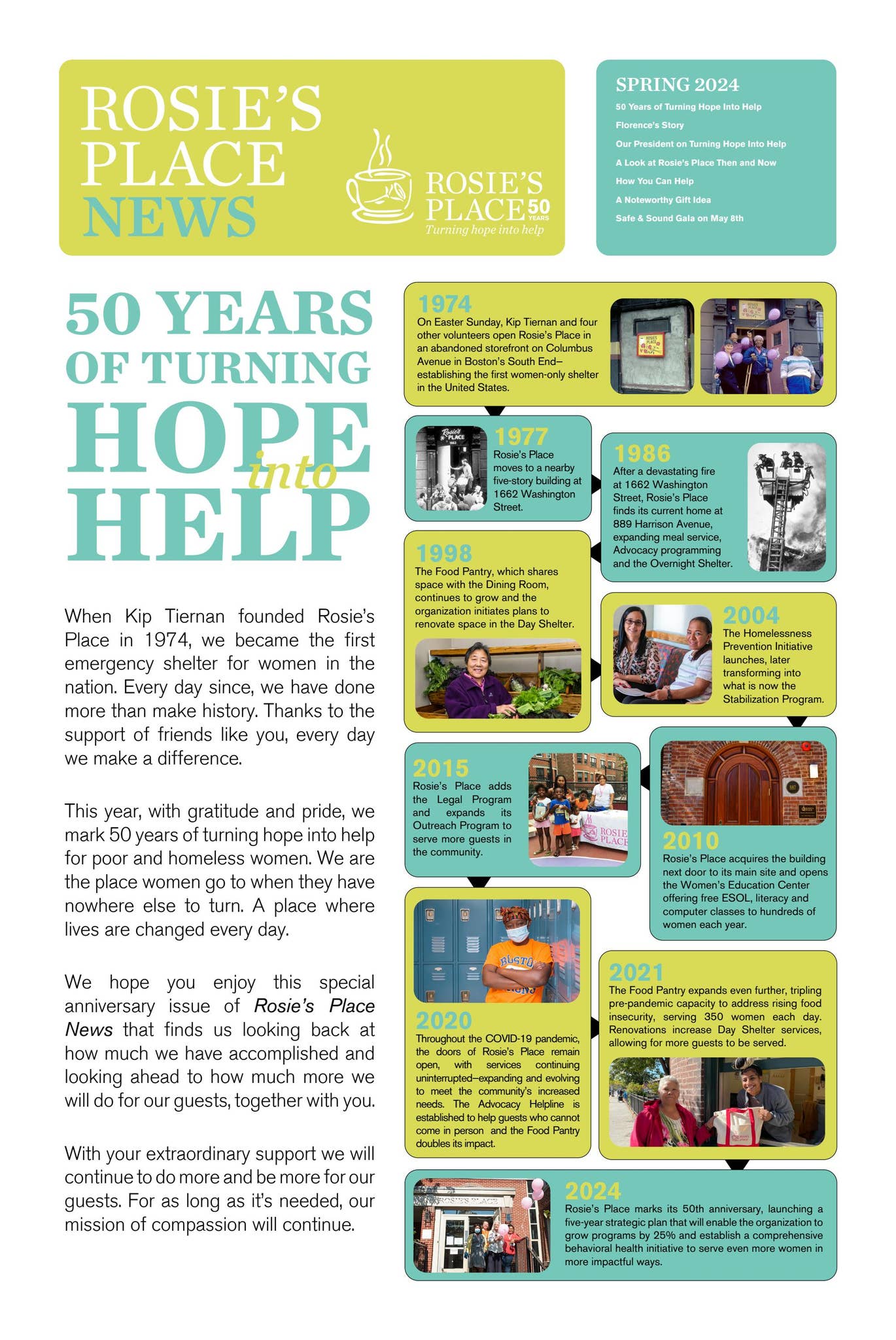
The ground beneath Rosie's Place at 889 Harrison Avenue holds a history of transformation that mirrors the institution itself. Throughout the 1700s and early 1800s, this specific coordinate in Boston was not solid ground a marsh, part of the South Cove that separated the Shawmut Peninsula from the mainland. It was only during the massive land reclamation projects of the mid-19th century, specifically the filling of the South Cove between 1833 and the 1850s, that the physical space for Harrison Avenue came into existence. By the late 1800s, the newly created land hosted a dense grid of rowhouses and industrial buildings, serving a swelling population of immigrants. The specific plot at 889 Harrison later became the site of the Warwick House, a location steeped in the radical Catholic activism of the 1960s and 70s. It was here, at the St. Philip's/Warwick House ministry, that founder Kip Tiernan volunteered, witnessing the absence of resources for destitute women that would eventually compel her to act.
The migration of Rosie's Place to this permanent in the South End was born of disaster. Following its initial years in a converted supermarket on Columbus Avenue and a subsequent move to 1662 Washington Street in 1977, the organization faced a catastrophe on April 29, 1984. A fire ravaged the Washington Street brownstone, destroying two floors and displacing the women who sought refuge there. While city officials, including Mayor Raymond Flynn, promised aid, Tiernan and the board held firm to their founding principle: absolute independence from state funding. They rejected government money to rebuild, relying instead on a surge of private donations. This financial autonomy allowed them to purchase the property at 889 Harrison Avenue in 1986, establishing a sovereign territory where their unorthodox philosophy of "unconditional love" could operate without bureaucratic interference.
The acquisition of the Harrison Avenue site marked a shift from makeshift shelters to a purpose-built sanctuary. Unlike the previous locations, which were adaptations of existing commercial or residential spaces, the new facility allowed for a design centered on dignity rather than mere warehousing. The layout prioritized privacy and community, moving away from the dormitory-style crowding common in men's shelters of the era. By 1998, the organization launched a capital campaign that raised $3. 2 million, funding a major renovation completed in 2000. This project did not just repair the physical structure; it redefined the shelter's function, converting it into a multi-service community center. The renovation expanded the lobby, improved the overnight facilities, and created dedicated spaces for advocacy and education, signaling that the solution to homelessness required more than a cot and a meal.
Expansion continued aggressively throughout the 2000s as the organization acquired adjacent properties to form a campus. In 2008, Chapman Construction completed a new administrative building at 47 Thorndike Street, attached directly to the main facility. This four-story structure, built on land contributed by the Boston Water and Sewer Commission, allowed administrative staff to move out of program areas, freeing up square footage for direct guest services. Two years later, in 2010, Rosie's Place opened the Women's Education Center at 887 Harrison Avenue, a rowhouse door that they purchased and renovated. This expansion added classrooms and computer labs, enabling the launch of strong ESOL and literacy programs. The physical integration of these buildings created a direct flow for guests, who could move from the dining room to a classroom without leaving the safety of the complex.
The dining room itself, the heart of the facility, underwent a significant transformation in 2014 and 2015. Designed by architects Finegold Alexander + Associates, the renovation increased capacity to 150 seats and introduced an enclosed courtyard, flooding the space with natural light. This construction project was not cosmetic; it reinforced the organization's core operational method: waitress service. Unlike standard soup kitchens where recipients wait in line for a tray, guests at Rosie's Place sit at tables and are served by volunteers. The 2015 renovation optimized the kitchen and service areas to support this model, ensuring that the architecture served the philosophy. The updated space also included a new handicapped-accessible entrance, removing physical blocks for the aging population of women who rely on the center.
Parallel to the dining room improvements, the food pantry evolved into a high-volume operation that the traditional "handout" model. The facility allocates space for a "choice pantry," designed to resemble a small grocery store. Here, women shop for items they need, fresh produce, proteins, and cultural staples, rather than receiving a pre-packed bag of generic goods. In 2021, in response to the economic of the pandemic, Rosie's Place tripled the capacity of this pantry. The physical layout was adjusted to handle increased foot traffic, serving approximately 350 women daily by 2024. This logistical shift required precise inventory management and storage solutions within the Harrison Avenue footprint, proving the building's adaptability to surging demand.
By 2026, the campus at Harrison Avenue stands as a complex ecosystem of social support, far removed from the single room at Rozen's Supermarket. The facility encompasses the main shelter, the education center, the legal advocacy offices, and the administrative wing. Data from the 2024-2025 fiscal period shows the of this operation: the dining room serves over 100, 000 meals annually, while the overnight program provides sanctuary to 20 women each night for up to 21 days. The infrastructure supports not just feeding and housing, hygiene and health, with facilities providing over 8, 600 showers and 1, 700 loads of laundry per year. This physical plant is maintained entirely through private funding, a testament to the viability of Tiernan's original refusal of state dependence.
| Year | Location/Project | Key Development |
|---|---|---|
| 1974 | Columbus Avenue | Founded in former Rozen's Supermarket. |
| 1977 | 1662 Washington St | Moved to brownstone; permanent housing initiative. |
| 1984 | 1662 Washington St | Major fire destroys two floors; decision to rebuild without state funds. |
| 1986 | 889 Harrison Ave | Purchase and opening of current main facility. |
| 2000 | 889 Harrison Ave | Major renovation to "Community Center" model ($3. 2M campaign). |
| 2008 | 47 Thorndike St | Construction of new administrative wing attached to main building. |
| 2010 | 887 Harrison Ave | Opening of Women's Education Center in adjacent rowhouse. |
| 2015 | 889 Harrison Ave | Dining Room renovation by Finegold Alexander; capacity increased to 150. |
| 2021 | 889 Harrison Ave | Food Pantry capacity tripled to meet post-pandemic demand. |
Operational Philosophy and Private Funding Model

The operational soul of Rosie's Place is defined by a single, non-negotiable financial doctrine established in 1974: the absolute refusal of all city, state, and federal government funding. This policy is not a fundraising strategy a political act, designed to insulate the sanctuary from the bureaucratic violence that has characterized poverty management in Massachusetts since the colonial era. By rejecting the "King's shilling," founder Kip Tiernan ensured that Rosie's Place would never be deputized as an arm of the state, freeing it from the mandate to categorize, track, and police the women it serves.
To understand the of this decision, one must examine the historical it rejected. Since the passage of the Massachusetts Poor Laws in the late 17th century, aid was contingent upon moral judgment. The "Overseers of the Poor," a body formalized in Boston in 1692, operated on a binary that separated the "worthy poor" (widows, the infirm) from the "vicious poor" (alcoholics, the idle). This system evolved into the 20th-century welfare state, which, while more secular, retained the obsession with eligibility. Government grants for homeless shelters in the 1970s and 1980s came with strings: mandatory identification, sobriety tests, invasive data collection for the Homeless Management Information System (HMIS), and strict limits on length of stay. Tiernan, influenced by the radical anarchism of Dorothy Day and the Catholic Worker movement, recognized that accepting state money would force Rosie's Place to become a gatekeeper rather than a sanctuary. She famously argued that "charity is scraps from the table, and justice is a seat at the table," positing that state-sponsored charity frequently served to control the poor rather than liberate them.
The financial model that sustains this independence has evolved from a chaotic, volunteer-driven effort into a sophisticated private equity engine for social justice. In its year, Rosie's Place operated on $250 gathered from Tiernan's friends in the suburbs. By the fiscal year ending June 30, 2024, the organization reported total revenue of approximately $18. 6 million, derived entirely from private sources. This capital structure is an anomaly in a sector where most shelters rely on government contracts for 50% to 80% of their operating budgets. The absence of public funding means Rosie's Place does not suffer from the "reimbursement gap", the chronic delay between service delivery and state payment that frequently bankrupts smaller non-profits. Instead, it operates with a liquidity and speed that the public sector cannot match.
The composition of this private funding reveals a broad base of support that insulates the organization from donor fatigue or economic downturns. Financial filings from 2023 and 2024 indicate that Rosie's Place maintains a "program expense ratio" of approximately 84%, meaning 84 cents of every dollar raised goes directly to services. This efficiency is high for the sector, yet it is achieved without the economy of provided by massive government block grants. The revenue stream is a mix of individual donations, corporate partnerships, and foundation grants. Notably, the organization has built a substantial financial; by 2025, net assets, including property, equipment, and cash reserves, hovered near $44 million. This endowment-like reserve functions as a "sovereignty fund," allowing the organization to weather fiscal storms without compromising its mission or laying off staff, a resilience displayed during the economic contractions of the early 2020s.
The operational dividends of this funding model are visible in the shelter's daily mechanics. Because they do not answer to the Department of Housing and Community Development (DHCD) or HUD, Rosie's Place staff are not required to demand a driver's license or social security number from a woman seeking a meal. In a surveillance age where data is a currency, this anonymity is a rare luxury afforded to the destitute. A woman can enter Rosie's Place, eat, sleep, and receive legal counsel without ever generating a digital footprint that could be used by law enforcement or immigration authorities. This "radical hospitality" creates a firewall between the guest and the state, making Rosie's Place one of the few truly safe harbors for undocumented women and those fleeing domestic violence who fear being tracked.
yet, the model is not without its critics or its risks. The reliance on private philanthropy requires a relentless fundraising machine. The development office at Rosie's Place is as serious to its survival as its kitchen staff. Executive compensation reflects this corporate-style reality; in FY2023, the President/CEO compensation was reported at approximately $345, 000, a figure that draws scrutiny in the non-profit world is defended by the Board as necessary to retain top-tier talent capable of managing a $20 million enterprise without a government safety net. The pressure to maintain this revenue stream is constant. Unlike a government contract which might be renewed for five years, private donors must be courted and convinced annually. This forces the organization to market the stories of its guests, a practice that walks a fine ethical line between raising awareness and commodifying suffering.
By 2026, the strategic of this model have shifted toward expansion. The organization's "2024, 2029 Strategic Plan" leveraged its financial independence to launch a behavioral health initiative and expand programming by 25%, moves that would have been impossible under the rigid scope-of-work restrictions of a government grant. While the state struggles to process housing vouchers due to administrative gridlock, Rosie's Place uses its liquid assets to provide immediate eviction prevention funds, cutting checks to landlords within days, not months. This agility highlights a widening in Boston's social safety net: a slow, data-heavy public system for the "documented" poor, and a fast, private, privacy-centric system for those who fall through the cracks.
| Operational Metric | Rosie's Place (Private Model) | Standard State-Funded Shelter |
|---|---|---|
| Primary Revenue Source | Individual/Corporate Donations (100%) | State/Federal Contracts (60-90%) |
| Data Requirement | Anonymous / Voluntary | Mandatory HMIS Entry |
| Spending Flexibility | High (Discretionary funds available immediately) | Low (Restricted to specific line items) |
| Cash Reserve (Net Assets) | ~$44 Million (High Stability) | <3 Months Operating Cash |
| Entry Barrier | None (Behavior-based only) | ID, Sobriety, or Referral frequently required |
The "Rosie's Place Model" stands as a rebuke to the prevailing logic of the non-profit industrial complex. It proves that a social service agency can without the state, provided it can mobilize a community of private conscience. Yet, this model is not easily replicable. It relies on fifty years of brand equity and a specific donor culture unique to Boston's wealthy philanthropic circles. While it offers a superior experience for the individual woman, dignity, privacy, speed, it cannot replace the of the state. Instead, it functions as a serious pressure valve and a moral compass, demonstrating what social welfare could look like if it were decoupled from the of control.
Emergency Shelter and Nutritional Services
The physical manifestation of this philosophy is the Emergency Shelter, which has evolved from ten cots in an abandoned supermarket to a specialized 20-bed program at 889 Harrison Avenue. Unlike the warehousing method of municipal shelters that line up hundreds of guests nightly, Rosie's Place maintains a deliberate small- intimacy. The program offers a 28-day stay, a duration designed to provide stability rather than just a single night of respite. Admission is determined through a lottery system held Monday through Friday at 9: 00 a. m., a mechanic that emphasizes fairness over favoritism. Because the demand consistently the 20-bed capacity, the shelter operates at 100% occupancy, serving approximately 150 to 200 unique women annually in this specific program. The small number of beds is not a failure of a preservation of dignity; guests have access to a sitting room, laundry facilities, and a computer lab, creating a semblance of home that mass shelters cannot replicate.
The nutritional services at Rosie's Place reveal the sheer of food insecurity in modern Boston. What began as a soup kitchen has morphed into a high-volume nutritional hub. The Dining Room operates 365 days a year, serving breakfast, lunch, and dinner. In Fiscal Year 2024, the Dining Room served 187, 000 meals, a 23% increase from the previous year. This surge reflects a post-pandemic economic reality where inflation has eroded the purchasing power of low-income residents. The demographic profile of the dining line has shifted; while it once primarily served the chronically homeless, it frequently includes working poor women and the elderly who cannot stretch their fixed incomes to cover grocery costs.
The Food Pantry operates alongside the Dining Room, functioning as a serious stopgap for women who have housing face "heat or eat" dilemmas. Unlike the pre-bagged, generic handouts common in the 20th century, the Pantry uses a choice-based model that allows women to select items culturally relevant to their diets, reducing waste and affirming autonomy. The volume of aid distributed here is massive. In the last fiscal pattern, the Pantry supported 8, 800 unique women, facilitating over 74, 000 visits. A disturbing trend in recent data is the sharp rise in geriatric poverty; visits by women over the age of 65 increased by 54% between 2020 and 2024. To accommodate this population, Rosie's Place instituted specific hours for seniors, ensuring they do not have to compete with the general rush.
| Fiscal Year | Meals Served (Dining Room) | Pantry Visits | Shelter Guests (Unique) | Key Operational Context |
|---|---|---|---|---|
| 2020 | 88, 109 | 17, 781 | 207 | COVID-19 onset; dining room shifted to "to-go" only; shelter stays extended indefinitely to prevent viral spread. |
| 2021 | 103, 000 | 34, 000+ | 178 | Pantry capacity tripled to meet pandemic economic; renovations to Day Shelter completed. |
| 2023 | 152, 000 | 60, 000+ | 152 | Inflationary pressure drives meal counts up 47% year-over-year; introduction of expanded produce options. |
| 2024 | 187, 000 | 74, 000 | 178 | Historic high in food demand; 54% increase in elderly guests (65+) over four-year period. |
The operational costs for these services are covered entirely by private philanthropy. In FY2024, the organization raised over $15. 3 million, with 84 cents of every dollar directed to programming. This financial independence shields the shelter from the volatility of government budget cuts. For instance, when federal funding freezes threatened other Boston nonprofits in early 2025, Rosie's Place continued operations without interruption. This autonomy also permits the organization to serve nutritious, high-quality meals, fresh produce, lean proteins, and low-sodium options, rather than the surplus commodity foods that frequently characterize state-funded nutritional programs.
The "Groceries" program has also expanded its reach beyond the shelter walls. Recognizing that transportation is a barrier for elderly and disabled women, the Stabilization Team delivers food directly to the homes of former guests. This prevents the pattern of homelessness from restarting; by subsidizing the grocery budget, Rosie's Place frees up a woman's limited income for rent and utilities. The data shows this method works: 100% of the guests receiving this targeted stabilization support remained housed in the last fiscal year.
Current projections for 2026 indicate that food insecurity remain the primary driver of new intakes. The organization has launched a strategic plan to grow its programs by 25% over four years to meet this need. This expansion includes extending Dining Room hours and increasing the volume of the Pantry. The persistence of hunger in a city as wealthy as Boston serves as a damning indictment of the social safety net, yet Rosie's Place remains the anomaly: a place where the right to eat and sleep is not contingent on behavior, sobriety, or citizenship, is treated as a fundamental human imperative.
Women's Education Center and Academic Programs

The establishment of the Women's Education Center (WEC) at Rosie's Place represents a decisive break from Boston's three-century history of managing poor women through "industrial" training. From the 1700s through the mid-20th century, charitable education for destitute women in Massachusetts was almost exclusively designed to produce competent domestic servants. Institutions like the Industrial School for Girls, founded in Dorchester in 1853, operated with the explicit goal of training "destitute or neglected girls" in housework and sewing to render them "self-supporting" within the confines of low-wage service. Rosie's Place rejected this utilitarian view of the poor female intellect. Instead of training women for servitude, the WEC was conceived to provide the literacy and linguistic tools necessary for autonomy, operating on the premise that education is a fundamental right rather than a behavior modification strategy.
The WEC began not as a formal institution as an organic response to the immediate needs of guests in the shelter's dining room. Early volunteers recognized that women could not navigate the city's bureaucracy simply because they could not read the forms or speak the language. What started as ad-hoc English tutoring at dining tables evolved into a detailed academic department that occupies three dedicated floors of the facility. By 2024, the center had formalized a curriculum that spans basic literacy for native English speakers, multiple levels of English for Speakers of Other Languages (ESOL), and advanced computer training. Unlike traditional adult education programs that penalize attendance gaps caused by housing instability, the WEC model is designed for the reality of homelessness, allowing women to pause and resume their education without bureaucratic expulsion.
The demand for these services reveals the depth of the educational deficit among Boston's marginalized women. In the 2024-2025 fiscal period, the WEC enrolled 340 students in 658 separate classes. These courses range from "Literacy" (for students with little to no formal schooling in their native language) to ESOL Levels 1 through 4. The student body is a demographic cross-section of global displacement and local widespread failure, including women from Haiti, China, Cape Verde, and the United States. A serious component of the curriculum is the "Connections" writing project, where students, writing for the time in any language, document their personal histories. In collaboration with the Emerson College Pub Lab, these narratives are professionally published, a psychological intervention that validates the students' experiences as worthy of public record.
The digital divide remains a primary barrier to economic stability for Rosie's Place guests. The WEC addresses this through a multi-pronged digital literacy initiative that intensified following the COVID-19 pandemic. Recognizing that guests rely solely on smartphones for internet access, the center integrated app-based learning tools like Cell-Ed, allowing women to continue their studies remotely even when shelter hours or work schedules conflict with class times. The facility maintains a computer lab where guests receive instruction in typing, email management, and software proficiency, skills mandatory for even entry-level employment. In 2024, the center reported that students utilized these labs not just for coursework, to reclaim their digital identities, navigating online housing portals and government assistance sites that have become inaccessible to the non-digital poor.
Workforce development at Rosie's Place operates in tandem with the academic programs, distinguishing itself from the "work- " models prevalent in federal welfare reform. The focus is on sustainable employment rather than rapid placement in low-quality jobs. Data from the 2024-2025 reporting period indicates that the Workforce Development team worked with 430 guests. Of these, 78 women entered and completed job training programs, a figure that more than doubled from the previous year. This surge suggests a growing efficacy in the center's ability to the gap between basic education and vocational certification. The program placed 27 women in new jobs during this period, a metric that reflects the high blocks to entry for homeless women in Boston's competitive labor market.
The operational engine of the WEC is its volunteer corps. The center does not rely on a large staff of paid instructors instead trains hundreds of volunteers to deliver its curriculum. This model serves a dual purpose: it keeps overhead costs low, ensuring that 84 cents of every dollar raised goes directly to services, and it social cohesion between Boston's housed and unhoused populations. Volunteers undergo rigorous training to understand the trauma-informed care model, ensuring that the classroom remains a sanctuary rather than a source of stress. This "collaborative" learning environment frequently sees advanced students assisting newer ones, disrupting the traditional power of charity and replacing it with a peer-support network.
Beyond the walls of the Harrison Avenue facility, the WEC's philosophy extends into the community through strategic partnerships. The Rosie's Place School Collaborative has established a presence in 50 Boston Public Schools, working to stabilize families before they enter the shelter system. By placing advocates directly in schools in high-poverty neighborhoods like Roxbury and Dorchester, the organization connects mothers with educational and housing resources, using the school system as a triage point for homelessness prevention. also, partnerships with legal organizations such as the Rian Immigrant Center and Greater Boston Legal Services provide the necessary legal advocacy to ensure that a student's academic progress is not derailed by immigration or housing court battles.
| Metric | Count/Value | Context |
|---|---|---|
| ESOL Students Enrolled | 340 | Classes offered on-site and virtually |
| Total Classes Held | 658 | Includes Literacy, ESOL Levels 1-4, Computer Skills |
| Workforce Dev. Guests | 430 | Women receiving career counseling and support |
| Job Training Completions | 78 | >100% increase from previous fiscal year |
| Job Placements | 27 | Direct placement in sustainable employment |
| Volunteer Hours (Org-wide) | ~60, 000 | Equivalent to approx. 30 full-time staff |
The trajectory of the Women's Education Center points toward an increasing integration of remote learning and behavioral health support. The pandemic forced a rapid adoption of hybrid models, Zoom classes and "teaching phone calls", which have as important tools for guests who work irregular hours or absence transportation. As the center moves toward 2026, the data indicates a shift from simple literacy to "life stabilization," where academic progress is tightly paired with housing retention and legal status. In a city where the cost of living continues to displace the working poor, the WEC functions not as a school, as a fortification against the erasure of Boston's most women.
Legal Advocacy and Housing Stabilization
The legal architecture of Massachusetts has functioned as a method for the displacement of poor women for over three centuries. In 1692, the Massachusetts General Court passed the Act for Regulating of Townships, a statute that codified the practice of "warning out." Under this law, town selectmen held the authority to legally banish any newcomer deemed likely to become a financial load on the public purse. Historical records from the 1700s indicate that this instrument was wielded with disproportionate frequency against single women, widows, and those bearing children out of wedlock. These women were not refused entry; they were served warrants and physically escorted across town lines to avoid the "welfare cost" of their existence. By 2026, the terminology had shifted from "warning out" to "summary process eviction," yet the demographic reality remained largely unchanged. Data from the Eviction Lab in 2024 and 2025 confirmed that women constituted 58% of all defendants in Boston eviction filings, even with comprising only 53% of the renting population. The line connecting the colonial constable to the modern housing court judge is direct: the law prioritizes property and municipal solvency over the stability of destitute women.
Rosie's Place recognized early in its history that providing a bed for the night was a temporary palliative to a permanent legal emergency. Kip Tiernan's founding vision in 1974 was rooted in immediate sanctuary, yet the organization quickly understood that homelessness was frequently a legal outcome rather than a personal failure. By the mid-1980s and into the 2000s, the shelter evolved into a of advocacy, rejecting the passive role of a charity in favor of active legal intervention. Unlike state-funded agencies bound by strict eligibility metrics, frequently requiring a woman to be literally street-homeless before receiving aid, Rosie's Place used its financial independence to intervene before the lock-out occurred. This distinction is important. In the state of Massachusetts, the "right to shelter" is heavily gatekept; the right to legal counsel in eviction court does not exist for tenants in the same way it does for criminal defendants. Rosie's Place stepped into this vacuum, establishing a Legal Program that by fiscal year 2024 was assisting 1, 200 women annually with high- cases involving housing, immigration, and family law.
The operational philosophy of the Legal Program challenges the standard "triage" model of legal aid. In the broader legal system, a woman facing eviction for non-payment is frequently processed through a rapid settlement negotiation that delays, rather than prevents, displacement. Rosie's Place advocates, yet, attack the root causes of the instability. In fiscal year 2024, the organization's eviction prevention services kept 2, 664 women housed, a 32% increase from the previous year. This surge reflects the expiration of pandemic-era protections and the resumption of aggressive filing tactics by landlords. The organization's data from 2023 through 2025 shows that while "non-payment" remains the reason for 72% of filings, a significant minority are "no-fault" evictions, modern equivalents of "warning out" where a landlord simply chooses to clear the unit, frequently to renovate and re-rent at a higher price point. In these cases, the legal team does not negotiate an exit; they fight for time, relocation expenses, and the sealing of court records to prevent the eviction from becoming a permanent scarlet letter.
The sealing of Criminal Offender Record Information (CORI) represents a serious component of this stabilization strategy. In Massachusetts, a criminal record, even for minor offenses or dismissed charges, can act as an indefinite bar to housing and employment. Landlords and employers routinely screen applicants using these databases, creating a class of "unhouseable" women who are legally free yet socially paralyzed. Rosie's Place conducts specialized CORI sealing clinics, erasing these digital shackles. By clearing a woman's record, they do not just solve a legal problem; they unlock access to the entire housing market. This work is particularly necessary for women of color, who are disproportionately represented in both the criminal justice system and the homeless population. The intersection of race and displacement is clear: while Black renters make up only 28% of the population in the areas tracked by Eviction Lab, they accounted for 36% of eviction filings in 2024. The legal aid provided by Rosie's Place serves as a corrective force against this widespread racial bias.
Housing stabilization at Rosie's Place extends beyond the courtroom. The organization pioneered a "Housing " adjacent model that prioritizes retention over mere placement. The transition from shelter to independent living is the most dangerous period for a formerly homeless woman; without support, the isolation and financial frequently lead to a return to the streets within twelve months. To counter this, Rosie's Place established a Stabilization Program that follows women into their new homes. Advocates perform home visits, negotiate with landlords, and provide funding for rent arrears or utility shut-offs. The efficacy of this method is absolute. In fiscal year 2024, the program reported a 100% retention rate for the women in its stabilization cohort. This metric defies the industry standard, where retention rates frequently hover between 70% and 85%. By treating the landlord-tenant relationship as a mediated partnership rather than an adversarial combat zone, Rosie's Place prevents the minor lease violations that precipitate eviction.
Immigration status constitutes another major front in this legal war. of the guests at Rosie's Place are undocumented or in precarious legal standing, making them ineligible for federal housing subsidies like Section 8. These women live in the shadow economy, to exploitation by landlords who know they cannot call the police or the housing inspector. The Legal Program partners with specialized immigration attorneys to regularize status where possible, securing work permits and asylum protections. This is housing stabilization by other means: a woman with a work permit can earn a legitimate wage, signing a lease in her own name rather than relying on predatory sublets. The influx of migrants into Boston in the mid-2020s, paired with a tightening federal immigration policy, intensified the demand for these services. By 2025, immigration-related legal inquiries at Rosie's Place had doubled compared to 2021 levels, reflecting the deepening emergency of the city's newcomer population.
The financial independence of Rosie's Place allows for a flexibility that state-funded programs cannot match. Government rental assistance vouchers, such as RAFT (Residential Assistance for Families in Transition), frequently require a "Notice to Quit" from a landlord before funds are released. This requirement perversely forces a tenant to escalate her own housing instability to qualify for help. Rosie's Place rejects this bureaucratic absurdity. If a woman is falling behind, the organization can problem a check immediately, preventing the Notice to Quit from ever being printed. This "upstream" intervention saves the court system thousands of dollars in processing costs and, more importantly, spares the woman the trauma of a legal battle. In 2024 alone, the organization raised over $15 million from private sources, ensuring that this rapid-response capability remained unhindered by state budget cuts or policy shifts.
The table illustrates the continuity of displacement tactics used against poor women in Massachusetts, contrasting the colonial era with the current housing emergency.
| Feature | Colonial Era (1700-1790) | Modern Era (2020-2026) |
|---|---|---|
| Legal method | "Warning Out" (Warrants issued by Selectmen) | Summary Process Eviction / No-Fault Notice to Quit |
| Primary Justification | Prevention of "Public Charge" (Welfare Cost) | Protection of Property Rights / Rent Arrears |
| Target Demographic | Widows, Single Mothers, "Disorderly" Women | Female-Headed Households (58% of defendants) |
| Consequence | Physical removal to another town | Blacklisting (CORI/Credit), Shelter System entry |
| Legal Defense | Non-existent (Status determined by town vote) | Right to Counsel (Limited/Non-guaranteed in civil court) |
As Boston moves through 2026, the housing market remains a hostile environment for low-income women. The median rent for a one-bedroom apartment in the city has far outpaced the value of state vouchers, creating a "subsidy gap" that legal aid alone cannot close. Yet, the combination of aggressive legal defense and direct financial stabilization offers a proven bulwark against homelessness. Rosie's Place has demonstrated that eviction is not an inevitability of poverty a consequence of a legal system that can be successfully challenged. By sealing records, funding arrears, and standing between the landlord and the tenant, the organization the of displacement one case at a time. The 100% retention rate in their stabilization program is not a statistical anomaly; it is an indictment of a state system that accepts eviction as a routine cost of doing business.
Public Policy Work and Legislative Activism
The legislative activism of Rosie's Place is rooted in a fundamental distinction drawn by its founder, Kip Tiernan: the difference between charity and justice. While charity provides immediate relief, Tiernan argued that justice requires a "seat at the table" where decisions are made. This philosophy necessitated a structural separation from the state; since its inception, Rosie's Place has refused all city, state, and federal funding. This financial independence was not symbolic a tactical need, allowing the organization to critique government policy without fear of financial retribution. Tiernan's concept of "The Edge", the precarious economic geography forced upon the poor by those in power, became the lens through which the organization viewed public policy. The mission was never solely to shelter women from the cold, to the statutory frameworks that kept them there.
During the conservative retrenchment of the late 1970s and 1980s, as government spending on human services contracted, Rosie's Place expanded its policy footprint through coalition building. In 1980, Tiernan and fellow activist Fran Froehlich co-founded the Poor People's United Fund (PPUF). This entity was designed to funnel "spare change" philanthropy directly to grassroots organizations that were too small or too radical to compete for major foundation grants. This era also saw the creation of the Boston Food Bank ( the Greater Boston Food Bank) and the Boston Health Care for the Homeless Program. These were not just service providers policy interventions, created to fill the vacuums left by a retreating welfare state. The organization's early activism was characterized by this dual method: creating parallel institutions to ensure survival while simultaneously besieging the legislature to demand widespread repair.
The 1990s brought the organization into direct conflict with the "welfare reform" movement that swept the United States. In 1995, Massachusetts enacted a punitive measure known as the "Family Cap" (or "Cap on Kids"), which denied additional cash assistance to children conceived while their families were already receiving aid. Based on the flawed premise that withholding $100 a month would alter reproductive behavior, the policy instead deepened child poverty for over two decades. Rosie's Place became a central player in the "Lift Our Kids" coalition, waging a twenty-four-year war against this statute. The organization provided testimony, mobilized guests to lobby the State House, and tracked the devastating metrics of the policy. This long-term struggle culminated in April 2019, when the Massachusetts Legislature voted to repeal the Family Cap, overriding a gubernatorial veto. The victory restored benefits to approximately 8, 700 children, a testament to the organization's generational stamina.
In the 21st century, the Public Policy department formalized its operations, focusing heavily on the intersection of criminal justice and homelessness. The passage of Chapter 256 of the Acts of 2010, known as the CORI (Criminal Offender Record Information) Reform, was a watershed moment. The "Ban the Box" provision prohibited employers from asking about criminal history on initial job applications, a barrier that had long trapped Rosie's Place guests in unemployment. Following the legislative win, the organization pivoted to implementation, establishing a CORI Sealing Clinic in partnership with Ropes & Gray. This clinic operationalized the new law, helping thousands of women seal old records to secure housing and employment, proving that legislative language implies little without legal enforcement.
The housing emergency of the 2020s forced a pivot toward aggressive tenant protections. As median rents in Massachusetts soared, rising 53% between 2016 and 2023, Rosie's Place advocates testified in support of S. 1447, the "Act Enabling Cities and Towns to Stabilize Rents." The organization presented data showing that eviction was no longer a result of personal failure a mathematical certainty for women on fixed incomes. In Fiscal Year 2023 alone, the organization's eviction prevention services kept 2, 664 women housed, a 32% increase from the previous year. These metrics were weaponized in committee hearings to that without rent stabilization, the shelter system would collapse under the weight of the newly displaced.
By 2025 and 2026, the policy agenda had expanded to address the of the social safety net's purchasing power. Rosie's Place lobbyists were instrumental in securing a 10% increase in TAFDC (Transitional Aid to Families with Dependent Children) cash assistance grants, which took effect in April 2025. This adjustment raised the monthly grant for a family of three from $783 to $861, a serious, albeit insufficient, step toward the "Deep Poverty" line of $1, 076. Simultaneously, the organization fought a defensive battle against federal retrenchment on language access. In response to federal signals to minimize multilingual services, Rosie's Place championed the "Act Relative to Language Access and Inclusion" (H. 3384 / S. 2125). This state-level legislation mandated that public-facing agencies provide translation for important documents, a direct response to the needs of the organization's increasingly diverse guest population, of whom had been barred from benefits solely due to linguistic blocks.
Central to this legislative work is the Public Policy Council, a body composed of Rosie's Place guests who meet monthly to analyze bills and prepare testimony. This structure rejects the traditional model of advocacy for the poor in favor of advocacy by the poor. Guests are trained not just to tell their trauma stories, to speak as experts on the failures of the safety net. Whether testifying on the Massachusetts Rental Voucher Program or the Affordable Homes Act, these women bring a granular, irrefutable data set to Beacon Hill: the reality of their own lives. This method ensures that when Rosie's Place speaks, it does so with the authority of those who live on the edge, demanding not just a meal, the justice of a seat at the table.
Social Enterprise Projects and Employment Training

| Era | Institution | Labor Type | Economic Model | Objective |
|---|---|---|---|---|
| 1739, 1800s | Boston Workhouse | Oakum picking, flax spinning | Forced Labor | Punishment / Offset costs |
| 1800s, 1900s | Industrial Schools | Domestic servitude training | Indentured / Low-wage | Moral reform / Social control |
| 1974, 1995 | Rosie's Place (Early) | None required | Charity / Sanctuary | Survival / Dignity |
| 1996, Present | Women's Craft Co-op | Artisan manufacturing | Social Enterprise (Paid) | Skill building / Resume gap filler |
| 2024, 2026 | Workforce Development | Digital literacy, CORI sealing | Support | Career placement / CORI clearance |
By the mid-2020s, the of employment training at Rosie's Place expanded beyond the craft table to address the digital and legal blocks of the modern economy. The **Workforce Development Program**, revitalized by a major three-year grant in 2025, integrates job readiness with legal advocacy. Data from the 2024, 2025 period highlights the program's intensity: staff worked with 430 guests, resulting in 78 women completing certification programs and 27 securing permanent employment. While these numbers may appear modest compared to the thousands served in the dining room, they represent high-friction victories. Each placement involves overcoming the "CORI barrier", criminal offender record information that frequently disqualifies homeless women from entry-level jobs in healthcare and retail. The integration of the Legal Program with employment services is a serious tactical evolution. In the 18th century, a criminal record was a life sentence to the almshouse. In 2026, Rosie's Place attorneys work with Ropes & Gray to run CORI sealing clinics, legally erasing past misdemeanors to clear the route for employment. This is "employment training" in its most pragmatic form: removing the bureaucratic shackles that prevent women from being hired. Simultaneously, the **Women's Education Center** serves as the feeder system for these employment initiatives. Recognizing that the 21st-century equivalent of "picking oakum" is manual labor without digital literacy, Rosie's Place prioritizes computer training. The drop-in computer lab and ESOL (English for Speakers of Other Languages) classes are essential prerequisites for the workforce program. In FY24, the center enrolled 340 students in ESOL classes. The ability to navigate an online job application or a Zoom interview has become as important as the job skills themselves, particularly after the post-2020 shift toward remote and digital- hiring processes. The financial model of these projects reflects a "mission- " accounting. While the Women's Craft Cooperative generates sales revenue, it does not subsidize the shelter's $21. 7 million operating budget (FY25). Instead, the organization subsidizes the cooperative, viewing the wages paid to guests as a program expense rather than a labor cost. This distinction is important. A commercial factory minimizes labor costs to maximize profit; Rosie's Place maximizes labor participation to maximize human capital. Looking toward the latter half of the 2020s, the organization's strategic plan (2024, 2029) a 25% growth in these programs. This expansion is not about adding seats to a classroom about deepening the "wraparound" nature of the support. The new behavioral health initiative, launched to address the mental health emergency exacerbated by the pandemic, works in tandem with employment specialists. The understanding is that a woman cannot hold a job if her trauma is untreated, just as she cannot heal from trauma if she is terrified of starvation. The contrast between 1739 and 2026 is clear. The Boston Overseers of the Poor sought to extract value from the poor to spare the taxpayer. Rosie's Place invests value into the poor to restore the citizen. The jewelry created in the Women's Craft Cooperative serves as a tangible symbol of this shift: small, beautiful objects created not by inmates, by artisans reclaiming their own agency.
Executive Leadership and Organizational Structure
| Era | Leadership Model | Key Figure | Primary Funding Source | Organizational Focus |
|---|---|---|---|---|
| 1974, 1978 | Volunteer shared | Kip Tiernan (Founder) | Small Private Donations | Emergency Shelter, "Presence" |
| 1978, 1998 | Early Staffing | Various Directors | Growing Private Donor Base | Stabilization, Facility Acquisition |
| 1998, 2019 | Professional Management | Sue Marsh (Exec. Director) | Major Philanthropy | Multi-service Community Center |
| 2019, 2026 | Corporate Non-Profit | Leemarie Mosca (President/CEO) | Endowment & Corporate/Foundation | Strategic Expansion, Data-Driven Advocacy |
Historical Designation as First American Women's Shelter
The designation of Rosie's Place as the emergency shelter for women in the United States is not a chronological footnote; it represents a fundamental shift in the American management of female poverty. Before 1974, the architecture of social welfare in Boston, and indeed the nation, operated on a gendered bifurcation that had since the colonial "Overseers of the Poor" were established in 1692. Men without means were viewed as vagrants or laborers down on their luck, serviced by flophouses and missions like the Pine Street Inn. Women without means, yet, were pathologized. They were either "fallen women" requiring moral reformation in asylums, or "worthy widows" deserving of quiet charity. There was no space for the woman who was simply poor, homeless, and perhaps struggling with addiction or mental illness, outside of the punitive wards of state hospitals or the county jail.
By the early 1970s, this gap in services had created a grotesque reality on the streets of Boston. Kip Tiernan, a towering figure in local activism, observed women disguising themselves as men, binding their breasts and deepening their voices, to gain entry into male-only shelters for a meal and a cot. This observation shattered the prevailing myth that homelessness was a male phenomenon. When Tiernan traveled to major cities like Chicago, New York, and Philadelphia in 1973, she found a uniform absence of facilities for women. The "shelter" as a concept existed for men; for women, the options remained limited to domestic violence refuges (which were just emerging, such as Women's Advocates in St. Paul) or lock-up facilities. Rosie's Place, opened on Easter Sunday 1974 in an abandoned Rozen's Supermarket on Columbus Avenue, was the institution to offer sanctuary to women without the prerequisite of a domestic violence claim or a pledge of moral conversion.
The operational philosophy established in 1974 was a direct rejection of the 1700s-era "worthy poor" distinction. Tiernan and the founding group refused all government funding, a policy that remains in force in 2026. This financial independence was strategic: it insulated the shelter from the bureaucratic requirement to report guests' names to the state, a practice that would have deterred the undocumented, the addicted, and the paranoid. In an era when "charity" frequently meant a transaction of obedience for bread, Rosie's Place adopted the slogan "Justice, not charity." The initial facility was rudimentary, coffee, used clothing, and mats on the floor, it provided a physical space where a woman's presence was not a legal or moral aberration.
The trajectory from that storefront to the current campus on Harrison Avenue mirrors the increasing complexity of female homelessness. The original 1974 model focused on immediate survival: freezing nights and starvation. By the 1980s, the deinstitutionalization of mental health patients flooded Boston's streets with women who required clinical support, not just a bed. The 1986 fire that destroyed the Washington Street location forced a rebuilding process that integrated these new realities into the architecture. The current facility, opened in the late 1980s and expanded repeatedly through the 2000s, evolved into a multi-service community center. It acknowledged that "shelter" was insufficient for a population dealing with the long-tail effects of the opioid epidemic, the housing affordability emergency of the 2010s, and the migrant influxes of the 2020s.
Data from the last decade illustrates the of this evolution. In 2026, Rosie's Place is no longer just a night shelter a high-volume triage center for the failures of the American safety net. The organization serves approximately 12, 000 to 13, 000 unique women annually. The demand for food services, in particular, has exploded, reflecting the widening gap between wages and the cost of living in Greater Boston.
| Metric | 1974 (Inception) | 2012 | 2025 (Fiscal Year) |
|---|---|---|---|
| Primary Service | Overnight Shelter, Coffee | Shelter, Meals, Advocacy | Community Center (Legal, stabilize, medical) |
| Annual Revenue | ~$250 (initial donations) | ~$10 Million | ~$21. 7 Million |
| Meals Served | Ad-hoc / Hundreds | ~65, 000 | 103, 000+ |
| Government Funding | $0 | $0 | $0 |
| Key Demographics | Single women, elderly, alcoholics | Diverse, mental health focus | Migrants, working poor, opioid recovery |
The 2020s have tested the " shelter" designation in new ways. The post-pandemic economic saw a surge in women who were employed unhoused, living in cars or "couch surfing" due to Boston's astronomical rents. Under the leadership of President/CEO Leemarie Mosca, the organization launched a strategic plan in 2024 to expand programs by 25%, specifically targeting eviction prevention and legal stabilization. The Legal Program, established in 2015, became a serious firewall, assisting nearly 1, 000 women a year by 2025 in matters of immigration, housing, and family law. This shift marks the third era of the shelter's history: from survival (1974-1990) to rehabilitation (1990-2015) to stabilization and prevention (2015-2026).
Historically, the significance of Rosie's Place lies in its proof of concept. In 1700, a destitute woman was a ward of the state or a pariah. In 1974, she was a guest. By 2026, she is a client with rights to privacy and legal defense. The shelter's refusal to accept the "inevitability" of female poverty, and its rejection of the state's money, allowed it to bypass the punitive moralizing that characterized three centuries of American poor relief. It demonstrated that a sanctuary could exist without coercion. As other cities scrambled to open women's shelters in the late 1970s and 1980s, they frequently looked to the Rosie's Place model, though few managed to replicate its strict adherence to private funding. The institution stands today not just as a building on Harrison Avenue, as the physical of the Puritanical idea that a homeless woman is a woman who has failed her society, rather than a woman whose society has failed her.