
Appellate Jurisdiction of the House of Lords (1700, 2009)
For over three centuries, the highest court in the United Kingdom existed not as a separate judicial, as a committee within the upper chamber of the legislature. The appellate jurisdiction of the House of Lords, which functioned from the early 18th century until October 2009, represented a constitutional anomaly where the lines between making laws and interpreting them were deliberately blurred. This fusion of powers, while traditional, frequently created friction between the professional judiciary and the hereditary aristocracy, culminating in a slow, centuries-long purge of "lay peers" from judicial proceedings.
The jurisdiction's true pan-British scope emerged following the Act of Union 1707. While the House of Lords had long served as the apex court for England, the Union extended this authority over Scotland, a move that immediately sparked conflict. The Scottish legal system, distinct in its civil law roots, found itself subject to review by English peers frequently ignorant of Scots law. This tension exploded in the case of Greenshields v Magistrates of Edinburgh (1711). James Greenshields, an Episcopalian minister imprisoned for using the English Book of Common Prayer in Presbyterian Scotland, appealed to the Lords. The House reversed the Scottish Court of Session's ruling, ordering Greenshields released. This decision was not a legal correction; it was a raw assertion of sovereignty, proving that the House of Lords could and would override Scottish courts on matters of deep religious and political sensitivity.
Throughout the 18th century, the court operated with a dangerous absence of professional rigor. "Lay peers", aristocrats with no legal training, possessed the technical right to vote on judicial appeals. In practice, they frequently did so, turning legal disputes into political contests. The system reached its breaking point in 1844 during the appeal of Daniel O'Connell, the Irish nationalist leader convicted of conspiracy. When the case reached the Lords, the professional judges (Law Lords) voted to quash the conviction. Yet, a group of Conservative lay peers, eager to see O'Connell punished, attempted to cast votes to uphold the conviction. Lord Wharncliffe intervened, warning that if "noble Lords unlearned in the law" overruled the judges, the "authority of this House as a Court of Justice would be very greatly lessened." The lay peers withdrew. This moment, O'Connell v The Queen, established the binding convention that only professional judges could decide legal appeals, ending the era of the "noble amateur" in the highest court.
Even with the O'Connell convention, the structural integrity of the Lords remained fragile. By the 1870s, the Liberal government sought to modernize the British judiciary. The Supreme Court of Judicature Act 1873 actually abolished the appellate jurisdiction of the House of Lords, aiming to create a single Imperial Court of Appeal. The Act passed, before it could come into force in 1876, a Conservative government returned to power and reversed the abolition. In its place, they enacted the Appellate Jurisdiction Act 1876. This statute was the mechanic that professionalized the court. It authorized the appointment of "Lords of Appeal in Ordinary", salaried, professional judges given life peerages to sit in the House specifically to hear cases. The two appointees, Lord Blackburn and Lord Gordon, marked the beginning of the modern Law Lords. The court was no longer a gathering of aristocrats, a tribunal of experts within the legislature.
The physical separation of the court from the legislative chamber began not by design, by need. During World War II, bomb damage and the noise of subsequent repairs made the debating chamber unsuitable for hearing complex legal arguments. In 1948, the House established the "Appellate Committee," allowing the Law Lords to hear cases in a quiet committee room rather than the main chamber. Although judgment was still formally delivered in the chamber, with the Law Lords moving back to the benches to vote, the intellectual work had migrated to a distinct space. This practice continued for sixty years, reinforcing the functional separation of the judiciary even while the theoretical union remained.
The final catalyst for the court's abolition arose from the very conflict of interest inherent in its structure. In 1998, the House of Lords heard the extradition case of former Chilean dictator Augusto Pinochet (*R v Bow Street Metropolitan Stipendiary Magistrate*). The Lords ruled that Pinochet did not enjoy immunity from prosecution. Shortly after, it emerged that one of the judges, Lord Hoffmann, was an unpaid director of a charitable arm of Amnesty International, a party to the case. The appearance of bias was undeniable. In an move, the House of Lords set aside its own judgment. The "Pinochet debacle" demonstrated that the informality of the Lords was incompatible with modern standards of judicial impartiality and the requirements of the European Convention on Human Rights.
The Constitutional Reform Act 2005 formalized the divorce. It stripped the Lord Chancellor of his judicial functions and created the Supreme Court of the United Kingdom, a body legally and physically distinct from Parliament. On July 30, 2009, the Law Lords gathered for their final sitting. They delivered judgments in cases such as R (Purdy) v Director of Public Prosecutions, which clarified the law on assisted suicide. With those final rulings, the judicial authority of the High Court of Parliament, which had survived the Act of Union, the O'Connell emergency, and the Blitz, was extinguished, transferring direct to the new Supreme Court across Parliament Square.
| Era | Defining Event/Statute | Structural Change | Key Consequence |
|---|---|---|---|
| 1707, 1844 | Act of Union 1707 | Integration of Scottish Appeals | Lay peers vote on cases; political interference in law (e. g., Greenshields). |
| 1844 | O'Connell v The Queen | Wharncliffe's Intervention | Lay peers cease voting; judicial power restricts to Law Lords by convention. |
| 1876 | Appellate Jurisdiction Act | Creation of Law Lords | Professional judges (Lords of Appeal in Ordinary) appointed; salaried apex judges. |
| 1948 | Formation of Appellate Committee | Physical Relocation | Hearings move to committee rooms; functional separation from legislative debates. |
| 1966 | Practice Statement | Stare Decisis modification | Lords declare they can depart from their own previous precedents to avoid injustice. |
| 1999 | Pinochet Case | Bias Scandal | setting aside of a Lords judgment; highlights conflict of interest in legislative-judicial fusion. |
| 2005, 2009 | Constitutional Reform Act | Abolition of Jurisdiction | Judicial function transferred to the new Supreme Court; Lord Chancellor role reduced. |
Constitutional Reform Act 2005 and Separation of Powers

The separation of the United Kingdom's highest court from its legislature began not with a solemn constitutional convention, with a chaotic government reshuffle on June 12, 2003. Prime Minister Tony Blair's administration announced the immediate abolition of the office of Lord Chancellor, a position that had existed for over 1, 400 years. This decision, communicated via press release, plunged the judiciary into confusion. The government failed to realize that the Lord Chancellor's role was in roughly 500 different statutes, requiring primary legislation to. Lord Irvine of Lairg was forced to resign, and Lord Falconer of Thoroton was appointed to oversee the transition, tasked with the paradoxical job of managing a department he was meant to destroy.
For centuries, the British constitution relied on a fusion of powers that directly contradicted the theories of Montesquieu. The Lord Chancellor sat at the apex of this anomaly, wearing three hats simultaneously: he was the Speaker of the House of Lords (legislature), a senior member of the Cabinet (executive), and the head of the judiciary (judge). This arrangement relied entirely on the personal integrity of the officeholder to prevent political interference in legal matters. By the turn of the millennium, this " secret" of the constitution had become a liability. The growing influence of European human rights law demanded a visible, structural separation between those who made the laws and those who interpreted them.
The legal imperative for this rupture arrived in 2000 with the European Court of Human Rights ruling in McGonnell v United Kingdom. The case concerned the Bailiff of Guernsey, who had presided over a planning dispute after also presiding over the legislative body that adopted the relevant planning plan. The Strasbourg court ruled that a judge who participates in the passing of legislation cannot be considered "independent and impartial" when adjudicating on that same legislation. Although the ruling technically applied to Guernsey, the for the Lord Chancellor were undeniable. The United Kingdom could no longer defend a system where its chief judge sat in the Cabinet and voted on government bills.
Parliament passed the Constitutional Reform Act 2005 (CRA) to formalize this divorce. The Act stripped the Lord Chancellor of his judicial functions, transferring the title of Head of the Judiciary to the Lord Chief Justice. Section 3 of the Act introduced a statutory duty for government ministers to "uphold the continued independence of the judiciary," replacing the old unwritten conventions with hard law. This provision fundamentally altered the relationship between Whitehall and the judges. Where the Lord Chancellor once served as a buffer, explaining the judges to the ministers and the ministers to the judges, the new system left the judiciary to defend itself in the public sphere, a that would lead to open conflict in the decades that followed.
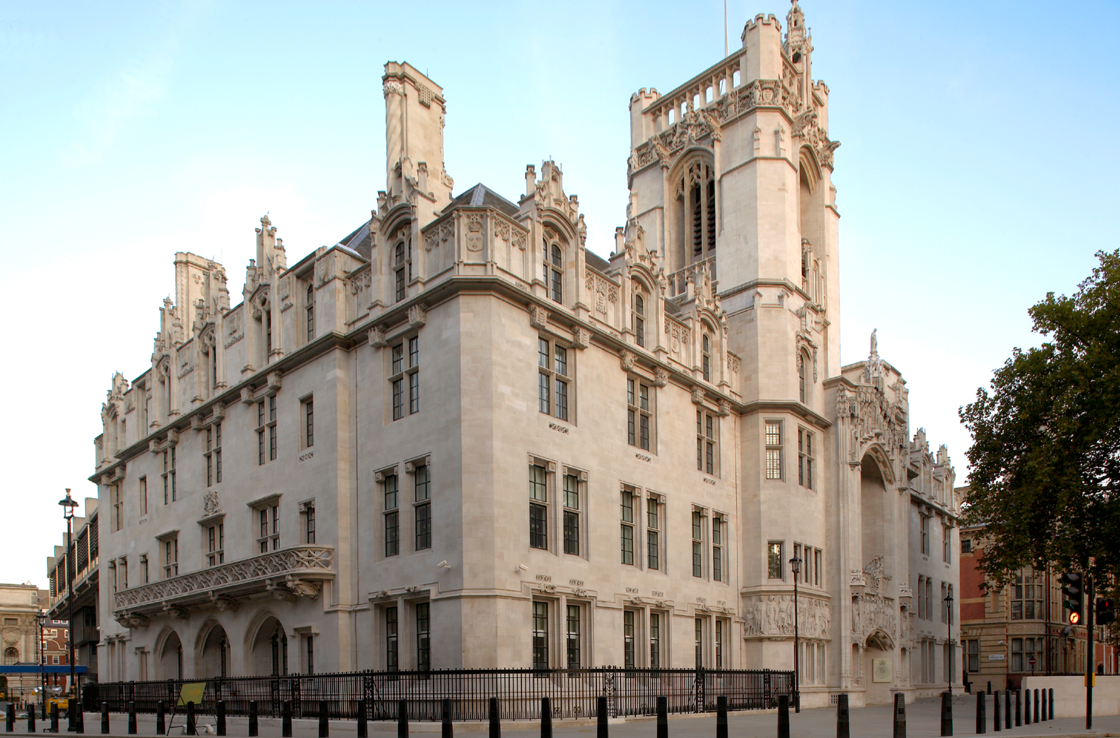
The physical manifestation of this separation was the creation of the Supreme Court of the United Kingdom, established under Section 23 of the CRA. The Act mandated the removal of the Law Lords from the Palace of Westminster, ending the appellate jurisdiction of the House of Lords. The government selected Middlesex Guildhall, a Grade II* listed building on the opposite side of Parliament Square, as the new venue. The renovation project became a lightning rod for criticism regarding cost and need. Originally estimated at roughly £30 million, the final bill for establishing the court rose to £59 million by the time it opened in October 2009. Critics, including opposition MPs, branded the project a "cosmetic exercise" that wasted taxpayer money to move twelve judges across the street.
The renovation of Middlesex Guildhall required stripping out a working Crown Court to build a venue suitable for the highest appellate body. The architectural changes were symbolic of the new constitutional order. The judges no longer sat in a committee room in the House of Lords, dressed in business suits and debating quietly. They sat in a dedicated courtroom, on a raised bench, with proceedings broadcast to the world. This visibility fundamentally changed the court's character. Lord Neuberger, the second President of the Supreme Court, later observed that the physical separation made the court more "visible" and, consequently, more likely to be scrutinized and challenged by the media and the public.
The CRA 2005 also revolutionized the selection of judges through the creation of the Judicial Appointments Commission (JAC). Prior to 2005, appointments were made by the Queen on the advice of the Lord Chancellor, a system known as the "tap on the shoulder." This unclear process relied on secret soundings within the legal profession, a method that reinforced a narrow, homogenous demographic on the bench. The JAC introduced a transparent, data-driven application process aimed at increasing diversity and eliminating political patronage. While the demographic shift was slow, by 2026, the bench remained predominantly white and male, the structural method for appointment had been permanently severed from direct ministerial control.
By 2026, the consequences of the Constitutional Reform Act were clear. The separation of powers, once a theoretical concept in Britain, had become a sharp reality. The Supreme Court, untethered from the legislature and protected by the statutory guarantees of the CRA, demonstrated a willingness to rule against the executive in high- constitutional matters. The friction that occurred during the prorogation emergency of 2019 and subsequent battles over immigration policy was a direct product of the 2005 reforms. The Act successfully created a judiciary that was independent not just in mind, in institution, ending three centuries of fused power and aligning the United Kingdom with modern democratic norms.
Courthouses: Middlesex Guildhall Acquisition and Refurbishment
The physical separation of the United Kingdom's highest court from the legislature required more than a statute; it demanded a. The site chosen for this constitutional divorce, the Middlesex Guildhall on the southwest corner of Parliament Square, sits upon ground soaked in judicial and ecclesiastical history. For centuries, this plot housed the Sanctuary Tower and the Old Belfry of Westminster Abbey, a place where fugitives sought refuge from the law until the privilege was abolished in the early 17th century. By 1805, the site had evolved into the Westminster Sessions House, and later, following the Local Government Act 1888, it became the administrative heart of the Middlesex County Council. The current structure, completed in 1913 by Scottish architect James Glen Sivewright Gibson, stands as a testament to "Art Nouveau Gothic," a style that projects an air of ancient authority even with its relatively modern construction. Its Portland stone façade, adorned with the sculptures of Henry Fehr, was designed to dominate the square, acting as a visual counterweight to the Houses of Parliament and Westminster Abbey.
The selection of this specific building was neither inevitable nor universally applauded. Following the Constitutional Reform Act 2005, the Department for Constitutional Affairs ( the Ministry of Justice) initiated a frantic search for a venue that could physically embody the independence of the new Supreme Court. The search committee examined five primary options, including the Victorian Gothic structure at Victoria House in Bloomsbury and the neoclassical grandeur of the New Wing at Somerset House. The Law Lords, led by Senior Law Lord Bingham, expressed a strong preference for Somerset House, citing its gravitas and distance from the political fray of Westminster. Yet, the government rejected this option, primarily driven by cost concerns and the logistical nightmare of displacing the Inland Revenue staff then occupying the wing. The Middlesex Guildhall was selected not for its suitability as an appellate court, for its proximity to Parliament and its availability, a decision that sparked a bitter administrative brawl between the judiciary and the executive.
This decision triggered an immediate and ferocious backlash from heritage conservationists. The Middlesex Guildhall was a functioning Crown Court, housing seven criminal courtrooms noted for their architectural integrity. English Heritage described the interiors of the three main courts as "unsurpassed by any other courtroom of the period the quality and completeness of their fittings." The government's plan required the gutting of these historic interiors to create the seminar-style hearing rooms favored by appellate judges, who do not require docks, witness stands, or jury boxes. The conservation group SAVE Britain's Heritage launched a judicial review against Westminster City Council's decision to grant planning permission, arguing that the renovation amounted to state-sponsored vandalism of a Grade II* listed building. In a twist of irony, the body destined to be the final arbiter of the law was born from a legal defeat; the High Court dismissed the challenge in 2007, allowing the bulldozers to enter.
The renovation, led by architects Feilden + Mawson with support from + Partners, was a £59 million exercise in symbolic transparency. The heavy, dark wood paneling of the criminal courts was stripped away or lightened, and the prisoner docks were removed to banish the atmosphere of retribution. The architects cut a new entrance into the western façade to separate the court from the bustle of Parliament Square, although security concerns later forced the use of the main entrance. The most distinct visual alteration occurred in Courtroom 2, where the traditional judicial bench was replaced by a curved table, and the floor was covered in a pop-art carpet designed by Sir Peter Blake. This carpet weaves together the four floral symbols of the United Kingdom, the rose, thistle, leek, and flax, into a vibrant, almost psychedelic pattern, a deliberate attempt to modernize the visual language of justice and assert the Court's jurisdiction over the entire union.
The conversion process revealed the structural complexities of Gibson's 1913 design. The building's steel frame, an early example of such construction in London, allowed for the removal of internal walls to create the airy, light-filled library that occupies the former Council Chamber. This library, with its triple-height ceiling and decorative friezes, serves as the intellectual engine of the Court. Yet, the renovation was not aesthetic; it was a security imperative. The separation from the House of Lords meant the Justices lost the protective umbrella of the Palace of Westminster's security cordon. The Guildhall had to be hardened against chance threats while maintaining the illusion of public accessibility, a paradox that resulted in airport-style scanners coexisting with an exhibition space and a café in the basement, formerly the holding cells for prisoners awaiting trial.
By 2026, the wisdom of moving the Court to the Guildhall has been underscored by the rapid deterioration of the Palace of Westminster across the street. While the Supreme Court operates in a fully modernized, climate-controlled facility, the Houses of Parliament face a catastrophic maintenance emergency, with a 2026 report estimating restoration costs at nearly £40 billion and warning of fire risks and sewage failures. The Guildhall, once criticized as too small and too controversial, has proven to be a stable operational base. The building's maintenance costs, while significant, are a fraction of the financial black hole consuming the legislature. The physical distance, less than 100 meters, has successfully calcified into a psychological chasm, with the Justices operating in a sphere distinct from the political chaos visible from their office windows.
| Feature | Middlesex Guildhall (1913-2007) | Supreme Court (2009-2026) |
|---|---|---|
| Primary Function | Criminal Crown Court & County Council HQ | Final Court of Appeal (Civil/Criminal) |
| Courtroom Layout | Adversarial: Docks, Jury Boxes, Elevated Bench | Inquisitorial: Curved tables, level seating |
| Interior Aesthetic | Dark oak, intimidation, Victorian Gothic | Glass, light, Pop Art carpet, transparency |
| Basement Use | Holding cells for prisoners | Exhibition space, café, gift shop |
| Security Status | Standard Court Security | High-level independent security zone |
The financial load of the Middlesex Guildhall acquisition and refurbishment remains a point of contention. The initial set-up costs of £58. 9 million were financed through a lease-and-leaseback arrangement that spreads the capital cost over 30 years, meaning the taxpayer continues to pay for the renovation well into the 2030s. This financial model, chosen to keep the upfront capital expenditure off the immediate government books, essentially means the Court pays rent to a private landlord for its own public building. Critics in 2009 argued this was an expensive way to procure a courthouse; in 2026, with public sector borrowing costs fluctuating, the fixed payments are viewed as a necessary, if irritating, operational expense. The building requires constant upkeep to maintain the intricate stonework and the Art Nouveau detailing, a responsibility that falls to the Court's own budget, further resources already stretched by the need for digital modernization.
even with the initial hostility from heritage groups, the building has settled into its role. The fears that the Supreme Court would be "just another court" housed in a mutilated historic shell have largely subsided. The architectural intervention by Feilden + Mawson is as a case study in adapting historic buildings for modern democratic functions. The "light" that Lord Phillips, the President of the Court, so frequently referenced has become more than a metaphor; the glass screens and open-plan library have fundamentally altered the acoustic and visual nature of the proceedings. Where the House of Lords Committee Rooms were cramped and obscure, the Guildhall courts are broadcast-ready studios where the business of law is conducted in high definition, a transformation made possible only by the ruthless repurposing of Gibson's stone.
Judicial Selection Commission and Demographics (2009, 2026)
The creation of the Supreme Court in 2009 necessitated a radical departure from the centuries-old "tap on the shoulder" system, where the Lord Chancellor unilaterally handpicked Law Lords from the ranks of the senior judiciary. The Constitutional Reform Act 2005 (CRA) sought to this unclear patronage network by establishing a statutory selection process designed to prioritize merit and transparency. Yet, the method that replaced the Lord Chancellor's fiat, an ad hoc Selection Commission convened for each vacancy, has faced intense scrutiny for reproducing the very social and professional homogeneity it was intended to dilute. Unlike the standing Judicial Appointments Commission (JAC) which oversees lower court selections, the Supreme Court's selection body is transient and insular, composed of the Court's President, a senior judge from outside the Court, and representatives from the appointment bodies of England and Wales, Scotland, and Northern Ireland.
This structural design immediately drew criticism for allowing the Court to recruit in its own image. The statute requires the commission to consult with "senior judges" before shortlisting, a procedural requirement that critics institutionalized the "secret soundings" of the past. By soliciting private opinions from the existing judicial elite, the process reinforces a specific definition of "merit", one heavily weighted toward high-level appellate advocacy and technical black-letter law, qualities most readily found in the commercial bar. Consequently, the demographic profile of the twelve justices remained remarkably static between 2009 and 2026. The "merit" criteria, while ostensibly objective, frequently acted as a filter that favored candidates with identical educational and professional pedigrees to those they were replacing.
The educational background of the justices serves as the most visible indicator of this stagnation. Data from the Sutton Trust and judicial diversity reports consistently show that the Supreme Court remains the most socially exclusive public body in the United Kingdom. Throughout the 2010s and early 2020s, the vast majority of justices were graduates of Oxford or Cambridge, with a disproportionate number having attended fee-paying independent schools. While the wider legal profession saw gradual diversification, the apex court remained a of the establishment. The route to the Supreme Court almost invariably ran through the "magic circle" sets of chambers and the Court of Appeal, a pipeline that had filtered out most non-traditional candidates decades before they reached the eligibility threshold for the highest bench.
Gender representation on the Court has followed a volatile trajectory rather than a linear ascent. When the Court opened in 2009, Baroness Hale of Richmond was the sole female justice, a solitary figure in a room of eleven men. Her elevation to President in 2017 marked a historic high point, and by 2018, the appointment of Lady Black and Lady Arden brought the number of female justices to three. This progress, yet, proved fragile. The mandatory retirements of Lady Hale (2020), Lady Black (2021), and Lady Arden (2022) stripped the Court of its female leadership. For a brief period following these departures, Lady Rose of Colmworth stood as the only woman on the bench, representing a numerical regression to the 2009 baseline. The appointment of Lady Simler in late 2023 (sworn in early 2024) restored the count to two, as of March 2026, women still constitute only 16% of the Court, a figure that lags significantly behind the supreme courts of comparable common law jurisdictions like Canada, Australia, and the United States.
The absence of ethnic diversity remains the Court's most deficit. From its inception in 2009 through early 2026, not a single Justice of the Supreme Court identified as Black, Asian, or from a minority ethnic background. While the High Court and Court of Appeal began to see slow improvements in BAME representation, such as the elevation of Lord Justice Singh to the Court of Appeal, this diversity did not penetrate the final glass ceiling. Successive Selection Commissions the "pipeline problem," arguing that the pool of eligible candidates in the senior judiciary was not yet sufficiently diverse. Critics, including the Law Society and judicial diversity advocacy groups, countered that the definition of "merit" was too narrow and that the Commission failed to use the "tipping point" provision in the Crime and Courts Act 2013, which allows diversity to be a deciding factor between two candidates of equal merit.
The turnover of justices, and thus the opportunity for demographic change, was further by the Public Service Pensions and Judicial Offices Act 2022. This legislation raised the mandatory retirement age for judges from 70 to 75. While intended to retain experienced jurists and reduce the recruitment load on the lower courts, the Act had the immediate side effect of freezing the composition of the Supreme Court. Justices who might have retired between 2022 and 2025 remained in post, delaying vacancies that could have been filled by a more diverse cohort. The "refresh rate" of the Court slowed considerably, solidifying the tenure of the existing white, male majority.
By early 2026, the Court's composition reflected these structural and legislative realities. The retirement of Lord Hodge in December 2025 triggered a reshuffle of the Court's leadership, with Lord Sales assuming the role of Deputy President in January 2026. The vacancy left by Lord Hodge, a Scottish seat, was filled by Lord Doherty, a judge of the Inner House of the Court of Session, who was appointed in November 2025 and sworn ly thereafter. Lord Doherty's background, Edinburgh University, Oxford, and a career at the Scottish Bar, adhered strictly to the traditional mold. His appointment confirmed that the Selection Commission continued to prioritize conventional judicial experience and intellectual "heft" over any radical departure from the.
| Year | Female Justices | BAME Justices | Oxbridge Graduates (Est.) | Key Event |
|---|---|---|---|---|
| 2009 | 1 (Hale) | 0 | 10/12 | Court established; transfer from House of Lords. |
| 2018 | 3 (Hale, Black, Arden) | 0 | 10/12 | Peak female representation. |
| 2022 | 1 (Rose) | 0 | 11/12 | Retirement of Hale, Black, Arden; Retirement age raised to 75. |
| 2024 | 2 (Rose, Simler) | 0 | 11/12 | Appointment of Lady Simler. |
| 2026 | 2 (Rose, Simler) | 0 | 11/12 | Lord Sales becomes Deputy President; Lord Doherty joins. |
The persistence of this demographic profile raises serious questions about the legitimacy of the judiciary in a multi-cultural society. While the intellectual caliber of the justices is rarely questioned, the Court's inability to reflect the population it serves remains a matter of acute constitutional concern. The "merit" argument, deployed to defend the homogeneity of the bench, increasingly appears to be a circular validation of a specific social capital. The Selection Commission, operating behind the shield of confidentiality and statutory independence, has insulated the Court from the demographic shifts occurring in the wider legal profession. As the Court moves deeper into the late 2020s, the tension between the statutory mandate for "merit" and the public imperative for diversity remains unresolved, with the raised retirement age ensuring that change continue to be measured in decades rather than years.
Caseload Analytics and Disposal Rates
| Metric | House of Lords (2008) | UK Supreme Court (2014-15) | UK Supreme Court (2024-25) |
|---|---|---|---|
| PTA Applications Determined | 207 | 245 | 212 |
| Domestic Judgments (UKSC/HoL) | 96 | 83 | 43 |
| Privy Council Judgments (JCPC) | N/A (Separate reporting) | 56 | 49 |
| Primary Jurisdiction Source | England & Wales | England & Wales (~85%) | England & Wales (~88%) |
Disposal rates, the speed at which the Court clears its docket, have fluctuated due to external factors and procedural changes. In the early 2020s, the COVID-19 pandemic caused temporary disruptions, though the rapid adoption of remote hearings mitigated long-term backlogs. By 2024, the average time from the grant of permission to the final judgment remained approximately 12 months. A notable dip in disposal rates occurred in May 2024, attributed to the Court's vacation schedule, though daily disposal rates during sitting days remained high. The implementation of the Supreme Court Rules 2024, which came into force on December 2, 2024, introduced a new digital portal designed to streamline the filing process. By early 2026, this system had reduced administrative friction, allowing for faster processing of PTA applications, even if the substantive hearing schedule remained constrained by the limited number of Justices. Jurisdictional analytics show a persistent imbalance. Appeals from England and Wales continue to dominate the docket, consistently accounting for over 85% of the caseload. Scottish appeals, while constitutionally significant, remain few in number, partly because the Supreme Court has no jurisdiction over Scottish criminal cases, a distinction that dates back to the Act of Union 1707 and was preserved by the Constitutional Reform Act 2005. Northern Ireland contributes fewer than five cases annually. This geographic distribution reinforces the perception of the Court as an institution primarily occupied with English civil and public law, even with its mandate to serve the entire United Kingdom. The "backlog" narrative frequently applied to the lower courts, Crown and Magistrates' Courts, does not apply to the Supreme Court in the same manner. The Court controls its own intake. If the backlog of cases waiting for a hearing grows too large, the Justices can simply grant fewer permissions to appeal. This self-regulating method keeps the active docket manageable, between 40 and 60 pending cases at any given time. The real bottleneck lies not in administrative processing in the finite judicial bandwidth of the twelve Justices, who must balance complex domestic constitutional questions with their duties to the Privy Council. The 2025 data indicates that as the complexity of cases increases, frequently involving hundreds of pages of submissions and multiple interveners, the raw number of judgments naturally contracts.
Budgetary Conflicts with Ministry of Justice

| Feature | Appellate Committee (Pre-2009) | Supreme Court (Post-2009) |
|---|---|---|
| Source of Funds | Parliament (House of Lords Vote) | Ministry of Justice (Executive Dept) |
| Budget Negotiation | Internal Parliament Committee | Bilateral with Justice Secretary |
| Protection from Cuts | High (Insulated by Parliament) | Low (Subject to MoJ Austerity) |
| Staff Accountability | Clerk of Parliaments | Chief Executive (Civil Servant) |
| Building Costs | Part of Palace of Westminster | Middlesex Guildhall (Direct Cost) |
Executive Overreach and the Miller Prorogation Judgments
The defining conflict of the United Kingdom's modern constitutional history occurred not in the debating chamber of the House of Commons, in Courtroom 1 of Middlesex Guildhall. Between 2016 and 2019, the Supreme Court found itself thrust into the center of a power struggle between the Executive and the Legislature, precipitated by the Brexit referendum. The resulting judgments, known shared as the Miller cases, did not interpret statutes; they defined the architectural limits of the British state. These cases marked the high-water mark of judicial intervention in the 21st century, establishing that the Prime Minister's powers, derived from the ancient Royal Prerogative, were not absolute subject to the common law supervision of the courts.
The collision, R (Miller) v Secretary of State for Exiting the European Union (2017), or "Miller I," concerned the method for leaving the European Union. The government, led by Theresa May, argued that it possessed the authority to trigger Article 50 of the TEU using the Royal Prerogative, the residue of monarchical power exercised by ministers. This power allows the executive to conduct foreign affairs and withdraw from treaties without parliamentary approval. The claimants, led by Gina Miller, argued that because the European Communities Act 1972 had created domestic rights for UK citizens, the executive could not use prerogative power to nullify an Act of Parliament. The Executive's attempt to bypass the legislature was met with a decisive 8-to-3 judgment against the government.
The majority, including Lord Neuberger and Lady Hale, held that the 1972 Act was not a standard statute a "constitutional statute" that could not be implicitly repealed by executive fiat. The judgment reaffirmed a principle dating back to the 17th century: the Prerogative cannot be used to alter domestic law or remove rights granted by Parliament. The dissenters, Lords Reed, Carnwath, and Hughes, argued for a more traditional reading, suggesting that the 1972 Act was always conditional on the UK's treaty obligations, which the government controlled. This split signaled a deep philosophical divide within the court regarding the judiciary's role in policing the boundaries of political power.
If Miller I was a dispute over statutory interpretation, R (Miller) v The Prime Minister (2019), or "Miller II," was a direct confrontation over the legitimacy of executive action. In August 2019, Prime Minister Boris Johnson advised Queen Elizabeth II to prorogue (suspend) Parliament for five weeks at the height of the Brexit emergency. The government claimed this was a routine procedure to prepare a new legislative agenda. Critics, and the Court, saw it as a tactical maneuver to silence Parliament and prevent scrutiny of the government's "No Deal" Brexit strategy. The High Court in London initially ruled the matter non-justiciable, categorizing it as "high policy" beyond the reach of judges. The Inner House of the Court of Session in Scotland disagreed, declaring the advice unlawful.
The Supreme Court's unanimous decision in September 2019 stunned the political establishment. A panel of 11 justices, led by Lady Hale, ruled that the advice given to the Queen was unlawful, void, and of no effect. The judgment relied heavily on the Case of Proclamations (1611), citing the principle that "the King hath no prerogative, that which the law of the land allows him." The Court established a new test: a prerogative action is unlawful if it frustrates or prevents, without reasonable justification, the ability of Parliament to carry out its constitutional functions. The government offered no justification for the five-week suspension, leading the Court to quash the Order in Council as if it had never been written. Parliament resumed sitting the day.
The backlash was immediate and severe. Newspapers branded the judges "Enemies of the People," and the Conservative government pledged to "ensure that there is a proper balance between the rights of individuals, our national security and government." This political friction catalyzed a legislative response aimed at curbing judicial reach. By 2022, the Dissolution and Calling of Parliament Act was passed, repealing the Fixed-term Parliaments Act 2011 and restoring the Prime Minister's power to dissolve Parliament. Crucially, Section 3 of the 2022 Act included a specific "ouster clause," stating that the exercise of these powers "shall not be called into question in any court of law." This was a direct legislative rebuke to the logic of Miller II, walling off the dissolution prerogative from future judicial review.
Following the retirement of Lady Hale in 2020, the Court entered a period of retrenchment under the presidency of Lord Reed (a dissenter in Miller I). The "Reed Court" (2020, 2027) frequently adopted a more deferential stance toward the executive, particularly in matters of social policy and national security. In cases such as R (SC) v Secretary of State for Work and Pensions (2021) and Begum v Home Secretary (2021), the Court emphasized that political and social choices were the domain of elected representatives, not judges. This shift suggests that while the Miller judgments remain binding precedent, the judicial appetite for intervening in "macro-political" disputes diminished significantly in the years leading up to 2026.
The legacy of this period is a sharpened definition of the UK's unwritten constitution. The Miller cases demonstrated that the Supreme Court functions as the guardian of the constitution, capable of checking an executive that attempts to govern without Parliament. Yet, the subsequent legislative reversals show that Parliament, possessing sovereign power, retains the ability to limit the Court's jurisdiction if it summons the political to do so. The tension between the rule of law and parliamentary sovereignty remains the central of the British state.
| Year | Case / Statute | Constitutional Principle Established |
|---|---|---|
| 1611 | Case of Proclamations | The Monarch cannot create new laws by proclamation; the Prerogative is limited by the law of the land. |
| 1920 | Attorney General v De Keyser's Royal Hotel | When a Statute and Prerogative cover the same ground, the Statute prevails. The Executive cannot rely on Prerogative to bypass statutory restrictions. |
| 1985 | CCSU v Minister for the Civil Service (GCHQ) | Prerogative powers are subject to judicial review, with exceptions for "high policy" (e. g., national security, treaties). |
| 2017 | R (Miller) v Secretary of State for Exiting the EU | The Prerogative cannot be used to change domestic law or remove rights created by Parliament (the "silence" of the ECA 1972 did not confer power). |
| 2019 | R (Miller) v The Prime Minister | The scope of Prerogative power is justiciable. Prorogation is unlawful if it frustrates Parliament's constitutional function without reasonable justification. |
| 2022 | Dissolution and Calling of Parliament Act | Parliament restores the Prerogative of Dissolution and explicitly excludes it from judicial review (Ouster Clause), reacting to Miller II. |
| 2024 | Safety of Rwanda (Asylum and Immigration) Act | Parliament legislates to override judicial fact-finding regarding the safety of a third country, asserting legislative supremacy over judicial assessment. |
Devolution Disputes and the Scotland Act

The table summarizes the decisive devolution
Friction with European Court of Human Rights
| Era | Key Case/Event | Nature of Relationship | Outcome |
|---|---|---|---|
| 2004 | R (Ullah) | Subservience | "Mirror Principle" established. UK courts track Strasbourg strictly. |
| 2005, 2017 | Hirst v UK | Political Standoff | ECtHR bans prisoner voting ban. UK refuses to comply. Minor concession ends dispute after 12 years. |
| 2009, 2011 | R v Horncastle | Judicial Rebellion | UKSC refuses to follow ECtHR on hearsay. ECtHR backs down in Al-Khawaja. |
| 2022 | Rule 39 Injunction | Intervention | Strasbourg stops Rwanda flight after UK courts allowed it. Triggers legislative backlash. |
| 2024, 2026 | Safety of Rwanda Act | Statutory Decoupling | Parliament orders UK courts to ignore ECtHR interim measures. UKSC bound by domestic statute over international orders. |
### The Shift to Domestic Constitutionalism Under the presidency of Lord Reed (2020, present), the UKSC has signaled a retreat from the *Ullah* principle, favoring a "domestic " method. In cases such as *R (AB) v Secretary of State for Justice* (2021), the Court emphasized that the HRA does not require the UK to replicate Strasbourg's errors or expansions. The Court treats the ECHR as a floor, not a ceiling, also refuses to extend rights beyond what is explicitly supported by British common law or statute. This doctrinal shift prepares the ground for a post-2026 legal terrain where the UKSC asserts its role as a supreme court in reality, not just in name. The friction with Strasbourg has evolved from a dispute over legal interpretation to a fundamental conflict over the source of legal authority. The UKSC operates with the understanding that while it must respect Convention rights, its primary allegiance lies with the statutes enacted by the King in Parliament, even when those statutes explicitly the European Court.
Digital Transformation and 2026 Procedural Reforms

The procedural history of the United Kingdom's highest court is a chronicle of media transition, moving from the parchment and vellum of the early 18th century to the encrypted data packets of 2026. For nearly three hundred years, the appellate process relied on the physical movement of atoms rather than bits. In 1726, the House of Lords issued a Standing Order that fundamentally altered legal advocacy: it required all appellants and respondents to print their "Cases", concise written arguments, for distribution to the Lords prior to a hearing. This 1726 mandate created the "Printed Case," a document format that dominated appellate procedure until the early 21st century. These printed briefs, frequently signed by counsel as required after 1731, were not administrative conveniences; they were expensive necessities that limited access to the highest court to those who could afford the printing press monopolies of London. The sheer weight of paper generated by this system was immense; by the time the House of Lords heard its final cases in 2009, the "bundle" for a single appeal could run to thousands of pages, requiring vans for transport and warehouses for storage.
The creation of the Supreme Court in 2009 initiated a slow drift away from this paper-heavy tradition, yet the institution initially inherited the procedural inertia of Parliament. While the move to Middlesex Guildhall introduced cameras for live broadcasting, a radical transparency measure at the time, the internal remained tethered to hard copies and legacy IT systems. It was not until the global disruptions of 2020 that the Court was forced to accelerate its modernization. The subsequent "Change Programme," launched formally in 2023 and concluded in March 2026, represented the most significant overhaul of appellate procedure since the 1726 Standing Order. This three-year strategic initiative, executed in partnership with digital consultancy Capgemini, dismantled the centuries-old reliance on physical filing in favor of a "digital by default" operating model.
By March 2026, the operational metrics of the Court had shifted dramatically. The centerpiece of this transformation is the Supreme Court Portal, a 360-degree case management system that replaced the fragmented email and paper chains of the past. The impact on efficiency has been measurable and severe. In 2022, the average time to process a Permission to Appeal (PTA) application hovered around 35 weeks, a delay that drew criticism from legal practitioners and litigants alike. Data released in the Court's 2025-2026 Annual Report confirms that this timeline has collapsed to just eight weeks. This reduction is not administrative; it represents a fundamental increase in access to justice, allowing commercial entities and individuals to know their legal standing nearly seven months faster than under the previous regime. The Court projects that these efficiency gains yield £6 million in savings over the decade, primarily through the repurposing of staff time from document handling to substantive case management.
The procedural framework governing this new digital terrain is codified in the Supreme Court Rules 2024, which came into force on December 2, 2024. These rules eliminated the "exceptional circumstances" provision for missed deadlines, signaling a stricter, more automated method to litigation compliance. Under the new regime, "portal parties", essentially all represented litigants, must file documents exclusively through the digital system. The era of the "hard copy" requirement for core bundles has ended. Service of documents, once a ritual of physical delivery, is instantaneous within the portal, with the system automatically logging timestamps that serve as irrefutable proof of receipt. This shift has forced law firms to upgrade their own internal systems to ensure compatibility with the Court's strict metadata and formatting standards.
Parallel to this infrastructural overhaul, the Court has had to confront the epistemological challenge of Artificial Intelligence. The ubiquity of Large Language Models (LLMs) by 2024 forced the judiciary to define the boundaries of machine assistance in legal reasoning. The Judicial Office, led by the Lady Chief Justice and the Senior President of Tribunals, issued updated guidance in April 2025 regarding the use of AI by judicial office holders. This guidance draws a hard constitutional line: while AI tools may be used for administrative summarization, they must not influence core judicial reasoning. Judges remain the sole arbiters of fact and law. The guidance explicitly warns against "AI hallucinations", the tendency of generative models to fabricate case law, and places the load of verification squarely on human actors. In 2026, the Court operates under a strict liability model for counsel: any citation submitted to the Supreme Court is presumed to be verified by a human lawyer. If a "hallucinated" case appears in a submission, the submitting counsel faces immediate professional sanction, a policy reinforced after several high-profile errors in lower courts during 2024.
The digital transformation has also redefined the concept of "open justice." Since its inception, the UK Supreme Court has been a pioneer in live streaming, the 2026 reforms have deepened this transparency. The new portal system allows for the integration of public-facing document repositories. For the time, "serious members of the public" can access the core written cases of the parties online, simultaneous with the live stream of the oral arguments. This development aligns with the vision articulated by Lord Briggs, who argued that transparency requires more than just watching a video; it requires access to the underlying documents that inform the debate. This shift moves the Court away from a purely oral tradition, where the audience knows only what is spoken, toward a hybrid model where the digital "paper trail" is visible to the global observer.
| Era | Primary Medium | Filing Requirement | Processing Time (PTA) | Transparency method |
|---|---|---|---|---|
| 1726, 2009 | Printed Paper | Physical "Printed Case" (Standing Order 1726) | Variable (Months to Years) | Public Gallery (Physical) |
| 2009, 2020 | Paper / Email | Hard Copy Bundles + USB/Email | ~25, 35 Weeks | Live Streaming (Video only) |
| 2020, 2023 | Hybrid | PDF via Email / SharePoint | ~30, 35 Weeks | Remote Hearings (Webex) |
| 2024, 2026 | Digital Portal | Mandatory Cloud Upload (Rules 2024) | 8 Weeks | Live Stream + Online Document Access |
The completion of the Change Programme in March 2026 marks the end of the Court's transition from a 19th-century administrative structure to a 21st-century digital platform. The physical building on Parliament Square remains the symbolic heart of the institution, yet its functional nervous system is entirely virtual. The Justices, equipped with secure, AI-enabled research tools (strictly walled off from public data), preside over a system where geography is irrelevant to the filing of an appeal. The friction of distance, which once required Scottish and Northern Irish agents to employ London correspondents, has been eliminated by the portal. As the Court prepares for the remainder of the 2026 legal term, it stands as a fully digitized apex court, having shed the paper weight of the 1726 Standing Order.
Security Protocols and Physical Access Controls
| Feature | House of Lords (Pre-2009) | Supreme Court (Post-2009) |
|---|---|---|
| Perimeter | Armed Police (Palace of Westminster) | PAS 68 Bollards & Private Security |
| Public Access | Restricted, by appointment/queue | Open access, airport-style screening |
| Justices' Access | Shared corridors with Peers/MPs | Dedicated secure vehicle dock & lifts |
| Guard Powers | Police & Serjeant-at-Arms | Statutory Powers (Crime and Courts Act 2013) |
| Blast Protection | Thick stone walls (Victorian) | Retrofit blast-resistant secondary glazing |
Transition from Parliamentary Sovereignty to Judicial Supremacy
| Year | Case / Event | Constitutional Impact |
|---|---|---|
| 1990 | R v Secretary of State for Transport, ex p Factortame | Established that UK courts could suspend Acts of Parliament that conflicted with EU law. The major breach of Diceyan sovereignty. |
| 2005 | Jackson v Attorney General | Law Lords (in dicta) suggested Parliamentary Sovereignty is a construct of the common law, which judges created and could theoretically qualify in extreme circumstances. |
| 2019 | R (Miller) v The Prime Minister (Miller II) | The Court quashed the prorogation of Parliament. Established that the judiciary determines the legal limits of the Executive's prerogative powers. |
| 2023 | R (AAA) v Secretary of State for the Home Department | Ruled the Rwanda asylum policy unlawful based on factual risk assessments, triggering a legislative collision. |
| 2024 | Safety of Rwanda (Asylum and Immigration) Act | Parliament attempted to legislate facts ("Rwanda is safe") and oust judicial review. The test of sovereignty vs. the rule of law, largely defused by the 2024 election. |
| 2025 | For Women Scotland v Scottish Ministers | The Court defined "sex" as biological sex for the Equality Act 2010. Confirmed the Court's supremacy in interpreting contested social definitions binding on the Executive. |
The trajectory from 1700 to 2026 shows a clear pattern. The "High Court of Parliament" has ceased to exist in practice. In its place stands a Supreme Court that, while respecting the legislative authority of Parliament, refuses to be a servile agent of the Executive. The "sovereignty" of Parliament remains on the statute books, yet it is exercised within a cage of common law principles and human rights norms constructed by the judges. The *Safety of Rwanda Act* proved that while Parliament can theoretically write any law, the political and legal cost of ignoring the Supreme Court has become almost prohibitive. As Lord Reed noted in 2025, trust in the judiciary is the currency of the rule of law; by 2026, that currency is the primary check on the power of the state. The transition is complete: Parliament reigns, the Supreme Court rules.