
Imperial Corridor and Administrative Board Offices (1700, 1911)
The space recognized globally as Tiananmen Square did not exist as a public plaza between 1700 and 1911. During the Qing Dynasty (1644, 1911), this area functioned as a strictly secured T-shaped imperial corridor, known as the "Thousand Steps Corridor" (Bubulang). Enclosed by high red walls, this zone served as the administrative throat of the empire, channeling the flow of power between the Forbidden City to the north and the bustling commercial districts of the Chinese City to the south. Commoners were categorically barred from entering this T-shaped enclave; trespassing was a capital offense. The corridor measured approximately 700 meters in length remained narrow, flanked by the empire's central bureaucracy.
At the northern apex stood the Gate of Heavenly Peace (Tiananmen). Originally built in 1417 as the Chengtianmen (Gate of Accepting Heavenly Mandate), it suffered destruction by fire and war before the Qing court rebuilt it in 1651. The Shunzhi Emperor renamed it Tiananmen, symbolizing the pacification of the. In 1699, the Kangxi Emperor ordered a massive renovation that established the structure's enduring dimensions: 66 meters long, 37 meters wide, and 32 meters high. The gate tower featured a double-eaved hip-and-gable roof covered in yellow glazed tiles, sitting atop a massive red masonry platform. Five arched gateways pierced the base; the central arch was reserved exclusively for the Emperor, while the flanking arches served imperial princes and high officials. Seven white marble spanned the Golden Water River immediately to the south, mirroring the strict hierarchy of the gates.
Flanking the Thousand Steps Corridor were the offices of the Six Boards (Six Ministries), the central nervous system of the Qing administration. These compounds were arranged according to the traditional principle of "Civil on the East, Military on the West" (Wen Dong Wu Xi). The eastern flank housed the ministries responsible for the empire's internal stability and revenue, while the western flank managed justice, infrastructure, and defense. This spatial arrangement physically manifested the Confucian hierarchy of state power.
| Location | Ministry (Board) | Primary Function |
|---|---|---|
| East Flank | Board of Personnel (Libu) | Managed appointments, promotions, and demotions of all civil officials. |
| East Flank | Board of Revenue (Hubu) | Controlled the census, tax collection, and imperial treasury. |
| East Flank | Board of Rites (Libu) | Oversaw state ceremonies, the examination system, and foreign relations. |
| West Flank | Board of War (Bingbu) | Directed military appointments, courier stations, and weaponry. |
| West Flank | Board of Punishments (Xingbu) | Administered the legal code, prisons, and judicial review. |
| West Flank | Board of Works (Gongbu) | Managed imperial construction projects, water control, and minting coinage. |
The corridor itself contained 144 bays of verandas, long, covered walkways where officials waited before dawn to attend the imperial audience. These structures were not architectural flourishes functional holding pens for the bureaucracy. The southern terminus of the corridor was marked by the Great Qing Gate (Daqingmen), a ceremonial portal that remained closed to all traffic except during imperial processions. Outside this gate lay the "Chessboard Streets" (Qipan Jie), a busy L-shaped commercial zone where merchants catered to the needs of the scholars and officials working within the imperial organs. This sharp delineation between the silent, walled imperial corridor and the noisy, chaotic market streets emphasized the separation between the Manchu ruler and the Han Chinese subject.
The structural integrity of this administrative zone collapsed in 1900 during the Boxer Rebellion. As the anti-foreign uprising consumed Beijing, the diplomatic legations, located just east of the imperial corridor, became a siege zone. In the ensuing chaos, fires set by both the Boxers and the responding Eight-Nation Alliance troops ravaged the ministry buildings. The Board of Revenue (Hubu) was incinerated, resulting in the catastrophic loss of centuries of census data and tax records. The Hanlin Academy, housing irreplaceable literary archives, also suffered extensive fire damage. When the Allied forces breached Beijing in August 1900, they occupied the imperial corridor, using the open spaces for bivouacs and artillery parks. The destruction of the ministry buildings along the east and west flanks inadvertently cleared the ground that would later allow for the widening of the square.
Following the signing of the Boxer Protocol in 1901, the Qing court returned to a capital in ruins. While the Tiananmen Gate itself survived, the surrounding administrative was scarred. The debris from the burned ministries lay scattered, and the strict spatial control began to. The "Thousand Steps Corridor" had lost its walls and its sanctity. By the time the Qing Dynasty fell in 1911, the area was no longer a pristine imperial passage a debris-strewn field of political failure. The physical void created by the fires of 1900 prefigured the vast open square of the 20th century, yet in 1911, it remained a symbol of imperial collapse rather than public assembly.
The transition from the Qing era to the Republican era marked the end of the T-shaped corridor's function as a purely exclusionary zone. The physical blocks that had shielded the Emperor from the gaze of the populace were damaged, and the psychological barrier was shattered by the presence of foreign troops camping on the imperial way. This period from 1700 to 1911 established the geographic coordinates of the future square, the space itself was defined by what it forbade: public access, political assembly, and the presence of the common citizen. The destruction of the Six Boards cleared the physical footprint for the massive expansion that would follow, transforming a closed imperial throat into an open public lung.
Transition to Public Space and May Fourth Movement (1912, 1948)

The collapse of the Qing Dynasty in 1912 did not immediately liberate the space before the Forbidden City. For two years after the abdication of the Last Emperor, the T-shaped imperial corridor remained a claustrophobic, walled enclave. It was Zhu Qiqian, the Minister of Internal Affairs under the new Republic, who physically dismantled the imperial barrier. In 1914, Zhu initiated a radical urban planning intervention that permanently altered Beijing's anatomy. He ordered the demolition of the high walls flanking the Thousand Steps Corridor, breaking the north-south imperial axis that had forbidden lateral movement for centuries. This demolition created a new east-west thoroughfare, Chang'an Avenue, and exposed the space in front of the Tiananmen Gate to the public for the time. The removal of these walls was not an architectural renovation; it was a political act that transformed a royal exclusion zone into a civic vacuum waiting to be filled.
The political character of this newly opened space solidified on May 4, 1919. At 1: 30 PM, approximately 3, 000 students from 13 universities, including Peking University, gathered at the gate. They assembled to denounce the Treaty of Versailles, which transferred German concessions in Shandong to Japan rather than returning them to China. This event, the May Fourth Movement, marked the time the square functioned as a theater for mass political dissent. The students did not petition; they demanded accountability from the Beiyang government. When police and Ministry of Education officials attempted to disperse them, the crowd refused, eventually marching toward the Legation Quarter. The protests escalated into violence, including the burning of the residence of pro-Japanese official Cao Rulin. May 4 established the square's modern function: a barometer of legitimacy where the youth judged the state.
Violence escalated dramatically in the 1920s as the square became a battleground between warlord factions and an increasingly radicalized populace. On March 18, 1926, the square witnessed its mass casualty event, known as the March 18 Massacre. A rally organized by Li Dazhao, a co-founder of the Chinese Communist Party, brought thousands to the square to protest the Taku Forts Ultimatum issued by foreign powers. The demonstrators marched from Tiananmen to the headquarters of the Beiyang government. Duan Qirui, the provisional chief executive, ordered military police to suppress the crowd. The guards opened fire, killing 47 protesters and wounding over 200. Among the dead was Liu Hezhen, a student whose death was immortalized in an essay by the writer Lu Xun. This massacre shattered the unspoken rule that the government would not use lethal force against unarmed student petitioners in the capital.
By the 1930s, the square served as the primary stage for anti-Japanese resistance. The December 9 Movement of 1935 mobilized over 10, 000 students against the Kuomintang's (KMT) policy of appeasement toward Japanese aggression in northern China. Unlike the chaotic rallies of the warlord era, these protests showed higher levels of organization, frequently coordinated by underground Communist cells. Police responded with freezing water hoses and clubs, yet the sheer volume of protesters overwhelmed the security apparatus. The physical openness of the square, created by Zhu Qiqian's demolitions two decades earlier, allowed for crowds of a magnitude that the old imperial corridor could never have contained. The space itself facilitated the mass mobilization that threatened the regime.
Following World War II, the square turned against the Nationalist government. The rape of Peking University student Shen Chong by a U. S. Marine in December 1946 ignited a firestorm of anti-American and anti-KMT sentiment. Demonstrators used the square to denounce the continued American military presence and the corruption of the Nationalist administration. This unrest culminated in the "Anti-Hunger, Anti-Civil War" movement of 1947. As hyperinflation destroyed the economy and the KMT war effort against the Communists faltered, students and workers flooded the square to demand an end to the civil war. These protests revealed the total collapse of the KMT's urban support base. By 1948, the square had become a visual metric of the Nationalist government's forfeiture of the "Mandate of Heaven," setting the stage for the Communist takeover.
| Date | Event | Est. Participants | Primary Cause | Outcome/Casualties |
|---|---|---|---|---|
| May 4, 1919 | May Fourth Movement | 3, 000+ | Treaty of Versailles / Shandong concessions | Cabinet resignation; refusal to sign treaty. |
| March 18, 1926 | March 18 Massacre | Thousands | Anti-Warlord / Taku Forts Ultimatum | 47 dead, 200+ injured by Duan Qirui's guards. |
| Dec 9, 1935 | December 9 Movement | 10, 000+ | Japanese aggression / KMT appeasement | Suspension of anti-Communist campaigns; police used water hoses. |
| Dec 1946 | Shen Chong Protests | Thousands | Rape of student by U. S. Marine | Withdrawal of U. S. forces; sharp rise in anti-US sentiment. |
| May 1947 | Anti-Hunger, Anti-Civil War | Varied (Citywide) | Hyperinflation / KMT corruption | Violent crackdowns; massive loss of KMT public support. |
1950s Expansion and Demolition of Chang'an Left and Right Gates
The transformation of Tiananmen Square from a restricted imperial corridor into a vast concrete plain required the systematic destruction of Beijing's medieval urban fabric. Between 1950 and 1959, the new government executed a demolition campaign designed to obliterate the "Thousand Steps Corridor" and replace it with a parade ground modeled after Moscow's Red Square. This physical reconfiguration served a specific political function: to convert a space of feudal exclusion into a theater for mass mobilization. The primary obstacles to this vision were the walls and gates that defined the T-shaped "Ding" layout, specifically the Chang'an Left Gate and Chang'an Right Gate.
Soviet urban planners, who arrived shortly after the 1949 revolution, advised the Chinese leadership to locate the administrative center within the old city rather than building a new district in the western suburbs. This decision directly contradicted the "Liang-Chen Proposal" submitted by architects Liang Sicheng and Chen Zhanxiang in 1950. Liang and Chen argued for preserving the ancient city walls and axis, suggesting a new government center near Gongzhufen to protect Beijing's historical integrity. The rejection of their plan sealed the fate of the imperial corridor. Authorities viewed the Ming-era gates and walls not as heritage, as impediments to traffic and security risks for mechanized military parades.
The Chang'an Left Gate (Dragon Gate) and Chang'an Right Gate (Tiger Gate) stood at the eastern and western entrances of the corridor, respectively. These arched structures had historically controlled access to the imperial administrative zone. In August 1952, the Beijing Municipal Government ordered their demolition. Officials traffic congestion as the primary justification, claiming the gates created bottlenecks for the growing number of vehicles and parade formations. Even with Liang Sicheng's vocal opposition, he famously compared the demolition to "cutting out my own skin", work crews dismantled the gates that summer. The removal of these structures broke the T-shape, allowing Chang'an Avenue to bleed laterally into the square.
Following the removal of the lateral gates, the demolition crews targeted the Gate of China (Zhonghuamen), originally known as the Great Ming Gate. Situated at the southern end of the square, this ceremonial portal marked the boundary between the Imperial City and the Chinese City. In 1954, workers razed the Gate of China to extend the square southward, further elongating the plaza. This action eliminated the southern enclosure of the corridor, dissolving the architectural boundaries that had defined the space for five centuries. The square ceased to be a corridor and began to take its modern rectangular form.
The expansion accelerated in preparation for the 10th anniversary of the People's Republic of China in 1959. Planners initiated a massive widening of Chang'an Avenue, expanding the thoroughfare from a narrow 15-meter road to a boulevard ranging from 60 to 120 meters in width. This widening necessitated the destruction of residential neighborhoods, pailous (ceremonial arches), and government offices flanking the avenue. The objective was to create a runway capable of accommodating tanks, intercontinental ballistic missiles, and marching columns of 100 soldiers abreast.
By August 1959, the renovation was complete. The new Tiananmen Square covered 44 hectares (440, 000 square meters), a fourfold increase from its imperial dimensions. Engineers replaced the traditional stone paving and dirt route with heavy-duty concrete and granite slabs, numbered to facilitate the precise positioning of troops. The renovation removed tram lines and overhead cables to ensure unobstructed sightlines for cameras and leaders atop the Tiananmen rostrum. The resulting space could hold up to one million people, making it the largest city square in the world at that time.
| Feature | Imperial Era (1911) | Post-Expansion (1959) |
|---|---|---|
| Geometry | T-Shaped (Ding) Corridor | Rectangular Open Plaza |
| Area | ~11 Hectares | 44 Hectares |
| East/West Boundaries | Chang'an Left/Right Gates (Walls) | Open access to widened Chang'an Ave |
| Southern Boundary | Gate of China (Zhonghuamen) | Open (Gate demolished 1954) |
| Paving Material | Flagstone and Earth | Reinforced Concrete/Granite |
| Capacity | Restricted (Imperial Staff only) | 1, 000, 000 (Mass Public) |
The 1959 expansion also involved the construction of the "Ten Great Buildings," two of which, the Great Hall of the People and the Museum of the Chinese Revolution, formed the new western and eastern borders of the square. These monumental structures replaced the low-rise ministries and court walls that had previously lined the corridor. The Great Hall of the People alone covered a floor area larger than the entire Forbidden City. This architectural encirclement finalized the square's transition from a passage of imperial transit to a static container for political ritual. The demolition of the Chang'an gates and the corridor walls successfully erased the physical memory of the Qing dynasty's administrative control, leaving a blank slate for the projection of socialist power.
Construction of the Ten Great Buildings (1958, 1959)

In August 1958, the Central Committee of the Communist Party of China convened at Beidaihe and issued a directive that would physically obliterate the last vestiges of the imperial T-shaped corridor. To commemorate the tenth anniversary of the People's Republic in October 1959, the leadership ordered the construction of ten monumental structures, the "Ten Great Buildings" (Shi Da Jian Zhu), and a massive expansion of Tiananmen Square. The objective was explicit: the new square had to surpass the Red Square in Moscow in size and grandeur, serving as a concrete manifestation of the Great Leap Forward. The timeline for this engineering overhaul was set at a punishing ten months, a pace of construction termed "Beijing Speed" that prioritized political deadlines over conventional engineering schedules.
The expansion project required the complete demolition of the residential districts and administrative walls that still flanked the central axis. While the Chang'an Left and Right Gates had been dismantled in 1952 to ease traffic, the 1958 renovation demanded a far more radical clearing. Planners widened the plaza to 500 meters from east to west and 880 meters from north to south, creating a 44-hectare (440, 000 square meter) open plain. This new footprint quadrupled the size of the original imperial corridor. To achieve this, demolition crews leveled the Gate of China (Zhonghuamen) to the south and cleared the labyrinth of hutongs that encroached on the planned perimeter. The resulting void was paved with specially treated concrete slabs, each numbered to facilitate the precise positioning of troops and mass formations during state parades.
Anchoring the western edge of this new expanse rose the Great Hall of the People. Designed by architects Zhang Bo and Zhao Dongri, the structure was conceived to dwarf the imperial palaces nearby. With a total floor area of 171, 800 square meters, the Great Hall exceeded the combined building area of the entire Forbidden City. The construction process relied on a "human wave" strategy; over 30, 000 workers and volunteers operated in three shifts around the clock. The workforce included shock brigades of laborers, PLA soldiers, and university students who moved 2 million cubic meters of earth and poured concrete through the harsh Beijing winter. The main auditorium was engineered to seat 10, 000 delegates, while the banquet hall could accommodate 5, 000 guests, figures chosen to demonstrate the of socialist participation.
On the eastern flank, directly opposing the Great Hall, the state erected the Museum of the Chinese Revolution and the Museum of Chinese History ( combined as the National Museum of China). Designed by Zhang Kaiji, this structure covered 65, 000 square meters and maintained a strict symmetry with the Great Hall, enforcing a new east-west axis of power that intersected the ancient north-south imperial line. While the Great Hall represented the present political authority, the museum was tasked with curating the historical narrative that legitimized that authority. The architectural style of both buildings fused Soviet "Socialist Realism", characterized by heavy colonnades and monumental , with "National Style" elements, such as yellow glazed tile cornices and flat roofs that hinted at traditional Chinese designs without replicating them.
| Structure | Location Relative to Square | Floor Area (1959) | Primary Function |
|---|---|---|---|
| Great Hall of the People | West | 171, 800 m² | Legislative Hub / State Banquets |
| National Museum (History/Revolution) | East | 65, 000 m² | Historical Narrative Control |
| Tiananmen Square (Paved Area) | Center | 440, 000 m² | Mass Assembly / Military Parades |
The completion of these projects in September 1959, just days before the October 1 deadline, fundamentally altered the urban ecology of Beijing. The intimate, walled-off corridors of the Qing dynasty were replaced by a vast, wind-swept concrete plaza designed for visibility and control. The removal of trees and benches was intentional; the space was not designed for leisure for political theater. The sheer openness exposed the individual to the gaze of the state, centered on the rostrum of the Tiananmen Gate. By the time the 10th-anniversary parade commenced, the square could hold varying estimates of 500, 000 to one million people, transforming the static imperial center into a engine for mass mobilization.
This architectural overhaul also signaled a diplomatic shift. While Soviet experts provided initial guidance, the cooling relations between Beijing and Moscow in the late 1950s meant that the Ten Great Buildings became a project of self-reliance. The use of domestic materials and the mobilization of the Chinese workforce served as a propaganda victory, asserting that China could modernize its capital without total dependence on foreign aid. The Great Hall and the Museum stood not as functional buildings as physical proofs of the regime's ability to reorganize matter and time. The "Ten Great Buildings" campaign remains one of the largest concerted urban construction efforts in 20th-century history, permanently setting the stage for the political dramas that would unfold in the square over the subsequent decades.
Mausoleum of Mao Zedong and 1977 Spatial Reconfiguration
| Material | Origin | Application |
|---|---|---|
| Granite (Burgundy) | Sichuan Province | Base of the structure |
| Granite (Black) | Shandong Province | Coffin platform |
| White Marble | Fangshan, Beijing | Statue of Mao (North Hall) |
| Phoebe Nanmu Wood | Hainan Island | Interior walls and ceiling |
| Rock Samples | Mount Everest (Qomolangma) | Incorporated into foundation |
| Water and Sand | Taiwan Strait | Mixed into concrete (Symbolic claim) |
| Quartz | Kunlun Mountains | Crystal coffin manufacturing |
| Porcelain | Guangdong Province | Decorative elements |
| Pine Logs | Jiangxi Province | Structural support/scaffolding |
The preservation of the body presented a severe technical challenge known as "Project 608." Due to the Sino-Soviet split, Chinese scientists could not access the embalming expertise used for Lenin in Moscow. Instead, they relied on limited guidance from Vietnam (regarding Ho Chi Minh) and an indigenous crash program in cryobiology and glass manufacturing. The crystal coffin was fabricated using fused quartz plates, ground to a tolerance of 0. 01 millimeters by Factory 608 in Beijing. The optical engineering required to light the face without creating reflections or heat damage involved complex systems of hidden projection, a technology developed specifically for this single room. The completion of the mausoleum in May 1977 necessitated a broader spatial reconfiguration of Tiananmen Square. The 1958 expansion had created a vast, paved void designed for mass rallies. The 1977 project introduced a new zone of solemnity in the south. Planners installed extensive belts of pine and cypress trees to frame the mausoleum, visually separating it from the bustle of Qianmen to the south and the open expanse to the north. These green belts narrowed the usable space for parades created a controlled acoustic and visual environment for the queues of visitors. The square was no longer a single, uniform plane; it was divided into a northern "rally" zone and a southern "memorial" zone. Sculptural groups were installed to the north and south of the mausoleum, further solidifying the new narrative. Created by over 100 sculptors from 18 provinces, these 62 clay figures (later cast in permanent materials) depict the history of the Chinese Revolution. The groups stand 3. 5 meters high and represent the "New Democratic Revolution" and "Socialist Construction." These figures permanently populated the square, replacing the fluid, living crowds of the Cultural Revolution with static, idealized representations of the "masses." The facility opened to the public on September 9, 1977. Since that date, the spatial usage of the southern half of Tiananmen Square has been dictated by the operating hours and security of the mausoleum. The flow of visitors created a permanent, snaking line that became a fixture of the square's geography. In 1997, the mausoleum closed for nine months for a significant renovation. This project, completed in January 1998, upgraded the internal climate control systems and the lighting of the crystal coffin. The renovation also addressed structural problem in the granite base. By 2026, the building remains the central anchor of the square's southern axis. Access is tightly controlled through digital reservation systems and facial recognition checkpoints, a modern of restriction atop the physical blocks erected in 1977. The presence of the mausoleum ensures that the square cannot revert to the open imperial corridor of the Qing dynasty nor the purely open rally ground of the 1950s; it remains a hybrid space where the political need for stability is enforced through heavy architecture and rigid pedestrian management.
1989 Protests and June Fourth Military Clearance

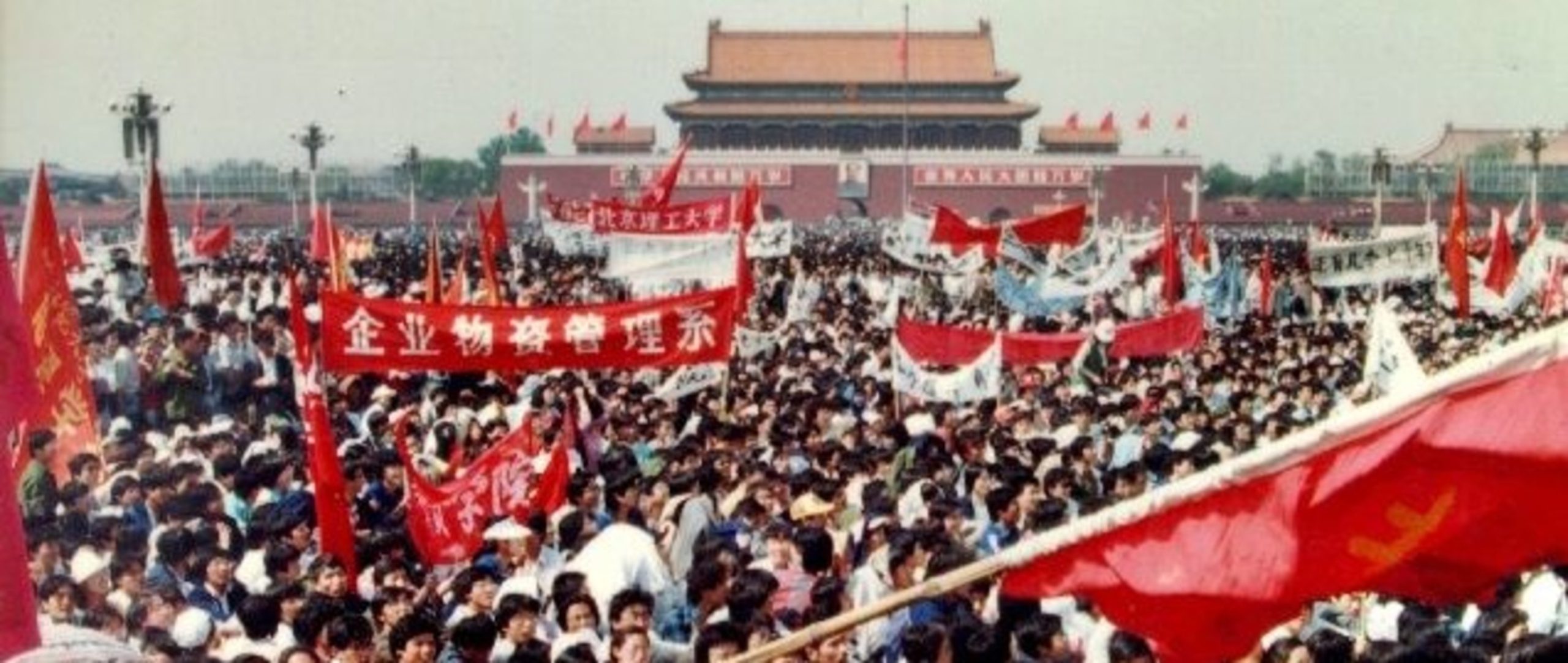
The catalyst for the 1989 occupation of Tiananmen Square appeared on April 15, when the death of deposed reformist leader Hu Yaobang triggered a mass outpouring of grief that rapidly mutated into political dissent. While the initial gatherings ostensibly mourned Hu, the underlying engine of the unrest was economic anxiety mixed with political frustration. By early 1989, inflation in China had surged to 18. 5 percent officially, with urban centers experiencing price spikes closer to 30 percent. Panic buying of goods ranging from salt to televisions destabilized the social order, while the "dual-track" pricing system allowed officials to engage in guandao (profiteering), buying goods at low state prices and selling them at market rates. This economic volatility provided the combustible material for the student movement, which coalesced around the "Seven Demands," calling for press freedom, the disclosure of leaders' assets, and a reversal of the government's stance on previous protests.
Tensions escalated following the April 26 Editorial in the People's Daily, which labeled the movement "turmoil" (dongluan). Rather than quell the unrest, the editorial galvanized support, leading to a hunger strike on May 13 that drew over one million people to the square and its surrounding arteries. The sheer of the occupation paralyzed central Beijing and humiliated the Communist Party leadership during the historic Sino-Soviet summit. On May 20, Premier Li Peng declared martial law. The initial military response involved the 38th Group Army, their advance was halted by barricades and citizens flooding the streets. The failure of the 38th Army, whose commander Xu Qinxian reportedly refused to engage civilians, forced the Central Military Commission to mobilize harder-line units from outside Beijing.
By the days of June, approximately 200, 000 to 300, 000 troops encircled the capital. The decisive operation began on the night of June 3, spearheaded by the 27th Group Army, a unit from Shanxi province considered loyal to President Yang Shangkun. Unlike the local garrison forces, the 27th Army operated with lethal instructions to clear the square by dawn at any cost. The primary violence did not occur within the square itself along the method routes, specifically at Muxidi to the west. Here, soldiers fired automatic weapons directly into crowds of demonstrators and bystanders who attempted to block the convoy. Declassified British diplomatic cables from the time allege that troops used expanding bullets and that Armored Personnel Carriers (APCs) crushed both barricades and individuals in their route.
The military column fought its way to Tiananmen Square by the early hours of June 4. Inside the square, thousands of students remained gathered around the Monument to the People's Heroes. At approximately 4: 00 AM, the lights in the square were extinguished. While negotiations led by intellectuals and older activists allowed students to file out through the southeast corner, reports and witness testimonies indicate that those who remained or attempted to return were beaten or shot. By 5: 40 AM, the square was largely cleared of protesters, replaced by a heavy military cordon of tanks and APCs. The government's "clearing" operation extended to a city-wide crackdown, with hospitals near Chang'an Avenue reporting overwhelmed morgues and blood absence.
Establishing an accurate death toll remains a matter of intense statistical dispute due to the immediate suppression of records and the disposal of bodies. Official Chinese government figures released shortly after the event claimed fewer than 300 deaths, including soldiers. In contrast, the Chinese Red Cross initially estimated 2, 600 deaths on the morning of June 4, a figure they were later pressured to retract. Foreign diplomatic cables provide significantly higher estimates, with a declassified British telegram citing a Chinese source claiming the toll exceeded 10, 000. The table summarizes the casualty metrics recorded by various entities in the immediate aftermath.
| Source | Date of Estimate | Estimated Deaths | Notes |
|---|---|---|---|
| Chinese Government (Official) | June 1989 | 200, 300 | Includes 23 soldiers; claims mostly "rioters" died. |
| Chinese Red Cross | June 4, 1989 | 2, 600, 3, 000 | Estimate released early morning, later retracted under pressure. |
| Student Action Committee | June 1989 | 2, 000, 3, 000 | Based on hospital reports collected by activists. |
| British Ambassador (Cable) | June 5, 1989 | 10, 000 (Minimum) | Cites a source within the State Council; classified until 2017. |
| Amnesty International | 1990 | Hundreds to Thousands | Acknowledges inability to verify exact numbers due to censorship. |
The physical and administrative transformation of Tiananmen Square began immediately following the clearance. The open public plaza, once a site of spontaneous kite-flying and political debate, became a highly regulated security zone. In the months following June 1989, the government installed fences and checkpoints, fundamentally altering the square's accessibility. This security architecture evolved in tandem with China's technological rise. By 2026, the square operates as a of algorithmic surveillance. The human checkpoints of the 1990s have been augmented by high-resolution cameras equipped with facial recognition software capable of identifying individuals within seconds. The "Thousand Steps Corridor" of the Qing dynasty, which barred commoners through physical walls, has been reconstituted through digital perimeters, ensuring that the square serves the state as a ceremonial stage rather than a civic forum.
2001 Self-Immolation Incident and Media Response
| Element | Official Narrative | Forensic/Video Evidence |
|---|---|---|
| Wang Jindong | Set himself on fire with gasoline. | Hair remains unburned; plastic Sprite bottle between legs stays intact; police wait for signal to throw blanket. |
| Liu Chunling | Died from burns. | Slow-motion footage shows a man in a military coat clear her head with a heavy object, causing her collapse. |
| Camera Angles | Captured by surveillance cameras. | Footage includes zooms, pans, and close-ups (including audio) impossible for fixed high-angle security cameras. |
| Fire Extinguishers | Police reacted quickly. | Patrols on the Square do not carry extinguishers; footage shows ~25 heavy extinguishers available within less than 2 minutes. |
The death of Liu Chunling, the only adult female to die on the scene, presents another dark inconsistency. While the official report states she died from burn injuries, a frame-by-frame examination of the CCTV footage shows a man in a military overcoat standing behind her. As she struggles amidst the smoke, the man swings a heavy object against the side of her head. She collapses instantly, not from the fire, from the blunt force impact. This detail, visible only in slow-motion analysis, suggests she was killed by a blow to the skull rather than the flames. Investigative work by *Washington Post* reporter Philip Pan further eroded the state's claims. Pan traveled to Kaifeng, the hometown of the victims, and interviewed neighbors of Liu Chunling. He found that Liu worked in a nightclub, frequently beat her mother, and, most significantly, no one had ever seen her practice Falun Gong. The neighbors described a troubled woman who did not fit the profile of a devout practitioner. This on-the-ground reporting contradicted the state's depiction of her as a fanatical follower to kill herself and her daughter for the practice. The provenance of the video footage itself raises questions about the timeline. The Chinese government claimed the close-up shots came from CNN reporters present at the scene. CNN, yet, issued a statement denying this, noting that their equipment was confiscated by police almost immediately after the incident began. The footage aired by CCTV contained stable zooms, overhead shots, and clear audio of Wang Jindong shouting slogans. These production values indicate a professional camera crew was positioned and ready to film before the fire started, rather than a chaotic reaction by surveillance operators or confiscated news tapes. Liu Siying, the 12-year-old survivor, became the face of the government's anti-Falun Gong campaign. Four days after the incident, CCTV aired an interview with her. even with reportedly undergoing a tracheotomy due to severe throat burns, she spoke clearly and even sang a song for the camera. Medical experts assert that a patient with a fresh tracheotomy cannot speak, let alone sing, as the procedure bypasses the vocal cords. Liu Siying died suddenly in the hospital in March 2001, just as international reporters were demanding access to interview the survivors. Her death closed the loop on the only witness who could have chance contradicted the script. The strategic impact of the self-immolation was absolute. Before January 2001, Chinese citizens viewed the crackdown on Falun Gong as unnecessary political theater. After the broadcast of the burning bodies, public sentiment shifted to fear and revulsion. The CCP used this capital to sanction the systematic use of "transformation" camps, where torture was applied to force renunciations. The incident immunized the general populace against empathy for the victims of the crackdown. By 2026, the self-immolation incident remains the primary justification for the continued ban on Falun Gong. In Chinese history textbooks and behind the Great Firewall, the image of Wang Jindong and his green Sprite bottle is presented as historical fact, devoid of the forensic context that suggests a staged event. The square, once a place of imperial projection, served in 2001 as a studio for a production that successfully inoculated the public against a perceived internal enemy. The physical space of Tiananmen was cleared of the charred debris within hours, the political utility of the event has for a quarter of a century.
2013 Vehicle Crash and Anti-Terrorism Fortifications
On October 28, 2013, at exactly 12: 05 PM, the security architecture of Tiananmen Square collapsed under the wheels of a white Mercedes-Benz SUV. The vehicle, bearing license plates from the Xinjiang Uyghur Autonomous Region, accelerated along the northern edge of the square, plowing through crowds of tourists before crashing into the guardrail of the Jinshui (Golden Water ). The driver, identified by police as Usmen Hasan, along with his wife Gulkiz Gini and mother Kuwanhan Reyim, ignited gasoline canisters inside the cabin. The resulting fireball killed all three occupants instantly and claimed the lives of two bystanders: a Filipino tourist and a male visitor from Guangdong province. Thirty-eight others suffered injuries, including three Filipino nationals and one Japanese tourist.
This event marked the major suicide attack in Beijing's modern history and forced a radical recalibration of the capital's defense strategy. Unlike the 1989 protests, which were a mass political mobilization, the 2013 crash was an asymmetric strike on the symbolic heart of the Communist Party. Authorities moved with extreme speed to sanitize the information space. Internet censors scrubbed photographs of the burning wreck from Weibo within minutes. Police erected high barricades to shield the site from view while crews power-washed the scorch marks from the ancient stones. By late afternoon, the physical debris was gone, yet the incident permanently altered the operational logic of the square.
The investigation yielded immediate political consequences. Beijing police identified the crash as a "violent terrorist attack" orchestrated by the East Turkestan Islamic Movement (ETIM). Investigators recovered knives, iron rods, and a flag bearing "jihadist" slogans from the charred vehicle. Five alleged co-conspirators were arrested within ten hours. The state used this event to justify an aggressive escalation of security measures not only in Xinjiang specifically around the perimeter of the Forbidden City. The crash demonstrated that the existing static defenses, designed to contain student protesters, were useless against a weaponized vehicle.
| Role | Name/Group | Outcome | Origin |
|---|---|---|---|
| Driver | Usmen Hasan | Deceased (Suicide) | Xinjiang (Uyghur) |
| Passenger | Gulkiz Gini (Wife) | Deceased (Suicide) | Xinjiang (Uyghur) |
| Passenger | Kuwanhan Reyim (Mother) | Deceased (Suicide) | Xinjiang (Uyghur) |
| Victim | Unidentified Female | Deceased | Philippines |
| Victim | Unidentified Male | Deceased | Guangdong, China |
| Injured | 38 Civilians | Hospitalized | China, Philippines, Japan |
In the months following the attack, the Ministry of Public Security initiated a "hardening" of the square that continues through 2026. The most visible addition was the installation of heavy-duty, crash-resistant hydraulic bollards along Chang'an Avenue. These steel blocks, capable of stopping a speeding truck, replaced the decorative fencing that had previously lined the sidewalk. The open plaza, once accessible from multiple uncontrolled points, became a. Security checkpoints were pushed hundreds of meters outward, creating a defense zone that pre-screens visitors long before they see the Gate of Heavenly Peace.
The technological response proved even more significant than the physical blocks. The 2013 attack accelerated the integration of the "Skynet" surveillance system into the square's daily operations. By 2015, high-definition cameras with facial recognition capabilities covered every square meter of the pavement. These systems do not record footage; they cross-reference visitor faces against national police databases in real-time. By 2026, this system evolved into a predictive policing model. Algorithms analyze gait, clothing, and crowd density to flag "anomalous behavior" before a crime occurs. The square operates under a "zero-trust" security model, where every entrant is treated as a chance threat until verified by biometric scans.
This fortification represents a return to the area's historical function, albeit with modern tools. Between 1700 and 1911, the T-shaped Imperial Corridor was a forbidden zone, accessible only to the emperor and his bureaucracy. The 2013 crash ended the brief period of relative openness that characterized the late 20th century. Today, entering Tiananmen Square requires navigating a security apparatus that rivals an international airport. Visitors must present identification cards which are scanned and logged; their bags pass through X-ray machines; and their digital footprint is frequently monitored via local cell tower interceptors.
The "grid management" system, revived under current leadership, divides the square and its surrounding neighborhoods into small, distinct zones managed by specific security teams. This method ensures that no sector remains unmonitored for even a second. During sensitive political events, such as the "Two Sessions" or party anniversaries, the square is frequently completely sealed, reverting to its imperial status as a stage for the state rather than a public gathering place. The 2013 vehicle crash did not just damage a; it provided the rationale for constructing the most sophisticated digital panopticon in the world.
By 2026, the legacy of Usmen Hasan's attack is visible in the silence of the square. The chaotic, spontaneous energy of the 1980s is impossible under the current regime of control. The anti-terrorism fortifications have succeeded in their primary goal: preventing another vehicle attack. Yet they have also solidified the square's status as a sterile, state-dominated space where the cost of entry is total submission to surveillance. The transition from a public plaza to a high-security containment zone is complete, driven by the fire that consumed a white SUV on a Monday afternoon in 2013.
Digital Surveillance Architecture and Facial Recognition Deployment
The transformation of Tiananmen Square from an imperial corridor to a digital panopticon represents a fundamental shift in the mechanics of state control. During the Qing Dynasty (1644, 1911), the area functioned as a T-shaped administrative zone where security relied on physical exclusion and human vigilance. The Imperial City Guard stationed soldiers at the Great Qing Gate and the Chang'an Left and Right Gates. These guards inspected waist tags, known as yaopai, carried by officials and strictly barred commoners. The primary technology of control was the wall itself. Stone blocks and heavy timber gates physically segmented the population. If a person was not authorized to be in the space, they were simply kept out by masonry and muscle. The surveillance was analog, local, and limited by the line of sight of a human sentry.
By 2026, the strategy of exclusion has evolved into a strategy of conditional inclusion managed through total information awareness. The physical walls have been replaced by a digital perimeter that is far more difficult to breach. The modern security architecture of Tiananmen Square operates as a filter that begins kilometers away from the plaza itself. This system integrates physical checkpoints with a vast network of optical sensors and data processing algorithms. The primary objective is no longer just to stop entry to identify, track, and record every individual who steps onto the pavement. This transition from stone walls to digital eyes marks the deployment of one of the most sophisticated surveillance environments on Earth.
The of this architecture is the physical checkpoint system. Since the security upgrades preceding the 2008 Beijing Olympics and the subsequent tightening in 2011, access to the square has been restricted to specific security gates. Visitors must queue for airport-style screening. This process involves X-ray machines for bags and metal detectors for bodies. The serious component is the identity verification station. Every visitor must present a Resident Identity Card or a passport. The scanner reads the digital chip in the card while a camera captures a high-resolution image of the visitor's face. The system performs a 1-to-1 match to verify that the card belongs to the holder. It simultaneously performs a 1-to-N match against national police databases. This real-time query checks for outstanding warrants, petitioning history, or inclusion on specific blacklists maintained by the Ministry of Public Security.
Once inside the square, the visitor enters a zone monitored by the "Skynet" (Tianwang) and "Sharp Eyes" (Xueliang) projects. These national surveillance initiatives have their highest density of deployment in this political center. Estimates from industry analysts and human rights reports indicate that the camera density in central Beijing exceeds 400 cameras per 1, 000 people. In Tiananmen Square, this density is significantly higher. The visual coverage is redundant and overlapping. No blind spots exist. The cameras are not passive recording devices. They are active sensors equipped with edge computing capabilities provided by vendors such as Hikvision and Dahua. These companies supply hardware that processes video data locally before sending metadata to central servers.
The square's lighting infrastructure serves as the backbone for this optical network. "Smart" lamp posts installed during renovations between 2018 and 2022 house multiple sensor types. A single pole frequently carries four to six cameras pointing in different directions. These include high-definition wide-angle lenses for crowd monitoring and telephoto lenses for capturing facial details at a distance. units are equipped with thermal imaging sensors to detect heat signatures. This capability allows the system to function at night or in adverse weather conditions. The integration of 5G technology in 2019 and its maturation by 2025 allows these cameras to transmit massive streams of 4K and 8K video to command centers with negligible latency.
Facial recognition technology in the square operates on a that dwarfs standard commercial applications. The system does not require a subject to look at a camera. Algorithms analyze video feeds to extract facial feature vectors from moving crowds. These vectors are compared against the national image library which contains the photo of nearly every Chinese citizen. The system can identify a specific individual within seconds of their appearance in the frame. This capability is augmented by gait recognition technology. Developed by companies like Watrix and integrated into police platforms, this software analyzes the unique way a person walks. It can identify a subject from up to 50 meters away even if their face is obscured by a mask or if they are walking away from the camera. This biometric ensures that disguises are largely ineffective.
Behavioral analysis algorithms run in parallel with identification. The software is programmed to detect "abnormal behavior." This category includes running, sudden congregation of groups, or the unfurling of banners. If the system detects such anomalies, it automatically triggers an alert in the command center. Police units stationed in mobile vans around the square receive these notifications on handheld devices. The response time is measured in seconds. This predictive policing model aims to neutralize protests before they can attract attention. The system automates the vigilance that once required thousands of human guards.
The digital surveillance extends beyond the visual spectrum. The square is equipped with IMSI catchers and Wi-Fi sniffers. These devices intercept signals from mobile phones. They record the International Mobile Subscriber Identity (IMSI) and MAC addresses of devices in the area. This data creates a digital footprint that corresponds to the physical presence of the visitor. By cross-referencing the phone's location data with the facial recognition logs, the security apparatus creates a confirmed link between a digital identity and a physical body. This prevents individuals from claiming they were not present. It also allows authorities to map the social network of visitors by analyzing which devices move together through the square.
The backend of this system feeds into the broader "Police Cloud" and social credit method. A visit to Tiananmen Square becomes a data point in a citizen's permanent record. For individuals labeled as "key personnel" (zhongdian renyuan), such as petitioners from rural provinces or known dissidents, their presence in Beijing triggers an immediate alarm. The system flags their entry into the capital at train stations or highway checkpoints long before they reach the square. If they manage to method the security perimeter of Tiananmen, the facial recognition cameras at the entrance provide the final confirmation required for interception. This digital net filters the population based on political risk profiles.
The evolution from the Qing Dynasty's "Thousand Steps Corridor" to the modern digital plaza reflects a continuity of purpose. The objective remains the centralization of power and the prevention of unauthorized assembly. The difference lies in the method. The Qing emperors used walls to hide the center of power from the people. The modern state uses cameras to make the people visible to the center of power. The square has become a laboratory for the surveillance state where anonymity is technologically impossible. Every step on the flagstones is recorded, analyzed, and stored. The space is public in name functions as a high-security containment zone where the digital architecture enforces the of the state with algorithmic precision.
| Time Period | Primary Surveillance Method | Key Technology | Identification Speed |
|---|---|---|---|
| 1900, 1949 | Human Sentry | Visual Inspection / Paper Papers | Minutes (Manual Check) |
| 1950, 1980 | Static Guard Posts | Analog Radio / Binoculars | Minutes to Hours |
| 1980, 2000 | Closed Circuit TV (CCTV) | Analog Tape Recording | Post-Event Review Only |
| 2001, 2010 | Digital Video Monitoring | Digitized Storage / Low-Res | Hours (Human Review) |
| 2011, 2017 | High-Def Networked Video | HD Cameras / License Plate Readers | Minutes (Database Query) |
| 2018, 2026 | AI-Driven Biometrics | Facial & Gait Recognition / 5G | Real-Time (Seconds) |
Military Parades and Anniversary Commemorations (1949, 2019)

The transformation of Tiananmen Square from a restricted imperial corridor into a theater for mechanized warfare displays required the total obliteration of its Qing Dynasty architecture. Between 1700 and 1911, the "Thousand Steps Corridor" was a narrow, walled administrative passage designed for the quiet transit of bureaucrats, not the rumble of main battle tanks. The T-shaped geometry of the imperial era physically prohibited the massed formations that defined 20th-century authoritarian power projection. To accommodate the People's Liberation Army (PLA), the new state had to erase the old city.
On October 1, 1949, the founding ceremony of the People's Republic of China took place in a space that was still largely imperial in layout. The logistics were improvised. The PLA Air Force possessed only 17 aircraft capable of flight. To project an image of greater strength, commanders ordered these planes to fly over the square, circle back unseen, and fly over a second time. This optical illusion created the impression of 26 aircraft for the 300, 000 spectators. The ground parade featured 16, 400 troops and a motley collection of 152 tanks and armored vehicles, most of which were captured Japanese or American hardware seized from Nationalist forces. The cavalry divisions rode horses, a visual remnant of pre-industrial warfare that would soon from the square.
The physical expansion of the square occurred rapidly during the 1950s to emulate the Red Square parades in Moscow. In 1954, crews demolished the Gate of China, the southern ceremonial gate that had stood for centuries. This demolition broke the claustrophobic seal of the imperial corridor. By 1959, in preparation for the 10th anniversary of the PRC, the square was expanded to 44 hectares. Engineers paved the entire surface with reinforced concrete slabs numbered for precise troop alignment. These slabs were specifically engineered to withstand the ground pressure of the Type 59 main battle tanks, which were licensed copies of the Soviet T-54. The 1959 parade marked the culmination of this Soviet-influenced era. It featured 11, 000 troops and lasted only 58 minutes. It was the last military parade held for 25 years.
Political instability halted these displays between 1960 and 1983. The Great Famine and the chaos of the Cultural Revolution made the disciplined choreography of a military parade impossible. Mass rallies occurred frequently during this period, they were chaotic political gatherings of Red Guards rather than structured military reviews. The square became a site of ideological fervor rather than martial precision. The absence of parades during these decades reflected the internal disarray of the state apparatus.
Deng Xiaoping revived the tradition in 1984 to signal the success of his Reform and Opening-up policies. The 35th-anniversary parade was the to display the Second Artillery Corps, the branch responsible for China's nuclear deterrent. The public debut of the Dongfeng-5 (CSS-4) intercontinental ballistic missile fundamentally changed the nature of the event. It shifted the focus from manpower to strategic firepower. This parade also introduced a moment of spontaneous political theater when students from Peking University unfurled a banner reading "Hello Xiaoping." This unauthorized display of personal affection for a leader stood in sharp contrast to the rigid scripting of the Mao era.
The parades of 1999 and 2009, presided over by Jiang Zemin and Hu Jintao respectively, served as benchmarks for the PLA's technological modernization. The 1999 parade, marking the 50th anniversary, occurred just months after the NATO bombing of the Chinese embassy in Belgrade. It featured the Dongfeng-31, a solid-fuel mobile missile that signaled a survivable second-strike capability. By 2009, the 60th anniversary parade displayed cruise missiles and early unmanned aerial vehicles. The square itself had evolved into a high-tech stage. Giant LED screens were installed to broadcast the event to the attendees, and the choreography became increasingly digitized, with soldiers marching at a pace of exactly 116 steps per minute.
Xi Jinping fundamentally altered the schedule and of these commemorations. In 2015, he broke with the tradition of holding parades only on National Day (October 1) by staging a massive review on September 3 to mark the 70th anniversary of the victory over Japan in World War II. This event was designed for an international audience and featured foreign troops from 17 nations, including Russia. The 2015 parade was less about internal party history and more about asserting China's role as a victor in the global anti-fascist struggle. It also served as the platform for Xi to announce a reduction of 300, 000 troops, signaling a shift from a bloated personnel-heavy army to a leaner, high-tech force.
The 70th-anniversary parade in 2019 represents the apex of this evolution up to the present day. It was the largest military parade in Chinese history, involving 15, 000 troops, 580 pieces of ground equipment, and 160 aircraft. The hardware on display confirmed the PLA's status as a near-peer competitor to the United States military. The parade featured the debut of the DF-41, a road-mobile intercontinental ballistic missile with an operational range of 14, 000 kilometers, capable of clear any target in the continental United States with multiple independent nuclear warheads. Also displayed was the DF-17, a short-range missile equipped with a hypersonic glide vehicle designed to evade existing missile defense systems. The sheer density of advanced weaponry rolling over the reinforced flagstones of Tiananmen Square demonstrated that the space had fully transitioned from a site of imperial ceremony to a platform for nuclear deterrence.
Logistical control over the Beijing environment reaches its peak during these events. Authorities use cloud-seeding technology to induce rain in the days prior to the parade, washing particulate matter from the air to ensure a "Parade Blue" sky for television cameras. Factories in surrounding provinces are ordered to shut down weeks in advance. In 2019, security measures included a ban on flying kites, drones, and even homing pigeons across the entire capital. The square becomes a hermetically sealed zone, emptied of the public and filled with the of the state.
| Year | Leader | Troops | Key Hardware Debut | Strategic Significance |
|---|---|---|---|---|
| 1949 | Mao Zedong | 16, 400 | Captured Japanese/US Tanks, P-51 Mustangs | Founding ceremony; relied on optical illusions (planes flew twice). |
| 1959 | Mao Zedong | 11, 000 | Type 59 Tanks (Soviet copy) | 10th Anniversary; marked the completion of the square's expansion. |
| 1984 | Deng Xiaoping | 10, 000+ | Dongfeng-5 (ICBM) | display of strategic nuclear missiles; return of parades after 25 years. |
| 1999 | Jiang Zemin | 11, 000 | Dongfeng-31 (Mobile ICBM) | 50th Anniversary; focus on survivable nuclear deterrent. |
| 2009 | Hu Jintao | 8, 000+ | DH-10 Cruise Missiles | 60th Anniversary; digitization of command and control. |
| 2015 | Xi Jinping | 12, 000 | DF-21D ("Carrier Killer") | V-Day Parade (Sept 3); non-National Day parade; foreign troops participated. |
| 2019 | Xi Jinping | 15, 000 | DF-41 (ICBM), DF-17 (Hypersonic) | 70th Anniversary; display of world-leading hypersonic technology. |
As of 2026, the 2019 parade remains the most significant display of military hardware in the history of the People's Republic. The trajectory from the 17 prop-planes of 1949 to the hypersonic glide vehicles of 2019 mirrors the physical transformation of the square itself. The Qing Dynasty's enclosed corridor, designed to hide the emperor from the masses, was destroyed to create a vast, open stage designed to reveal the state's power to the world. The reinforced concrete beneath the tank treads serves as the literal foundation for this projection of strength.
Beijing Central Axis Integration and UNESCO Status
On July 27, 2024, the United Nations Educational, Scientific and Cultural Organization (UNESCO) World Heritage Committee formally inscribed "Beijing Central Axis: A Building Ensemble Exhibiting the Ideal Order of the Chinese Capital" onto the World Heritage List. This designation, finalized at the 46th session in New Delhi, codified the status of Tiananmen Square not as a political venue, as the central pivot of a 7. 8-kilometer urban spine stretching from the Bell and Drum Towers in the north to the Yongdingmen Gate in the south. The inscription marked the culmination of a thirteen-year campaign initiated in 2011, fundamentally altering the management and physical preservation standards applied to the square and its surrounding architecture.
The inscribed property encompasses 15 specific heritage components, five of which are directly associated with the Tiananmen Square complex: the Tiananmen Gate itself, the Outer Jinshui, the Tiananmen Square open space, the Monument to the People's Heroes, and the Chairman Mao Memorial Hall. The inclusion of the Memorial Hall and the Monument was a significant diplomatic and curatorial maneuver. By integrating these socialist-era structures into a lineage of imperial planning dating back to the Yuan Dynasty (1271, 1368), the Chinese government successfully argued that the Central Axis is a living entity that evolves with the nation's governance, rather than a static relic of dynastic rule. The narrative accepted by UNESCO posits that the expansion of the square in the 1950s transformed the axis from a closed "imperial way" serving the emperor into a "public way" serving the citizenry.
To secure the designation, Beijing authorities executed a rigorous physical purification of the axis between 2020 and 2024. In the immediate vicinity of Tiananmen Square, this involved the removal of non-historic commercial signage and the demolition of temporary structures that obstructed the north-south sightlines. The Zhengyangmen Arrow Tower, located at the southern edge of the square, underwent extensive restoration starting in 2021 and reopened to the public in December 2024. This restoration re-established the visual corridor that allows an observer standing on the Golden Water of Tiananmen to see clearly through to the southern gates, a perspective that had been intermittently blocked by smog and urban clutter for decades.
The management framework enforced post-2024 imposes strict constraints on urban development within the buffer zone, which covers 4, 542 hectares flanking the axis. As of March 2026, the "Conservation and Management Plan for Beijing Central Axis (2022, 2035)" dictates the height, color, and volume of all buildings in the Dongcheng and Xicheng districts visible from the square. New construction projects in these zones face near-prohibitive approval processes to ensure they do not disrupt the undulating skyline described in the UNESCO dossier. The plan prioritizes the "visual dominance" of the central monuments, legally subordinating modern commercial architecture to the political and historical center.
Technological integration serves as the primary enforcement method for these protections. By early 2025, the Beijing Central Axis World Cultural Heritage Monitoring and Protection Platform became fully operational. This system uses a network of sensors installed throughout the square and the Forbidden City to monitor environmental factors such as vibration, humidity, and structural subsidence in real-time. The "Digital Central Axis" project, completed in late 2024, created a high-precision digital twin of the entire 7. 8-kilometer strip. This digital model allows preservationists to simulate the impact of crowd movements during major political events, ensuring that the heavy foot traffic associated with flag-raising ceremonies or National Day parades does not degrade the structural integrity of the heritage sites.
The 2024 inscription also formalized the "Three-Year Action Plan for the Protection and Inheritance of the Beijing Central Axis (2025, 2027)." Currently in its second year of implementation, this plan focuses on "sustainable tourism" and the interpretation of the axis for international audiences. While the square remains a high-security zone, the heritage status has led to the installation of bronze pavement markers and informational steles identifying the exact trajectory of the axis. These markers allow visitors to physically trace the line of power that bisects the city. The narrative presented on these markers emphasizes the Confucian concept of "Zhong" (centrality) and "He" (harmony), framing the Communist Party's administration of the square as the latest iteration of a 700-year-old tradition of orderly governance.
The integration of the Chairman Mao Memorial Hall into this World Heritage property presents a unique case in international heritage law. While UNESCO prioritizes structures with longer historical provenance, the dossier successfully framed the 1977 mausoleum as a serious architectural counterweight to the Imperial Palace. The axis is defined by a dialogue between the Forbidden City (feudal authority) and the Mausoleum/Monument complex (revolutionary authority). This dualism is central to the site's "Outstanding Universal Value" as recognized by the World Heritage Committee. It legitimizes the physical destruction of the Qing-era T-shaped corridor in the 1950s by categorizing it as a necessary evolution of the urban plan.
| Component Name | Construction / Major Modification | Role in the Central Axis Narrative |
|---|---|---|
| Tiananmen Gate | 1417 (Rebuilt 1651) | The transition point between the Imperial City and the public square; the "eye" of the axis. |
| Tiananmen Square | 1958 (Expansion) | The "Public Way"; transforms the axis from a royal route to a people's gathering space. |
| Monument to the People's Heroes | 1958 | The geometric center of the modern square; anchors the north-south line with revolutionary history. |
| Chairman Mao Memorial Hall | 1977 | The southern anchor of the square; provides visual balance to the Forbidden City. |
| Zhengyangmen (Gate & Arrow Tower) | 1419 (Restored 2024) | The historical southern entry to the Inner City; marks the boundary between the square and the commercial district. |
The heritage status has not relaxed the security apparatus governing the square. Instead, it has modernized it. The "smart tourism" initiatives launched in 2025 require visitors to book entry slots through a centralized digital system that manages carrying capacity in accordance with UNESCO guidelines. This system serves a dual purpose: it prevents overcrowding to protect the physical site and allows for granular surveillance of all individuals entering the heritage zone. The data collected is fed into the broader Central Axis monitoring platform, merging heritage preservation with state security operations.
serious, the inscription validates the geopolitical alignment of the square. By securing global recognition for the axis in its current form, the Chinese government has immunized the square's layout against future radical changes. The position of the Mausoleum and the Monument is protected by international treaty obligations to maintain the "authenticity and integrity" of the site. Any attempt to remove or alter these socialist monuments would constitute a violation of the World Heritage convention, adding a of diplomatic protection to the symbols of the ruling party.
Visitor Management and Reservation Protocols (2020, 2026)
By March 2026, the transformation of Tiananmen Square from a public gathering space into a digitally gated, sterile zone is complete. While the physical walls of the Qing Dynasty's "Thousand Steps Corridor" (1700, 1911) were dismantled over a century ago, the Chinese state has erected a far more barrier: a mandatory, biometric-linked digital reservation system that eliminates anonymity and spontaneity. The square is no longer a plaza where citizens can congregate; it is a high-security theater that requires government pre-authorization to enter.
The pivot to this "permission-only" model began under the guise of public health. On December 15, 2021, authorities introduced the mandatory reservation system, citing COVID-19 crowd control. Yet, when the pandemic restrictions lifted in 2023, the digital gates remained shut. As of early 2026, the only way to access the square is through the "Tiananmen Square Reservation for Visit" WeChat mini-program or the "Beijing Tong" app. Walk-ins are strictly prohibited. The system enforces a hard cap on daily visitors, metrics that fluctuate based on the political sensitivity of the date, and requires users to input their national ID (shenfenzheng) or passport details between one and nine days in advance.
Securing a slot has become a competitive algorithm-driven event. New tickets are released daily at 12: 00 PM, frequently within minutes during peak seasons or holidays. This "midnight refresh" method filters out casual observers and chance protestors, as every visitor is vetted against government databases before they even reach the perimeter. For the 2026 visitor, the experience is defined by the "noon scramble," where millions of chance visitors compete for a few thousand slots, turning the right to walk on the square into a scarce commodity.
Once a reservation is secured, the physical entry process resembles an international border crossing rather than a city park visit. The security perimeter consists of three distinct., the digital verification: scanners at the periphery validate the reservation against the visitor's physical ID. Second, the biometric lock: facial recognition cameras, integrated into the checkpoints, cross-reference the live face with the ID photo and the Ministry of Public Security's databases. Third, the physical search: airport-style X-ray machines and pat-downs hunt for prohibited items. By 2025, the list of banned objects expanded to include not just weapons and explosives, also lighters, drones, tripods, banners, and any paper materials deemed "propaganda."
The Flag Raising Ceremony, once a chaotic and organic gathering of patriots and tourists, is a separate, high-security sub-event. Visitors must specifically select the "Flag Raising" time slot in the app. Even with a reservation, attendees line up as early as 3: 00 AM at the checkpoints. The crowd is then corralled into specific viewing pens, preventing any large- movement or coalescence. This compartmentalization ensures that while the square may appear full in state media broadcasts, the crowd is fragmented, monitored, and physically unable to surge or organize.
Foreign visitors face an additional of friction. While Chinese nationals can scan their ID cards for entry, foreign passports must be manually verified or scanned at specific lanes, frequently leading to processing delays. The system ends the era of the "Beijing layover" visit; a traveler arriving without a pre-booked slot is turned away at the outer cordon, kilometers from the square itself. The digital logs create a permanent record of every individual who has set foot in the square, a data trail that links the visitor's identity to their precise time of entry and exit.
| Era | Access Model | Verification Method | Penalty for Unauthorized Entry |
|---|---|---|---|
| 1700, 1911 | Imperial Exclusion | Physical Guards / Walls | Capital Punishment / Corporal Punishment |
| 1912, 1989 | Open Plaza | None (Open Access) | None (Public Right of Way) |
| 1990, 2019 | Surveilled Public Space | Random ID Checks / Bag Checks | Detention / Expulsion |
| 2020, 2026 | Digital | Biometric Scan / Pre-approved App Reservation | Denial of Entry / Blacklisting |
The operational logic of the 2026 is deterrence through friction. By making the process of visiting Tiananmen Square bureaucratically exhausting and digitally tracked, the state reduces the likelihood of "incidents." The square has returned to its Qing Dynasty roots: it is once again a projection of state power, designed to be viewed from a distance or entered only by the submissive and the authorized. The "People's Square" is,, a government building without a roof.